What Is Cluster Scheduling? Patient Scheduling Methods Compared
04.08.26
How appointments are grouped can shape everything from patient wait times to practitioner workload. Cluster scheduling is one way clinics can organize the day more intentionally and create a smoother, more predictable flow.
A clinic can have enough appointment capacity on paper and still have a difficult day. Mornings run over. The waiting room fills at 9:40 and empties by 2:00. Practitioners rush through paperwork between rooms, patients wait longer than they were told, and nobody can point to the moment it went wrong.
Usually nothing did. The appointments were all there. They were just arranged in an order that made the day harder than it needed to be. A 90-minute assessment wedged between two 15-minute follow-ups, a treatment booked into a room that is still occupied.
Cluster scheduling is one response. Instead of filling the calendar in the order requests arrive, the clinic groups similar appointments so the day moves in predictable stretches. It is not right for every practice, but the logic behind it that appointment arrangement matters as much as appointment volume applies whichever method a clinic chooses.
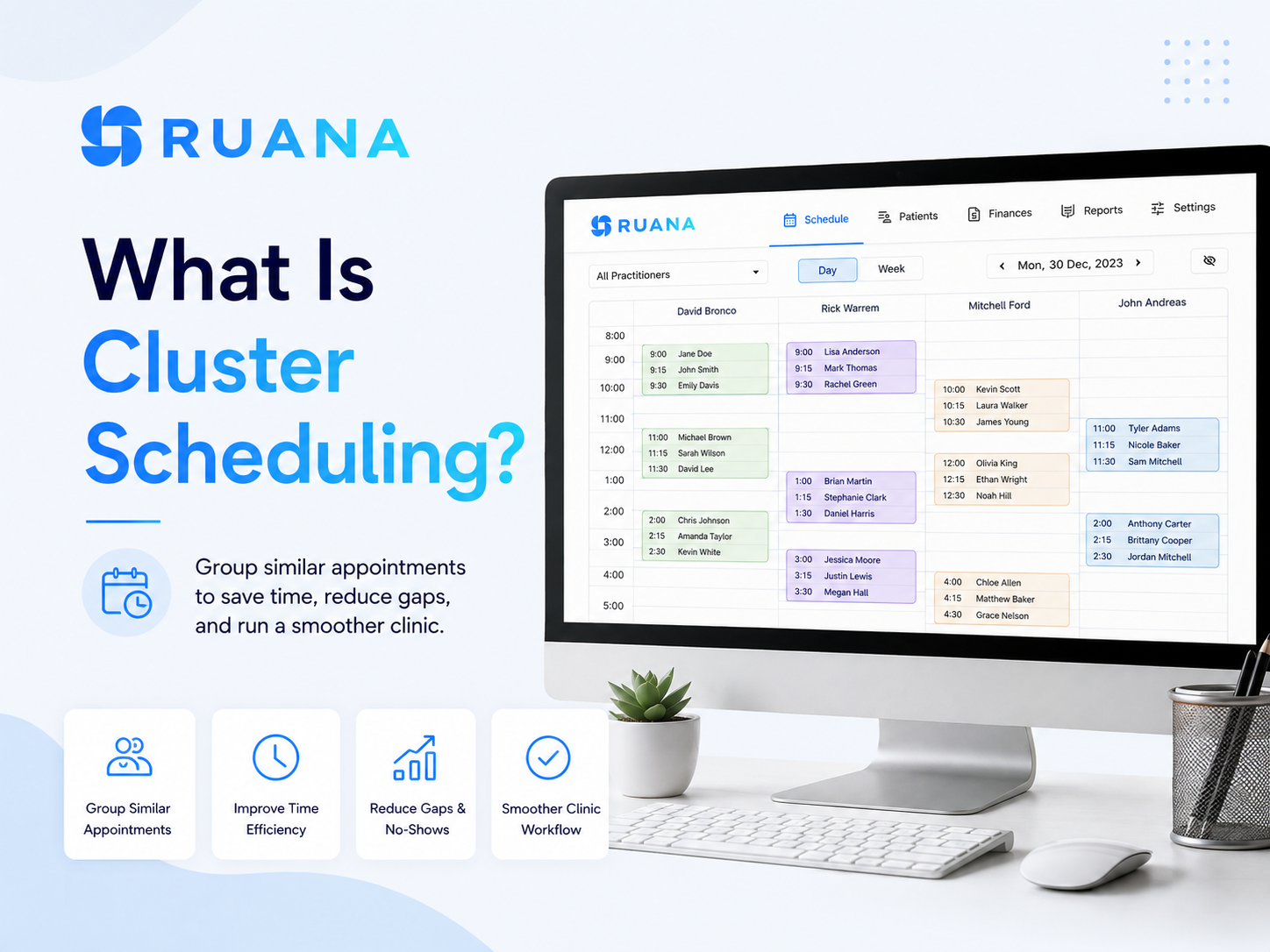
Cluster scheduling is a patient appointment scheduling method in which similar visits are grouped into dedicated time blocks. Appointments that share a visit type, duration, room, equipment, or practitioner skill are booked together rather than spread across the day, so staff repeats one kind of work at a time instead of switching between several.
The grouping itself is what defines a cluster. Most clinics build clusters around one or more of the following:
What Defines a Cluster
Example
Visit type
New patient evaluations, follow-ups, re-assessments
Treatment type
Adjustments, massage, injections, physical exams
Appointment duration
20-minute visits in one block, 60-minute visits in another
Required room or equipment
Visits needing the treatment table, X-ray, or quiet room
Practitioner specialization
Sessions only one clinician on staff can deliver
Staffing requirements
Visits needing an assistant or chaperone
Clusters are often defined by two or three of these at once. “Massage therapy sessions” is a treatment type, a duration, and a room requirement in one, which is exactly why it makes a clean cluster.
How Does Cluster Scheduling Work?
Cluster scheduling is less a software setting than a set of rules the clinic agrees on and applies consistently.
Here is how practices usually build it:
1. Identify Repeatable Appointment Categories
Start by listing every appointment type the clinic actually books, then look for the ones that repeat often enough to fill a block. A category that appears twice a month is not a cluster. A category that appears eight times a week probably is.
This step is more revealing than it sounds. Many practices find that five named appointment types are really two, distinguished only by the wording on the booking page or the opposite: one generic “consultation” hiding three very different visits.
2. Estimate the Time and Resources Each Cluster Requires
For each category, work out how long it genuinely takes, including the parts that do not happen in the room: documentation, turnover, cleaning, setup, etc. A 30-minute visit that needs 10 minutes of progress notes afterward is a 40-minute commitment, and a schedule built on the 30 will run late every day.
Note the resources too: which room, which equipment, which staff member.
3. Assign Each Cluster a Time Block
Now place the clusters into the day. Two considerations drive the layout:
Cognitive load. Appointments requiring the most assessment and decision-making go earlier, when practitioners are fresh.
Patient demand. Working patients often want early morning or late afternoon, so clusters serving them should sit where they can actually book.
Where a cluster sits also determines who can reach it. If new patient evaluations only exist between 8:00 and 10:00 on weekdays, some people simply cannot become new patients at that clinic. That is a real trade-off.
4. Set Capacity and Buffer Rules
A cluster without limits stops being a cluster. Each block needs a maximum number of appointments, and the day needs deliberate gaps between blocks so a single overrun does not push everything after it.
Most clinics also protect an overflow slot near the end of the day for same-day requests and appointments that slipped. Without it, urgent cases get forced into whatever cluster they least belong in, and the structure quietly falls apart.
5. Review the Schedule Using Real Clinic Data
The first version of a cluster schedule is a hypothesis. After four to six weeks, check it against reality: which blocks ran over, which sat half-empty, whether patients declined the times they were offered.
Then adjust by resizing, moving, merging, or dropping certain blocks. Clinics that treat the first draft as permanent usually conclude the method does not work, when what did not work was one particular layout.
Cluster Scheduling Example for a Chiropractic or Wellness Clinic
Here is what a clustered day might look like in a practice offering both chiropractic and massage services.
Time
Appointment Cluster
Scheduling Logic
8:00 AM – 10:00 AM
New patient evaluations
Longer appointments requiring assessment and documentation
10:15 AM – 12:00 PM
Routine follow-ups
Shorter, more predictable visits
12:00 PM – 1:00 PM
Lunch and documentation
Protected buffer
1:00 PM – 3:00 PM
Massage therapy sessions
Similar room and session requirements
3:15 PM – 4:30 PM
Progress assessments
Appointments requiring review and treatment-plan updates
4:30 PM – 5:00 PM
Same-day or overflow appointments
Absorbs urgent requests and delays
This is only an example, not a template to copy.
Every clinic should build clusters around its own services, staffing levels, room availability, and the hours its patients actually want to book. A solo practitioner and a six-provider clinic will reach very different layouts from the same method.
What Are the Benefits of Cluster Scheduling?
Cluster scheduling works best when a clinic has repeatable appointment types and wants to reduce the friction created by constantly changing tasks. Its main value comes from making the day more structured and easier to predict.
Fewer context switches for practitioners. Running six similar visits in a row is mentally lighter than alternating between assessment, treatment, and re-evaluation. Documentation tends to get faster too, since the notes follow a familiar shape.
More efficient use of rooms and equipment. When every appointment in a block needs the same room, that room is set up once and used continuously instead of prepared and cleared repeatedly.
More predictable timing. Grouped appointments of similar length make the day easier to forecast, which means fewer patients waiting past their appointment time.
Simpler staffing. If a block needs an assistant, the clinic knows exactly when rather than keeping someone on standby all day.
Clearer capacity planning. Blocks make it visible how many new patients the clinic can genuinely take each week, which helps with marketing decisions and hiring.
What Are the Limitations of Cluster Scheduling?
The same structure that makes cluster scheduling efficient can also make it rigid. Problems usually appear when patient demand, staffing, or appointment patterns do not fit neatly into predefined blocks.
Reduced booking flexibility. A patient who wants an evaluation at 4:00 pm cannot have one if that cluster runs in the morning. Some of those patients book elsewhere.
It depends on consistent demand. Clusters work when appointment types repeat reliably. A practice with irregular or highly varied visits will have blocks sitting empty while patients wait for the block they need.
Underused blocks waste capacity. An unfilled cluster is idle time that cannot easily be given to another appointment type without breaking the structure.
Disruptions hit harder. A practitioner absence or a cancelled block removes a whole category of availability at once, rather than a scattered handful of slots.
It needs maintenance. Services change, staff change, demand shifts seasonally. A layout that fits the clinic in January may fit poorly by September if nobody revisits it.
Cluster Scheduling vs. Other Patient Appointment Scheduling Methods
Most clinics will recognise their current system somewhere in this list.
Method
How it works
Suits
Cluster scheduling
Similar appointment types grouped into dedicated blocks
Repeatable visit types, shared rooms or equipment
Time-slot (stream) scheduling
Each patient gets an individual slot, length varying by visit type
Most general practices; the software default
Wave scheduling
Several patients booked at the top of the hour, seen in arrival order
High-volume, short-visit settings
Wave and walk-in
Booked appointments first half of the hour, walk-ins second
Balancing scheduled care with unplanned demand
Open booking scheduling
Patients get a window (10:00 AM – 12:00 AM) rather than a fixed time
💡The practical difference: cluster scheduling optimises for the clinic’s internal flow, while open booking and open-access optimise for patient convenience.
Time-slot scheduling sits between the two, and wave scheduling and double booking are mainly tools for absorbing volume and uncertainty. None is more advanced than the others, because they all solve different problems.
Is Cluster Scheduling Right for Your Practice?
Cluster scheduling may work well when:
The clinic delivers a small number of appointment types that repeat weekly
Certain visits need a specific room, table, or piece of equipment
Appointment durations differ substantially between types
Practitioners lose time switching between very different kinds of visits
Demand is stable enough to fill blocks reliably
Another method may work better when:
Nearly every visit is unique or highly variable
Same-day and urgent demand makes up a large share of the schedule
Patient booking convenience matters more than internal efficiency
The practice is small enough that switching between visit types costs little
Demand fluctuates seasonally, and blocks would sit empty
If the honest answer is “some of each,” that is not a failed assessment. It is the reason hybrid scheduling exists, suggesting a clustered morning with an open-access afternoon.
Build a Scheduling System Around How Your Clinic Actually Works
There is no universally correct patient scheduling method. Cluster scheduling brings structure to clinics with repeatable appointment types and shared resources. The right choice depends on the clinic’s services, staff, rooms, and what its patients are actually trying to book.
What matters most is that the rules are explicit. Once a practice knows how long each visit really takes, which resources it needs, how many fit in a day, and what buffer protects the rest of the schedule, the calendar largely runs itself.
That is where the software matters. Ruana is practice management software for chiropractors, massage therapists, mental health practitioners, and other health and wellness professionals, and its scheduling tools apply those rules for you.
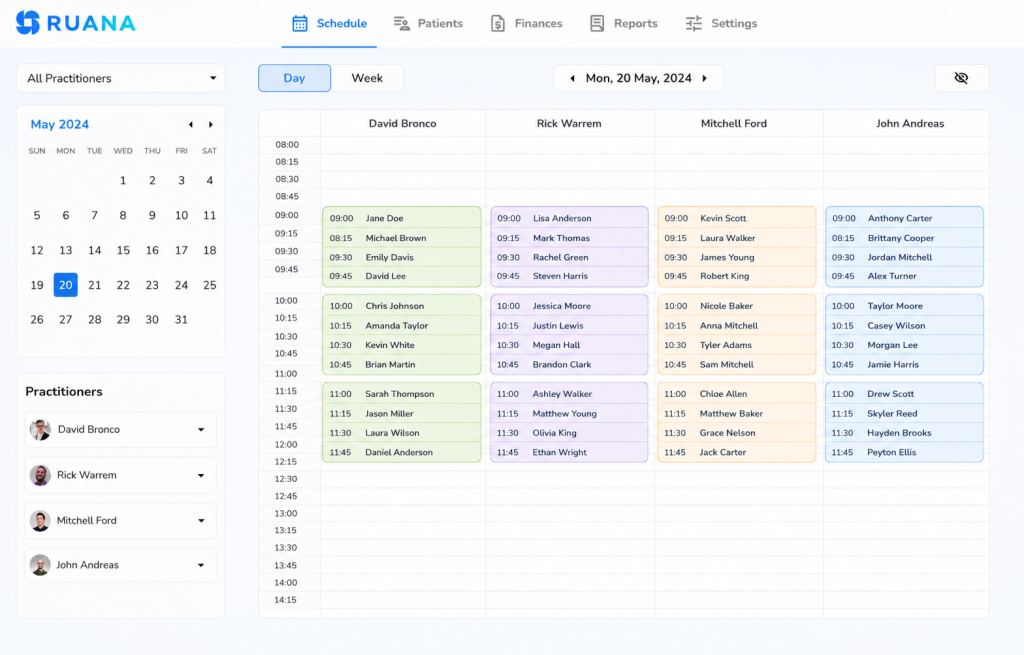
Cap appointments per day, limit working hours, and block out time for breaks and documentation, so protected buffers stay protected. A colour-coded, drag-and-drop calendar keeps blocks visible and quick to rearrange when the day changes. Online booking lets clients book 24/7 within the availability you have defined, and automated email and SMS reminders help keep those blocks full.
In healthcare, cluster scheduling means grouping patients with similar visit types, conditions, procedures, or resource needs into the same time block or day. The goal is to reduce switching between kinds of work and make better use of rooms, equipment, and staff.
What is the difference between cluster and wave scheduling?
Cluster scheduling groups appointments by what kind of visit they are, giving each patient a slot within a themed block. Wave scheduling groups patients by when they arrive. One categorises work; the other manages arrival flow.
Can a clinic combine different scheduling methods?
Yes, and most do. Hybrid scheduling is common: clustered blocks for predictable appointment types, plus open or same-day capacity held back for urgent requests. A clinic might cluster its mornings and leave the last hour of the day fully open.
What type of scheduling is best for a small clinic?
Small clinics often start with time-slot (stream) scheduling, since it is simple and gives each patient a defined time. Cluster scheduling becomes worthwhile once a few appointment types repeat regularly, or when specific rooms and equipment start creating bottlenecks. The practical test is whether the current schedule produces overruns and idle stretches. If it does, grouping similar appointments is usually the first thing to try.
About the Authors
★★★★★4.9 · 329 Reviews
Rouzbeh NoroozyChiropractor & Co-Founder · Palmer West · UC Berkeley · 14 Years of ExperienceRouzbeh Noroozy is a chiropractor with 14 years of clinical experience and co-founder of Ruana practice management software. He completed his undergraduate studies at the University of California, Berkeley and graduated from the renowned Palmer College of Chiropractic West in California. As a practicing clinician and clinic owner, he understands firsthand the administrative challenges practices face — and which digital tools genuinely help streamline day-to-day operations.
Anastasiia NoroozyMedical Graduate & Co-Founder · 8 Years of ExperienceAnastasiia Noroozy is a medical graduate and co-founder of Ruana with 8 years of experience working directly with patients at the clinic in Cologne. She manages the day-to-day flow of the practice and knows every patient-facing process from the inside out — from intake and scheduling to follow-up care. Her hands-on clinical and operational experience directly shapes how Ruana is built to work in the real world.
Our team will review your inquiry and get back to you as soon as possible.
Privacy Settings
To provide the best experiences, we use technologies like cookies to store and/or access device information. Consenting to these technologies will allow us to process data such as browsing behavior or unique IDs on this site. Not consenting or withdrawing consent, may adversely affect certain features and functions.
Functional
Always active
The technical storage or access is strictly necessary for the legitimate purpose of enabling the use of a specific service explicitly requested by the subscriber or user, or for the sole purpose of carrying out the transmission of a communication over an electronic communications network.
Preferences
The technical storage or access is necessary for the legitimate purpose of storing preferences that are not requested by the subscriber or user.
Analytics
The technical storage or access that is used exclusively for statistical purposes.The technical storage or access that is used exclusively for anonymous statistical purposes. Without a subpoena, voluntary compliance on the part of your Internet Service Provider, or additional records from a third party, information stored or retrieved for this purpose alone cannot usually be used to identify you.
Marketing
The technical storage or access is required to create user profiles to send advertising, or to track the user on a website or across several websites for similar marketing purposes.
To provide the best experience for our practitioners, we use cookies to personalize content, analyze our traffic, and support our marketing efforts. By clicking 'Accept', you consent to our use of these technologies. You can manage your preferences at any time.
Functional
Always active
The technical storage or access is strictly necessary for the legitimate purpose of enabling the use of a specific service explicitly requested by the subscriber or user, or for the sole purpose of carrying out the transmission of a communication over an electronic communications network.
Preferences
The technical storage or access is necessary for the legitimate purpose of storing preferences that are not requested by the subscriber or user.
Analytics
The technical storage or access that is used exclusively for statistical purposes.The technical storage or access that is used exclusively for anonymous statistical purposes. Without a subpoena, voluntary compliance on the part of your Internet Service Provider, or additional records from a third party, information stored or retrieved for this purpose alone cannot usually be used to identify you.
Marketing
The technical storage or access is required to create user profiles to send advertising, or to track the user on a website or across several websites for similar marketing purposes.