7 Best ChiroTouch Alternatives for Chiropractic Practices in 2027
25.09.26
Looking for a ChiroTouch alternative usually means something in your current setup is no longer working as well as it should. This guide compares the strongest options for chiropractic practices, focusing on workflow, documentation, billing, scalability, and overall fit.
ChiroTouch remains one of the most substantial chiropractic-specific platforms available. Yet, its AI-assisted charting and the deep insurance billing suite don’t make it the right fit for every clinic. Practices look for ChiroTouch alternatives for specific reasons:
The workflow feels heavier than their clinic needs
Pricing is only available after a demo
Their billing mix has shifted
They have grown into a shape ChiroTouch was not built around
The best alternative depends entirely on which of those reasons applies to you. So rather than ranking products by feature count, this guide compares them around the way a chiropractic practice actually runs: booking, intake, documentation, checkout, billing, and follow-up.
Pricing verified in September 2026 from each vendor’s public pricing page.
ChiroTouch publishes no pricing.
Software
Best for
Starting price
Insurance billing
Ruana
Streamlined workflow for solo and small chiropractic practices
$35.99/mo
Superbills only
ChiroFusion
Chiropractic-specific EHR with established insurance billing
$129/mo (annual)
Integrated clearinghouse, free e-claims
ChiroHD
Modern chiropractic workflows and patient management
$299/mo flat
Paid add-on
Jane App
Multidisciplinary clinics
$54/mo (20 appts)
Via Claim.MD add-on
zHealth
Chiropractic EHR with automation and patient engagement
$119/mo per provider
Integrated clearinghouse
Genesis (now ClinicMind)
Billing and RCM-heavy practices
From $2 per visit
Integrated, with managed billing option
ChiroSpring
Full-featured chiropractic-specific all-in-one
$149/mo
$149/mo clearinghouse add-on
Evaluation Criteria Used Throughout the Article
Our goal wasn’t finding the best software to replace ChiroTouch, but to help you understand your needs and see which of the software listed can streamline your business.
Thus, every product was assessed against the same six questions:
Front-Desk Speed: How quickly does a patient move from booking to check-in, and how much of that needs a person?
Charting Speed: How long does a routine follow-up SOAP note actually take, and does the system get out of the way?
Billing Fit: Does it match your real revenue mix, whether that is cash, insurance, or both?
Pricing Visibility: Can you work out your annual cost before speaking to a salesperson?
Practice Shape: Is it built for a solo DC, a multi-doctor clinic, or a multidisciplinary team?
Switching Cost: Setup fees, migration, training, and how long before the clinic is running normally.
Why Consider an Alternative to ChiroTouch?
Most practices that evaluate alternatives are not fully unhappy with ChiroTouch’s capability. They are questioning fit.
Here are a few reasons why you may need a switch from your legacy system.
You Want Simpler Day-to-Day Workflows
A platform built to handle complex, insurance-heavy, multi-location operations carries that depth into every screen. For a practice running two treatment rooms and a small front desk, some of that depth becomes clicks between the patient arriving and the note being signed.
“Too many clicks for basic tasks” is a recurring theme in ChiroTouch reviews.
You Want Clearer or More Predictable Pricing
ChiroTouch lists three packages, Start, Grow, and Scale, with no published prices. Evaluation starts with a demo, and third-party sources report entry pricing around $139 to $159 a month before add-ons.
Practices that prefer to model costs independently often look elsewhere for that reason alone.
Your Clinic’s Billing Needs Have Changed
A practice that has moved toward cash-based care may no longer need the claims infrastructure it originally bought for.
The reverse happens too, when an insurance-heavy clinic wants billing handled by a managed service rather than in-house staff.
You Need a Better Fit for a Small or Multidisciplinary Practice
ChiroTouch is built exclusively for chiropractic.
A clinic that adds massage, physiotherapy, or acupuncture needs scheduling and documentation that work across disciplines, which is a different design problem.
7 ChiroTouch Alternatives Worth Considering
Each product below is assessed against the same six criteria and described in the same format, so you can compare them directly. Pricing comes from each vendor’s public page, and where a vendor does not publish a figure, we say so.
1. Ruana
Best for: Solo and small chiropractic clinics that prioritise front-desk speed and fast charting.
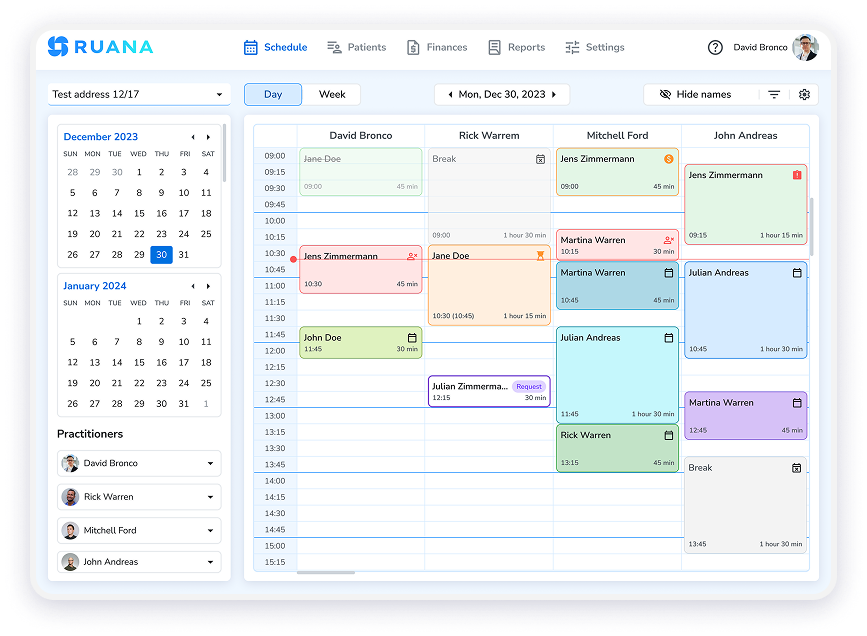
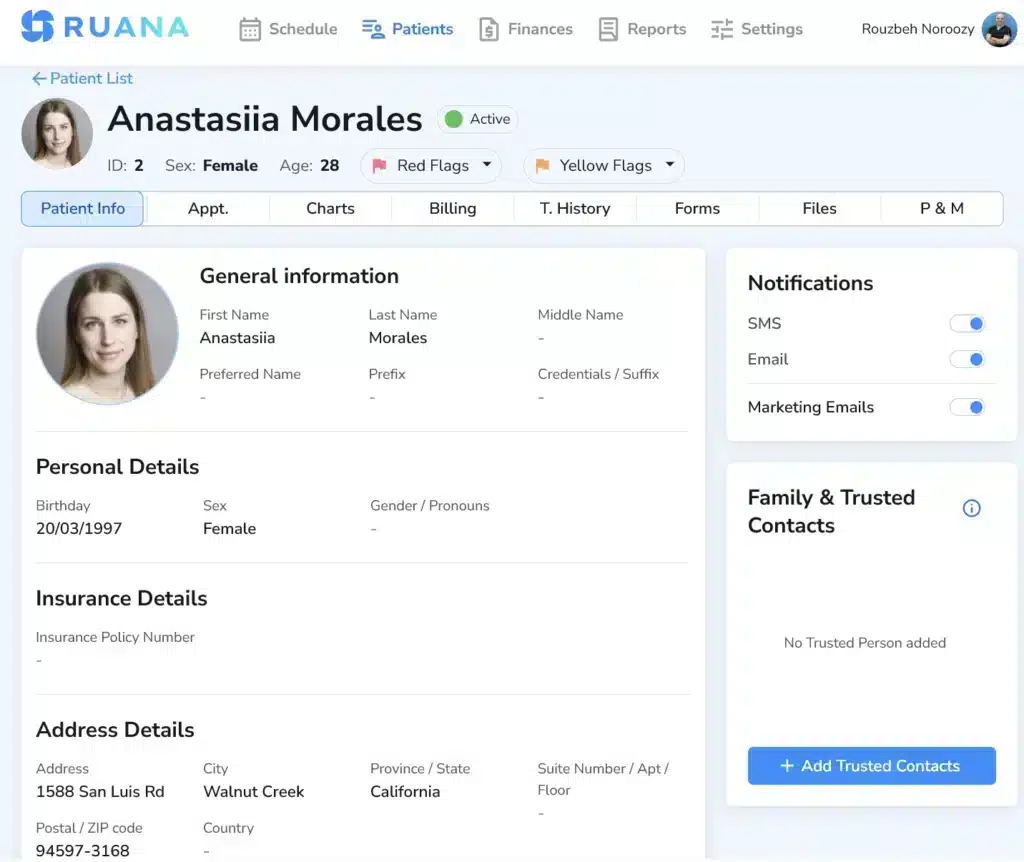
Ruana brings online booking, scheduling, digital intake forms, SOAP notes, invoicing with ICD-10 codes, superbills, packages and memberships, reminders, and reporting into one system. It also serves massage therapists and mental health practitioners.
Where it differs from ChiroTouch
The difference is clinic flow rather than feature count.
Patients book as guests in under a minute, and can reschedule in one click from their confirmation email, so routine schedule changes stay off the phone.
Intake forms go out automatically after booking and arrive completed.
SOAP notes use anatomical diagrams you mark rather than describe, plus auto-complete shortcuts, so routine follow-ups stay quick.
Most practices are running within 30 to 90 minutes.
Yet, Ruana does not provide EDI or clearinghouse claim submission.
Pricing
Solo is $35.99/month with unlimited appointments
Professional is $55.99/month
$19.99 per additional practitioner.
Free 14-day trial, no credit card.
Choose it if… your practice is cash-based or superbill-based, and the time you lose is at the front desk and in end-of-day charting rather than in claims.
If insurance is most of your revenue, this is the wrong category of product.
2. ChiroFusion
Best for: Chiropractors wanting a chiropractic-specific EHR with established billing capabilities.
ChiroFusion is cloud-based chiropractic EHR software, running since 2009, with scheduling, online booking, intake with self-check-in, SOAP notes built on templates and macros, integrated payments, and wellness plans with auto-debit.
Where it differs from ChiroTouch
Insurance billing is included rather than sold separately. ChiroFusion offers free, unlimited electronic claims through an integrated clearinghouse, with automatic ERA posting and care plan authorisation tracking. A separate managed billing service is also available. Charting relies on templates and macros rather than AI. Reviewers flag card payment integration and reporting depth as weaker areas, and note it suits smaller clinics better than large ones.
Pricing
Essentials is $129/month on an annual commitment
Complete is $299 annually
Each additional provider adds $49/month, staff users are free, and there is a $299 setup fee.
Choose it if… you bill insurance regularly and want claims included in a published price. Price out Complete if you need text reminders and online booking, since those add-ons close most of the gap between the two tiers.
3. ChiroHD
Best for: Growing chiropractic practices wanting a modern chiro-specific system.
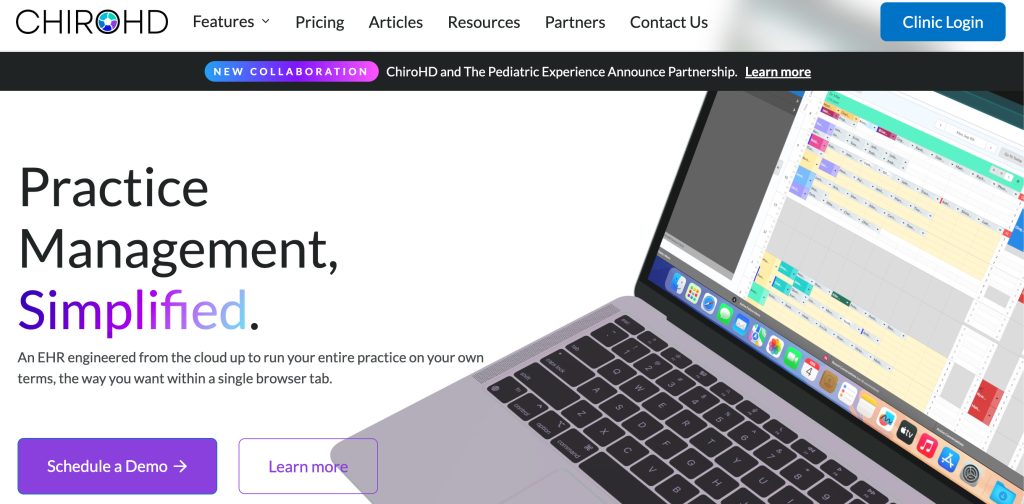
ChiroHD is cloud-based chiropractic software with drag-and-drop scheduling, a patient app for booking and check-in, SOAP macros with chaining and auto-complete, care plan tracking, integrated merchant services, and a strong engagement toolkit covering two-way texting, automated triggers, reactivation campaigns, and reputation management.
The company has also partnered with The Pediatric Experience (PX), which serves pediatric and family chiropractors. The partnership combines PX’s clinical, practice-growth, and marketing frameworks with ChiroHD’s EHR and patient communication technology, making ChiroHD particularly relevant for practices built around pediatric and family chiropractic care.
Where it differs from ChiroTouch
ChiroHD publishes flat pricing rather than charging per provider. Its Standard plan includes unlimited providers and users, which can change the economics considerably as a clinic adds doctors. It also has no long-term contract requirement. Its positioning leans heavily into chiropractic-specific workflows, patient engagement, and practice growth rather than treating the EHR primarily as a documentation and billing system.
Pricing
The Standard plan is $299/month, with $799 setup and onboarding and $499 data migration.
Providers and users are unlimited. ChiroHD also advertises a new-graduate program offering up to one year free, ending when the practice reaches 50 visits per week or the one-year limit.
Choose it if… you expect to add doctors or are building a pediatric/family chiropractic practice. At one provider, $299/month is relatively substantial. As the number of doctors grows, the flat unlimited-provider model becomes considerably more attractive.
4. Jane App
Best for: Multidisciplinary clinics combining chiropractic with massage, physiotherapy, or other services.
Scheduling, online booking, intake, charting, native telehealth, payments, packages and memberships, and insurance billing, designed across many allied health disciplines rather than one.
Where it differs from ChiroTouch
Jane App is not chiropractic-specific, and that is the point. Its strength is coordination: room and equipment management, concurrent appointments, and availability that works across practitioners in different disciplines. Telehealth is native on every plan. Chiropractic-specific depth in charting, coding, and care plan billing is lighter than a dedicated chiro software, and features like room management sit on the top Thrive tier, so check which plan your clinic’s layout actually requires before comparing prices.
Pricing
Balance is $54/month capped at 20 appointments
Practice is $79
Thrive is $99
Each tier includes one full-time practitioner, with additional practitioners at $39 part-time or $49 full-time. Insurance billing is a $20/month add-on. There is no free trial.
Choose it if… your clinic already runs, or plans to run, several disciplines sharing rooms. For a chiropractic-only practice, a dedicated chiro platform will usually fit better.
5. zHealth
Best for: Practices prioritising patient communication and automation alongside EHR functions.
zHealth is another cloud chiropractic EHR with customisable SOAP templates, voice dictation, multilingual intake forms, a patient portal and app, unlimited text and email reminders, integrated payments with recurring billing, care plans, and memberships.
Where it differs from ChiroTouch
Automation is built into the documentation flow. Claims are created automatically once a SOAP note is signed, ERAs post automatically, and the Professional plan adds two-way texting, review requests, birthday messages, and email marketing. Several capabilities are paid add-ons, including AI Scribe, eligibility verification, analytics, and patient recall. Reviewers praise ease of use but report that customisation must go through zHealth rather than being done in-house.
Pricing
Essentials is $119/month per provider
Professional is $249/month per provider, with 10% off annual billing
Staff are free, and discounts apply at three or more providers.
Managed billing costs 5.99% to 6.99% of collections, with monthly minimums.
No free trial available.
Choose it if… you want engagement and billing automation on one chiro-specific platform, and you are comfortable asking the vendor to customise templates for you. Price the add-ons you need before comparing, since AI Scribe, eligibility, and recall change the monthly total noticeably.
6. Genesis Chiropractic Software (Now ClinicMind)
Best for: Insurance-heavy clinics where billing and revenue-cycle management are major priorities.
An important update first. ClinicMind acquired Genesis in January 2024, and the Genesis website now redirects to ClinicMind. Existing Genesis Classic users are still supported, but new buyers are effectively buying ClinicMind.
The platform includes AI-powered SOAP notes with an AI scribe, scheduling, patient self-scheduling, intake, payments, an integrated clearinghouse with real-time eligibility checks, ERA handling, and denial tracking.
Where it differs from ChiroTouch
Two things.
Revenue-cycle management can be fully outsourced: ClinicMind’s billing team handles claims, denials, and reconciliation.
Pricing is charged per visit rather than per provider, and no-shows are not charged. Medicare documentation prompts, including AT modifier flags before a note is signed, are built in.
Reviewers describe a structured workflow that works best if your office runs the way the system expects.
Pricing
From $2 per visit for cash-based practices. In-house billing adds a per-claim fee, and fully managed billing adds a percentage of insurance reimbursement.
Neither rate is published. No free trial.
Choose it if… insurance is central to your revenue and you would rather hand billing to a specialist team than staff it yourself.
7. ChiroSpring
Best for: Clinics wanting another full-featured chiropractic-specific platform.
ChiroSpring is chiropractic-only software with more than 50 SOAP templates, hundreds of macros, AI note tools, integrated payments, treatment plans, native patient and provider apps, and two-way texting reminders.
Where it differs from ChiroTouch
Pricing is published, which alone makes evaluation faster. Documentation is its strongest area, built around macros and notes designed to hold up under audit. The trade-off is tier placement: memberships with recurring payments, online intake forms, and the check-in kiosk begin at the $249 Pro tier, and full online scheduling at $299 Pro+.
Reviewers rate it highly overall but flag financial reporting and the way payments are applied as areas that could be clearer.
Pricing
360 is $149/month
Pro is $249/month
Pro+ is $299/month with two providers included
No clearly stated free trial.
Choose it if… you want chiropractic-specific documentation depth with transparent pricing. For a cash practice, budget for the Pro tier, since memberships and intake are where cash practices need to start.
Switching From ChiroTouch: What to Check Before You Move
Migration is where software switches go wrong, and almost all of the risk is avoidable.
Data export and migration. Confirm what the new vendor can import, in what format, and at what cost. Ask for a sample migration before committing.
Records retention. Clinical and billing records must remain accessible for your jurisdiction’s retention period, whichever system they end up in.
Intake and forms. Recreate intake, consent, and policy forms and test them before patients see them.
SOAP templates. Rebuild your most-used templates and macros first. Charting speed determines how painful the first fortnight feels.
Billing and outstanding claims. Decide where open claims will be worked. Many practices keep read-only access to the old system until outstanding A/R clears.
Patient communications. Update reminder templates, booking links, and your website before the switch date.
Staff training. Schedule it before go-live, not during the first busy morning.
Parallel testing. Run both systems briefly and book test patients end-to-end before you cancel anything.
Frequently Asked Questions
What Is the Best Alternative to ChiroTouch for a Small Chiropractic Practice?
It depends on how you bill. Cash-based practices usually get the most from a lighter system focused on booking, intake, and fast charting, such as Ruana. If you bill insurance regularly, ChiroFusion includes claims in its published price. And for a clinic expecting to add doctors soon, ChiroHD’s flat pricing becomes hard to beat.
What Is the Best ChiroTouch Alternative for a Cash Practice?
Look for three things: packages and memberships on the plan you would actually buy, fast checkout, and superbills for out-of-network patients. Ruana includes all three without claims infrastructure you would never use. ChiroHD suits cash practices that want heavier engagement and marketing automation. On ChiroSpring, cash practices should start at the Pro tier.
Which ChiroTouch Alternatives Include Chiropractic SOAP Notes?
All seven include SOAP documentation. ChiroSpring, ChiroFusion, ChiroHD, zHealth, and ClinicMind offer chiropractic-specific templates and macros, with AI note tools on several. Ruana includes SOAP notes with anatomical diagrams and auto-complete shortcuts. Jane offers charting templates designed across multiple disciplines rather than chiropractic alone.
What Should I Look for When Switching Chiropractic Software?
Start with your billing mix, because it rules out half the market immediately. Then time a routine SOAP note during the trial, check whether the features you use daily are on the tier you would actually buy, total up setup and migration fees, and confirm how outstanding claims will be handled during the transition.
Final Thoughts
ChiroTouch is a capable platform, and for a large, insurance-heavy chiropractic practice it may remain the right one. The case for an alternative is about fit rather than capability.
Small cash-based practices usually need less infrastructure and faster flow. Insurance-heavy clinics may want claims included in the price, or billing handed off entirely. A clinic running several disciplines needs a system built for coordination rather than for one specialty.
Name the reason you are looking, then trial the two or three products that answer it. That is almost always a faster route to the right decision than comparing seven feature lists.
About the Authors
★★★★★4.9 · 329 Reviews
Rouzbeh NoroozyChiropractor & Co-Founder · Palmer West · UC Berkeley · 14 Years of ExperienceRouzbeh Noroozy is a chiropractor with 14 years of clinical experience and co-founder of Ruana practice management software. He completed his undergraduate studies at the University of California, Berkeley and graduated from the renowned Palmer College of Chiropractic West in California. As a practicing clinician and clinic owner, he understands firsthand the administrative challenges practices face — and which digital tools genuinely help streamline day-to-day operations.
Anastasiia NoroozyMedical Graduate & Co-Founder · 8 Years of ExperienceAnastasiia Noroozy is a medical graduate and co-founder of Ruana with 8 years of experience working directly with patients at the clinic in Cologne. She manages the day-to-day flow of the practice and knows every patient-facing process from the inside out — from intake and scheduling to follow-up care. Her hands-on clinical and operational experience directly shapes how Ruana is built to work in the real world.
Our team will review your inquiry and get back to you as soon as possible.
Privacy Settings
To provide the best experiences, we use technologies like cookies to store and/or access device information. Consenting to these technologies will allow us to process data such as browsing behavior or unique IDs on this site. Not consenting or withdrawing consent, may adversely affect certain features and functions.
Functional
Always active
The technical storage or access is strictly necessary for the legitimate purpose of enabling the use of a specific service explicitly requested by the subscriber or user, or for the sole purpose of carrying out the transmission of a communication over an electronic communications network.
Preferences
The technical storage or access is necessary for the legitimate purpose of storing preferences that are not requested by the subscriber or user.
Analytics
The technical storage or access that is used exclusively for statistical purposes.The technical storage or access that is used exclusively for anonymous statistical purposes. Without a subpoena, voluntary compliance on the part of your Internet Service Provider, or additional records from a third party, information stored or retrieved for this purpose alone cannot usually be used to identify you.
Marketing
The technical storage or access is required to create user profiles to send advertising, or to track the user on a website or across several websites for similar marketing purposes.
To provide the best experience for our practitioners, we use cookies to personalize content, analyze our traffic, and support our marketing efforts. By clicking 'Accept', you consent to our use of these technologies. You can manage your preferences at any time.
Functional
Always active
The technical storage or access is strictly necessary for the legitimate purpose of enabling the use of a specific service explicitly requested by the subscriber or user, or for the sole purpose of carrying out the transmission of a communication over an electronic communications network.
Preferences
The technical storage or access is necessary for the legitimate purpose of storing preferences that are not requested by the subscriber or user.
Analytics
The technical storage or access that is used exclusively for statistical purposes.The technical storage or access that is used exclusively for anonymous statistical purposes. Without a subpoena, voluntary compliance on the part of your Internet Service Provider, or additional records from a third party, information stored or retrieved for this purpose alone cannot usually be used to identify you.
Marketing
The technical storage or access is required to create user profiles to send advertising, or to track the user on a website or across several websites for similar marketing purposes.