Chiropractic Cash Practice vs Insurance: Which Model Makes Sense for Your Practice?
22.09.26
Cash vs insurance changes far more than how a chiropractor gets paid. It shapes the entire business model, from patient acquisition and admin workload to cash flow and growth.
Going cash-based may reduce billing headaches, but it also means convincing more patients to pay out of pocket. Accepting insurance can bring a larger pool of prospective patients, since they arrive with benefits they already pay for, but reimbursement, documentation, claims, and denials add another operational layer to the practice.
This guide digs into the chiropractic cash practice vs insurance comparison, exploring the revenue, administrative workload, patient acquisition, documentation, cash flow, and scalability. It also covers the hybrid option, which more practices use than they admit.
Chiropractic Cash Practice vs Insurance: The Short Answer
A cash-based chiropractic practice collects payment directly from the patient at the time of service.
An insurance-based practice contracts with payers, submits claims, and waits for reimbursement.
Cash tends to offer simpler collections, faster payment, full control over pricing, and far less insurance administration. The trade-off is that every patient sees the full cost and has to decide it is worth paying.
Insurance can make patient acquisition easier, because people search for in-network providers and arrive ready to use benefits they already hold. The trade-off is claims, payer rules, fee schedules, reimbursement delays, denials, and the staff time to manage all of it.
Neither model is universally better. Hybrid is a legitimate third option, and for many practices it is the realistic one.
In simple terms, a cash-based chiropractic practice is not contracted with insurance payers. Patients pay the practice directly at the visit, through a package, or through a membership, and the fee is set by the practice rather than by a payer’s fee schedule.
The name is misleading. Cash practices take cards, HSA and FSA funds, and financing. What defines the model is the absence of a third-party payer inside the transaction, not the payment method.
Cash Practice Does Not Always Mean “Patients Cannot Use Insurance”
This is where a lot of coverage gets it wrong, and it matters commercially.
A cash-pay patient may still have out-of-network benefits. If they do, they can request an itemised receipt or a superbill from you, submit it to their insurer themselves, and pursue reimbursement directly. The practice is paid in full at the visit either way. The insurance conversation happens between the patient and their plan, without you filing anything.
Whether that reimbursement arrives depends entirely on their coverage. Some plans reimburse a meaningful share of out-of-network chiropractic care, some apply it toward a deductible, and some exclude the discipline altogether.
The practical implication is that “cash practice” and “patients get nothing back from insurance” are not the same statement. Practices that can produce a clean superbill at checkout remove a real objection from the buying decision, and it costs them nothing to do so.
On the contrary, an insurance-based practice contracts with payers as an in-network provider. Patients present their insurance, the practice bills the payer, and the patient pays only their copay, coinsurance, or deductible portion.
In exchange for accepting the payer’s fee schedule, the practice gains access to that payer’s members, who are actively looking for in-network care.
How Chiropractic Insurance Reimbursement Works
At a high level, every visit runs through the same cycle:
A few things about that sequence shape daily operations.
Documentation feeds the claim directly, so notes are no longer just clinical records.
Claims can be rejected for administrative reasons that have nothing to do with care delivered.
Payment arrives weeks after the service.
And the patient balance still has to be collected afterwards, which is a second collection cycle on top of the first.
Chiropractic Cash Practice vs Insurance: 7 Differences That Matter
The models diverge in seven places.
Read these as trade-offs rather than a scorecard, because each one cuts both ways.
1. Cash Flow and Payment Timing
Cash practices are paid at the visit. Revenue is known the day it is earned, and the only accounts receivable is whatever you choose to extend.
Insurance-based practices earn revenue at the visit and collect it weeks later, minus contractual adjustments, minus whatever gets denied, plus a patient balance that arrives later still. Forecasting is harder, and a claims backlog becomes a cash flow problem rather than an administrative one.
For a newer or smaller practice, that timing difference is often the single most important factor.
2. Administrative Workload
Compare the two sequences directly:
Cash: collect payment → document the visit → issue a receipt or superbill
Insurance: verify benefits → document → code → submit claim → track status → correct and resubmit rejections → post payment → collect the patient balance
The insurance path has five more steps, and several of them repeat. Denials in particular consume time that generates no additional revenue when resolved, because you are recovering money you already earned.
This is the workload that drives most practices to consider going cash in the first place.
3. Pricing Control
A cash practice sets its own fees. You can price by visit, by package, by membership, or by treatment length, and you can adjust based on your costs and your market rather than a payer’s schedule.
An insurance-based practice accepts contracted rates that may be well below its cash fee, and may have limited room to change them. Payers may also limit visit frequency or require documentation to justify continued care.
Control over pricing is also control over practice design. Longer appointments become viable when nobody else decides what the visit is worth.
4. Patient Acquisition
This is the trade-off that decides the question for most practices.
Insurance participation puts you in front of people already searching for an in-network chiropractor, with benefits they are motivated to use. The cost objection is largely handled before they contact you. Payer directories generate referrals passively, and physicians referring patients onward often check network status first.
Cash practices have to make the value proposition explicit, because the patient sees the full price with nothing softening it. That means clearer positioning, stronger local search visibility, service pages that explain what a visit actually involves, visible reviews, and a booking experience that converts someone who found you at nine in the evening.
Patient acquisition is consistently identified as the main challenge of cash-only models, and the practices that succeed treat marketing as a core operational function rather than something they get to when the schedule goes quiet.
There is a real upside on the other side of that work. Cash-pay patients have already decided the care is worth paying for, which tends to show up as better attendance, higher plan completion, and fewer people who booked because a benefit was expiring. You also spend nothing on care that a payer later decides was not medically necessary.
5. Documentation and Compliance
Both models require thorough clinical documentation. Notes support clinical decisions, continuity of care, and your position if records are ever requested.
Insurance adds a second purpose. Documentation becomes the evidence supporting the claim, so it must satisfy payer requirements for medical necessity, coding accuracy, and treatment justification. That raises the audit stakes and means notes are read by people who were never in the room.
Cash practices still need accurate ICD-10 coding if they issue superbills, but the documentation exists primarily for care rather than for reimbursement.
In a cash practice, the financial conversation happens once, upfront, and is over. The patient knows the price before booking and pays at the visit. No surprise bills arrive three months later.
Insurance-based care is more affordable per visit for the patient, sometimes dramatically so, which genuinely widens access. The friction is uncertainty:
Deductibles that reset
Coverage limits nobody explained
Balance bills arriving long after the appointment
Neither experience is better in the abstract. One trades cost for certainty, the other trades certainty for cost.
7. Staffing and Scalability
An insurance-heavy practice needs billing capacity that grows with volume. At some point that means a dedicated biller, a billing service, or a meaningful share of someone’s week, and the cost scales with claims rather than with patients.
Cash practices remove most of that workflow. What they need instead is a set of systems that keep the schedule full: marketing, conversion, retention, and rebooking. Those are less specialised than claims management, but they are just as operational, and they cannot be left to whoever has a spare afternoon.
The useful way to frame it: insurance practices scale by adding billing capacity; cash practices scale by adding demand and keeping it.
What About a Hybrid Chiropractic Practice?
Plenty of practices run both, and it is usually the most honest description of what is actually happening. A common arrangement is staying in-network with one or two major payers while operating cash-pay for everyone else. Another is accepting insurance for an initial course of care, then moving patients onto cash-based maintenance plans once the covered episode ends.
Hybrid makes sense in three situations:
Your market has a dominant payer you cannot realistically be outside of.
You are transitioning between models and want to protect revenue while demand builds.
Different services genuinely suit different payment paths.
Rehabilitative care billed to a payer and wellness maintenance sold as a membership is a coherent split rather than a compromise.
Why Hybrid Is Operationally More Complicated
Running two models means running two of everything, and the complexity is easy to underestimate.
Two Workflows: Front desk staff has to know which path each patient is on before check-in, not after.
Two Fee Arrangements: Contracted rates for in-network patients, cash fees for everyone else, with rules about which applies when.
Patient Communication: People compare notes. If two patients pay different amounts for the same service without understanding why, that becomes a conversation you did not want.
Documentation at the Higher Standard: In-network visits still have to satisfy payer requirements, so you cannot lighten documentation across the board.
Two Payment Paths: Some visits are collected in full at checkout, while others are split between copay now and claim later.
None of this is prohibitive, but hybrid is the most demanding of the three models administratively, not the easy middle ground. Practices that drift into it accidentally usually feel the friction long before they identify the cause.
The Software Needs Are Also Different
The billing model determines what software you actually need, and this is where practices frequently overbuy.
A cash-based practice needs: scheduling and online booking, digital intake, clinical documentation, transparent invoices and receipts, package and membership management, reminders, reporting, and the ability to produce superbills.
An insurance-heavy practice needs all of that, plus: electronic claims and EDI, clearinghouse connectivity, ERA and remittance workflows, eligibility and benefit verification, denial management, and CMS-1500 handling.
That second list is expensive infrastructure. It is also completely idle in a cash practice, where it adds cost, configuration complexity, and fields nobody fills in.
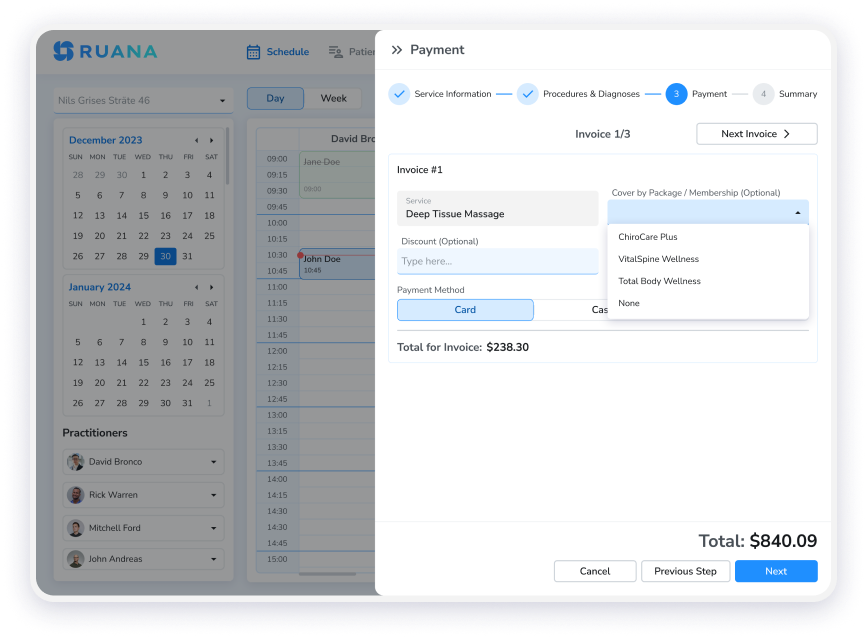
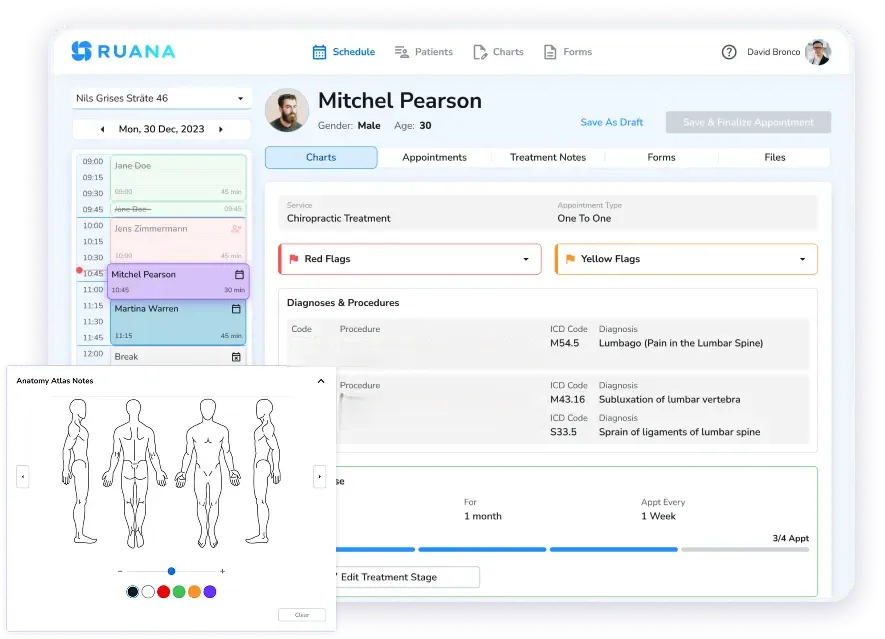
Ruana is built for the first list. It brings online booking, scheduling, intake forms, SOAP notes and charting, billing, reminders, packages and memberships, and reporting into one system.
To be precise about the boundary: Ruana does not currently offer clearinghouse or EDI connections, so it is not a fit for a clinic that submits electronic claims to payers daily. It is aligned with cash-based practices and lighter out-of-network workflows, where the patient pays you and then pursues reimbursement themselves.
If your revenue runs mostly through claims, you need a platform built around them.
There is no universally correct chiropractic billing model. Cash offers simplicity, control, and immediate payment while placing the acquisition burden squarely on you. Insurance widens your potential patient pool and lowers the cost barrier while adding a claims operation to run.
Decide by looking at your own situation honestly.
How strong is local demand for cash-pay chiropractic care?
What volume of administrative work are you willing to own or pay someone to own?
Does your financial position need predictable weekly income, or can it absorb a reimbursement cycle?
And are you genuinely prepared to spend time on marketing rather than treating?
Answer those four questions and the model usually chooses itself. Then build the practice and the software stack around that decision rather than around the one you assumed you would make.
About the Authors
★★★★★4.9 · 329 Reviews
Rouzbeh NoroozyChiropractor & Co-Founder · Palmer West · UC Berkeley · 14 Years of ExperienceRouzbeh Noroozy is a chiropractor with 14 years of clinical experience and co-founder of Ruana practice management software. He completed his undergraduate studies at the University of California, Berkeley and graduated from the renowned Palmer College of Chiropractic West in California. As a practicing clinician and clinic owner, he understands firsthand the administrative challenges practices face — and which digital tools genuinely help streamline day-to-day operations.
Anastasiia NoroozyMedical Graduate & Co-Founder · 8 Years of ExperienceAnastasiia Noroozy is a medical graduate and co-founder of Ruana with 8 years of experience working directly with patients at the clinic in Cologne. She manages the day-to-day flow of the practice and knows every patient-facing process from the inside out — from intake and scheduling to follow-up care. Her hands-on clinical and operational experience directly shapes how Ruana is built to work in the real world.
Our team will review your inquiry and get back to you as soon as possible.
Privacy Settings
To provide the best experiences, we use technologies like cookies to store and/or access device information. Consenting to these technologies will allow us to process data such as browsing behavior or unique IDs on this site. Not consenting or withdrawing consent, may adversely affect certain features and functions.
Functional
Always active
The technical storage or access is strictly necessary for the legitimate purpose of enabling the use of a specific service explicitly requested by the subscriber or user, or for the sole purpose of carrying out the transmission of a communication over an electronic communications network.
Preferences
The technical storage or access is necessary for the legitimate purpose of storing preferences that are not requested by the subscriber or user.
Analytics
The technical storage or access that is used exclusively for statistical purposes.The technical storage or access that is used exclusively for anonymous statistical purposes. Without a subpoena, voluntary compliance on the part of your Internet Service Provider, or additional records from a third party, information stored or retrieved for this purpose alone cannot usually be used to identify you.
Marketing
The technical storage or access is required to create user profiles to send advertising, or to track the user on a website or across several websites for similar marketing purposes.
To provide the best experience for our practitioners, we use cookies to personalize content, analyze our traffic, and support our marketing efforts. By clicking 'Accept', you consent to our use of these technologies. You can manage your preferences at any time.
Functional
Always active
The technical storage or access is strictly necessary for the legitimate purpose of enabling the use of a specific service explicitly requested by the subscriber or user, or for the sole purpose of carrying out the transmission of a communication over an electronic communications network.
Preferences
The technical storage or access is necessary for the legitimate purpose of storing preferences that are not requested by the subscriber or user.
Analytics
The technical storage or access that is used exclusively for statistical purposes.The technical storage or access that is used exclusively for anonymous statistical purposes. Without a subpoena, voluntary compliance on the part of your Internet Service Provider, or additional records from a third party, information stored or retrieved for this purpose alone cannot usually be used to identify you.
Marketing
The technical storage or access is required to create user profiles to send advertising, or to track the user on a website or across several websites for similar marketing purposes.