Billing Code 99202 Explained: Time, Documentation, and Payer Rules
07.08.26
99202 looks simple on paper. In practice, the harder part is knowing whether the patient, practitioner, payer, and documentation all line up before the code is used.
Can your practice bill 99202, or will the claim be denied before it reaches payment?
Billing code 99202 applies to certain new-patient office visits, yet it is not available to every practitioner or accepted by every payer. As a chiropractor, massage therapist, or other wellness provider, you need to confirm eligibility, patient status, documentation, time, and payer requirements before using the code.
This guide breaks down when 99202 applies, how it compares with similar codes, and what can cause a claim to be denied.
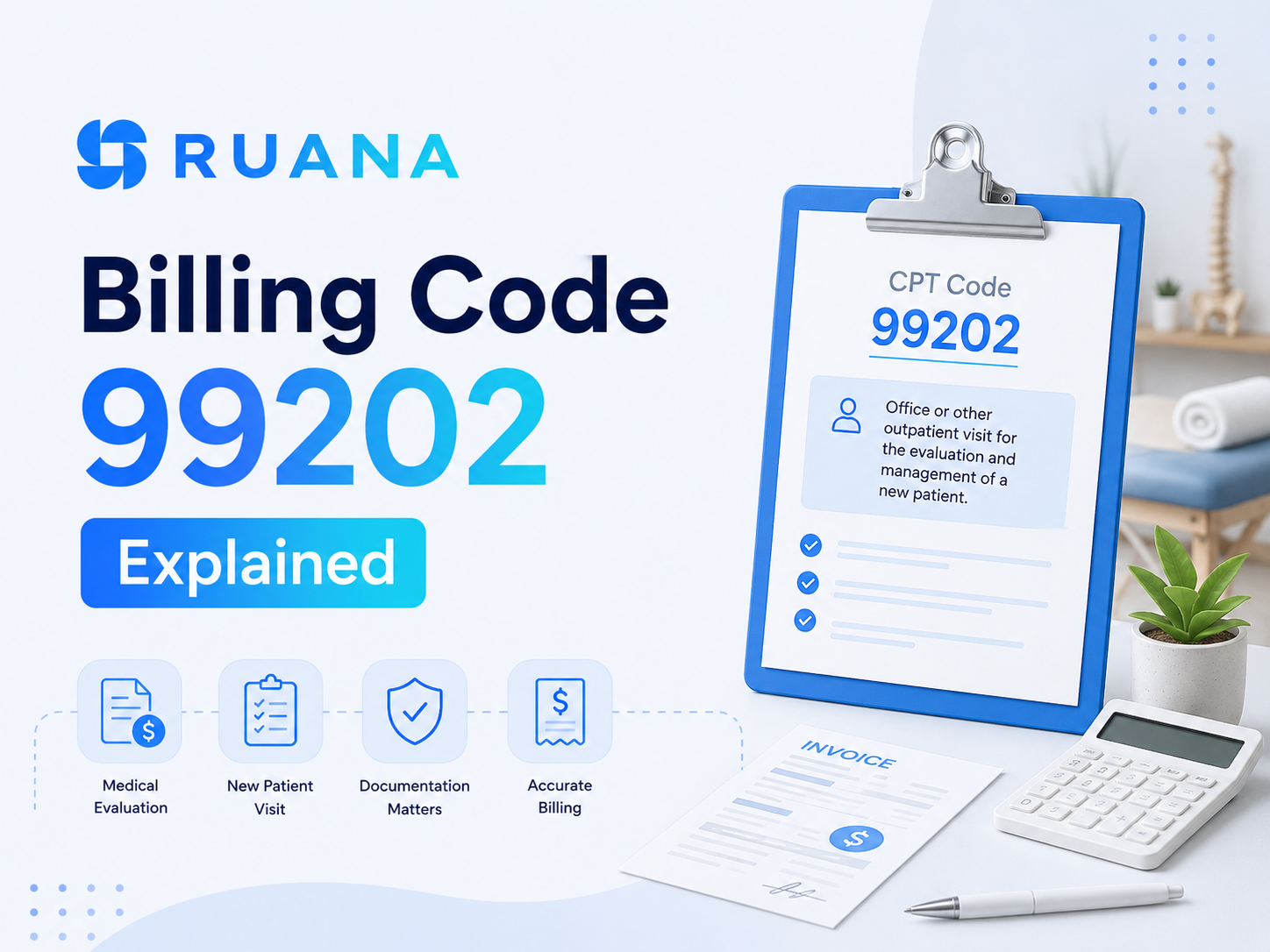
99202 billing code is used for certain new-patient office or outpatient visits. The encounter must involve straightforward decision-making or 15-29 minutes of qualifying practitioner time on the date of the visit.
Before Using 99202, Check Whether You Can Bill It
Meeting the time or decision-making requirements does not automatically make 99202 billable. You should also be allowed to perform and report the services, in addition to the patient’s plan recognizing the code for that practitioner type.
Here’s what that means in practice:
Question to check
What to verify
Is the service within the practitioner’s scope?
State licensing and scope-of-practice rules
Is the practitioner credentialed to report E/M services?
Payer enrollment and credentialing records
Does the payer recognize the practitioner type?
Commercial plan, Medicaid, workers’ compensation, or auto insurance policy
Does the patient’s plan cover the service?
Eligibility, benefits, exclusions, and visit limits
Is the visit separately reimbursable?
Bundling and same-day service rules
Are referral or authorization requirements met?
Payer policy and the patient’s plan
Does the documentation support 99202?
New-patient status, decision-making, time, and services performed
Will the practice bill directly or issue a superbill?
Network status and out-of-network reimbursement rules
Treat this table as a set of billing checkpoints rather than a guarantee of payment. A practitioner may meet the clinical requirements for 99202 and still receive a denial because the plan excludes the service or requires a different billing arrangement.
Chiropractors may be able to report 99202 under some commercial insurance, Medicaid, workers’ compensation, auto insurance, or other payer arrangements. There is no single rule that applies across every state and plan.
For example, Kentucky’s 2026 Medicaid chiropractor fee schedule includes 99202, while North Carolina’s workers’ compensation chiropractic fee schedule also recognizes the code. These examples show that 99202 can be available to chiropractors outside Original Medicare, although they do not create nationwide billing permission. Auto and no-fault programs may apply their own profession-specific fee schedules and reporting rules.
Before reporting the code, confirm:
State scope-of-practice rules
Practitioner credentialing
The payer contract
Chiropractic benefit limitations
The patient’s specific plan
Whether the E/M work is separately reimbursable
Any referral, authorization, or network requirements
The safest approach is to verify the code directly with the payer rather than relying on how another chiropractor or another insurance plan handles it.
Original Medicare applies much narrower chiropractic coverage rules. CMS limits covered chiropractic services to manual manipulation of the spine to correct a subluxation. Doctors of chiropractic are limited to billing the following three treatment codes under Medicare:
98940: one to two spinal regions
98941: three to four spinal regions
98942: five spinal regions
As a result, 99202 billing code should not be presented as a routinely reimbursable Original Medicare service when reported by a chiropractor. CMS also requires the AT modifier for covered active or corrective chiropractic treatment and does not cover maintenance therapy.
Payer check: A code appearing in the CPT code set does not automatically mean that every payer reimburses it for every practitioner type. Coverage, credentialing, scope, and documentation rules still apply.
Can Massage Therapists Use Billing Code 99202?
Massage therapists should not assume they can report 99202 simply because they complete an intake assessment or evaluate a new client. The visit description alone does not establish eligibility to bill an E/M code.
For Original Medicare, massage therapists are not recognized as qualified therapy professionals who can independently bill services under the outpatient therapy benefit.
However, rules outside Medicare may differ. Some commercial, workers’ compensation, auto, and other plans may reimburse certain massage-related services, while others may require the service to be ordered, supervised, or billed under another eligible practitioner type. Before using 99202 or placing it on a superbill, verify:
State massage therapy scope
Payer credentialing requirements
Practitioner types covered by the plan
Referral or prescription requirements
Accepted billing codes
Network participation requirements
Direct billing versus superbill reimbursement
Whether the payer requires another practitioner to order or oversee the service
A superbill does not bypass these rules. It gives the client documentation to submit, while reimbursement still depends on the plan’s coverage and practitioner eligibility requirements.
Rules for Other Wellness Practitioners
Acupuncturists, physical therapists, occupational therapists, counselors, and other practitioners follow profession-specific billing rules. Their ability to use 99202 may depend on state scope, payer recognition, enrollment status, and whether another code family is required for the service.
CMS provides the broader rule: reimbursement for an E/M service requires the practitioner’s state to permit that service within their professional scope. The code must also reflect the patient type, service setting, and level of work performed. See the CMS E/M billing guidance.
Who Counts as a New Patient for Code 99202?
For billing purposes, a new patient is not always someone visiting the clinic for the first time.
Under CMS guidance, a patient is generally considered new when they have not received a professional service from:
The same practitioner
Another practitioner of the same specialty or subspecialty
A practitioner in the same group practice
during the previous three years.
This means a patient may be new to a particular location, staff member, or booking system and still count as established for billing. The practice should review previous encounters across the entire group before selecting 99202.
A practitioner who changes locations should also check whether they have previously treated the patient. Under the CMS definition, seeing the same practitioner within the previous three years generally makes the patient established, even when the visit takes place at a different practice location.
Important: Commercial insurers, Medicaid programs, workers’ compensation plans, and auto insurers may apply their own definitions. Confirm the payer’s policy rather than assuming the CMS rule applies unchanged.
Practical New-Patient Examples
Scenario
Likely Billing Status
Reasons Why
A patient has never received services from the chiropractor or another chiropractor in the same group
New
There is no previous professional service within the group
A patient saw the same chiropractor 18 months ago at another location
Established
A change of location does not reset the three-year period
A patient saw another chiropractor in the same group two years ago
Established
The previous service was provided by the same specialty in the same group
A patient last received services from the chiropractor more than three years ago
May qualify as new
The previous service falls outside the three-year period
A patient visits a newly opened branch of the same chiropractic group
May qualify as new for the chiropractor
The practitioner type and specialty differ, although payer rules must still be checked
A patient saw a practitioner from a different specialty within the same group
May qualify as new
CMS applies the rule to practitioners of the same specialty or subspecialty
A patient completed an intake form and booked an appointment but never received a professional service
Generally new
Administrative contact alone does not usually establish a prior professional encounter
A patient followed their chiropractor from another practice within the last three years
Established
The patient previously received services from the same practitioner
These examples are practical starting points rather than universal payment decisions. Before submitting 99202, check the patient’s history by practitioner, specialty, group, and date of service. The practice should also verify the payer’s definition of a new patient, particularly when multiple locations or practitioner types are involved.
New-patient check: “First visit here” and “new patient for billing” can mean two different things. Review the previous three years of professional services before choosing 99202.
When Does a Visit Qualify for Billing Code 99202?
A new-patient visit may qualify for 99202 in one of two ways:
Through straightforward decision-making
Through the total time the practitioner spends on the encounter
Option 1: Select 99202 Through Straightforward Decision-Making
This option may apply when the practitioner evaluates a relatively simple concern that requires limited review and carries minimal risk.
Suppose a new patient comes with a single uncomplicated complaint. The chiropractor reviews the relevant history, performs an appropriate evaluation, and recommends a straightforward care plan. The note should clearly show what was assessed and how the practitioner reached the decision.
Option 2: Select 99202 Using Total Time
The visit may also qualify when the practitioner spends 15-29 minutes on the encounter during the same date.
Qualifying time may include:
Reviewing the patient’s intake information
Completing the evaluation
Discussing findings and the care plan
Educating the patient
Finishing the encounter note
Only the reporting practitioner’s qualifying time should be counted. Front-desk work, waiting time, and separately billed services are excluded. When selecting 99202 by time, record the total time in the note.
Billing Code 99202 vs. Similar Codes
The main differences between these codes are the patient’s status, the level of decision-making, and the total time spent on the visit.
For a new patient, the 99203 CPT code may be more appropriate when the visit involves low-level decision-making or at least 30 minutes of qualifying time. Codes 99212 and 99213 apply to established patients, so they should not be used simply because the visit is shorter.
The main idea is that the code should reflect the work documented during the encounter.
Why 99202 Claims Get Denied
CMS identifies incorrect coding and insufficient or missing documentation as major causes of E/M claim errors. Common reasons for a 99202 denial include:
The patient is not new. A previous service from the same practitioner or same-specialty group within three years may make the patient established.
The documentation does not support the code. The note may not show straightforward decision-making or 15-29 minutes of qualifying practitioner time.
The practitioner or service is not covered. The payer may not recognize 99202 for that practitioner type or under the patient’s specific plan.
A same-day service is bundled. When another procedure is performed, the E/M work must be significant and separately documented for modifier 25 to apply.
Before correcting or appealing a claim, review the denial reason, compare the submitted codes with the encounter note, and confirm the payer’s policy.
Keep Documentation, Billing Codes, and Superbills Connected With Ruana
Accurate billing is easier when all the connected systems, including the appointment, patient information, documentation, and billing details, stay in the same workflow.
Ruana helps chiropractors, massage therapists, and wellness practices:
Collect digital intake forms before the visit
Create and store SOAP notes and charting
Add billing and insurance codes to the patient record
Generate invoices, receipts, and superbills
Keep appointment and documentation details connected
Review patient information without switching between multiple systems
This makes it easier to confirm that the codes on an invoice or superbill match the services documented during the visit. Ruana does not currently submit insurance claims through an EDI connection or clearinghouse, so practices should continue to verify payer rules and submit claims through their usual billing process.
Always check the requirements before checkout to reduce avoidable denials and create a clearer billing experience for both the practice and the patient.
Keep your documentation and billing workflow organized with Ruana.
About the Authors
★★★★★4.9 · 329 Reviews
Rouzbeh NoroozyChiropractor & Co-Founder · Palmer West · UC Berkeley · 14 Years of ExperienceRouzbeh Noroozy is a chiropractor with 14 years of clinical experience and co-founder of Ruana practice management software. He completed his undergraduate studies at the University of California, Berkeley and graduated from the renowned Palmer College of Chiropractic West in California. As a practicing clinician and clinic owner, he understands firsthand the administrative challenges practices face — and which digital tools genuinely help streamline day-to-day operations.
Anastasiia NoroozyMedical Graduate & Co-Founder · 8 Years of ExperienceAnastasiia Noroozy is a medical graduate and co-founder of Ruana with 8 years of experience working directly with patients at the clinic in Cologne. She manages the day-to-day flow of the practice and knows every patient-facing process from the inside out — from intake and scheduling to follow-up care. Her hands-on clinical and operational experience directly shapes how Ruana is built to work in the real world.
Our team will review your inquiry and get back to you as soon as possible.
Privacy Settings
To provide the best experiences, we use technologies like cookies to store and/or access device information. Consenting to these technologies will allow us to process data such as browsing behavior or unique IDs on this site. Not consenting or withdrawing consent, may adversely affect certain features and functions.
Functional
Always active
The technical storage or access is strictly necessary for the legitimate purpose of enabling the use of a specific service explicitly requested by the subscriber or user, or for the sole purpose of carrying out the transmission of a communication over an electronic communications network.
Preferences
The technical storage or access is necessary for the legitimate purpose of storing preferences that are not requested by the subscriber or user.
Analytics
The technical storage or access that is used exclusively for statistical purposes.The technical storage or access that is used exclusively for anonymous statistical purposes. Without a subpoena, voluntary compliance on the part of your Internet Service Provider, or additional records from a third party, information stored or retrieved for this purpose alone cannot usually be used to identify you.
Marketing
The technical storage or access is required to create user profiles to send advertising, or to track the user on a website or across several websites for similar marketing purposes.
To provide the best experience for our practitioners, we use cookies to personalize content, analyze our traffic, and support our marketing efforts. By clicking 'Accept', you consent to our use of these technologies. You can manage your preferences at any time.
Functional
Always active
The technical storage or access is strictly necessary for the legitimate purpose of enabling the use of a specific service explicitly requested by the subscriber or user, or for the sole purpose of carrying out the transmission of a communication over an electronic communications network.
Preferences
The technical storage or access is necessary for the legitimate purpose of storing preferences that are not requested by the subscriber or user.
Analytics
The technical storage or access that is used exclusively for statistical purposes.The technical storage or access that is used exclusively for anonymous statistical purposes. Without a subpoena, voluntary compliance on the part of your Internet Service Provider, or additional records from a third party, information stored or retrieved for this purpose alone cannot usually be used to identify you.
Marketing
The technical storage or access is required to create user profiles to send advertising, or to track the user on a website or across several websites for similar marketing purposes.