Chiropractic Billing Codes: CPT, Diagnosis Codes, and Billing Tips
29.05.26
Billing mistakes rarely start with the claim form. They usually start earlier, when the visit note, diagnosis code, procedure code, and payer rules do not fully match. For chiropractic clinics, that small mismatch can turn into denied claims, delayed payments, extra admin work, or awkward patient billing questions. And the pressure is not getting lighter. […]
Billing mistakes rarely start with the claim form. They usually start earlier, when the visit note, diagnosis code, procedure code, and payer rules do not fully match.
For chiropractic clinics, that small mismatch can turn into denied claims, delayed payments, extra admin work, or awkward patient billing questions. And the pressure is not getting lighter. In fact, recent statistics show that claim denials continue to rise across healthcare, with payer rules becoming stricter. An industry report notes that 41% of surveyed providers said at least one in ten claims is denied, which means billing accuracy is no longer a back-office detail. It directly affects cash flow.
Chiropractic billing codes help explain what was done, why it was medically necessary, and how the service should be billed. But using the right code is only part of the job.
Chiropractic billing codes are standardized numbers used to describe a patient visit for billing, insurance, and documentation purposes.
In simple terms, they help the payer understand what service was provided, why the patient needed it, and how the service should be processed further.
Codes are part of the daily workflow at any chiropractic office. They show up when creating a claim, preparing a superbill, documenting a visit, or explaining charges to a patient. Having an accurate system that’s supported by the clinical progress notes ensure more smoothly billing. But when everything’s vague, mismatched, or incomplete, claims can be delayed, denied, or sent back for more information.
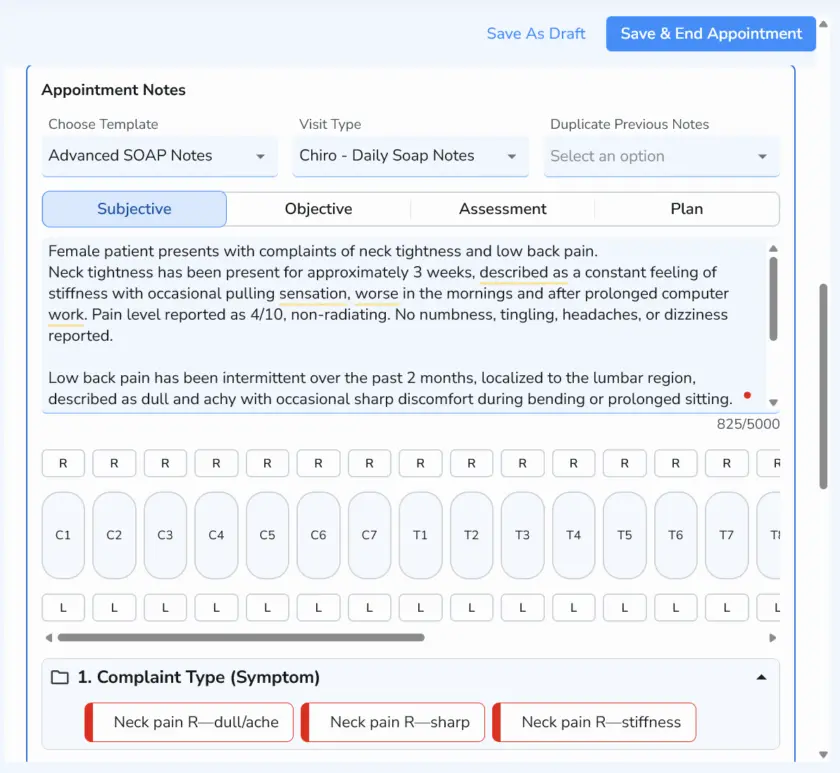
Document patient visits faster with structured Advanced SOAP Notes, including symptoms, spinal levels, and automated selections.
The important thing to understand is that chiropractic billing codes do not work alone. A CPT code may describe an adjustment or therapeutic exercise, but it still needs the right diagnosis code and documentation behind it. The note should clearly show what was treated, why it was necessary, and how the service connects to the patient’s condition.
The Three Main Code Types Used in Chiropractic Billing
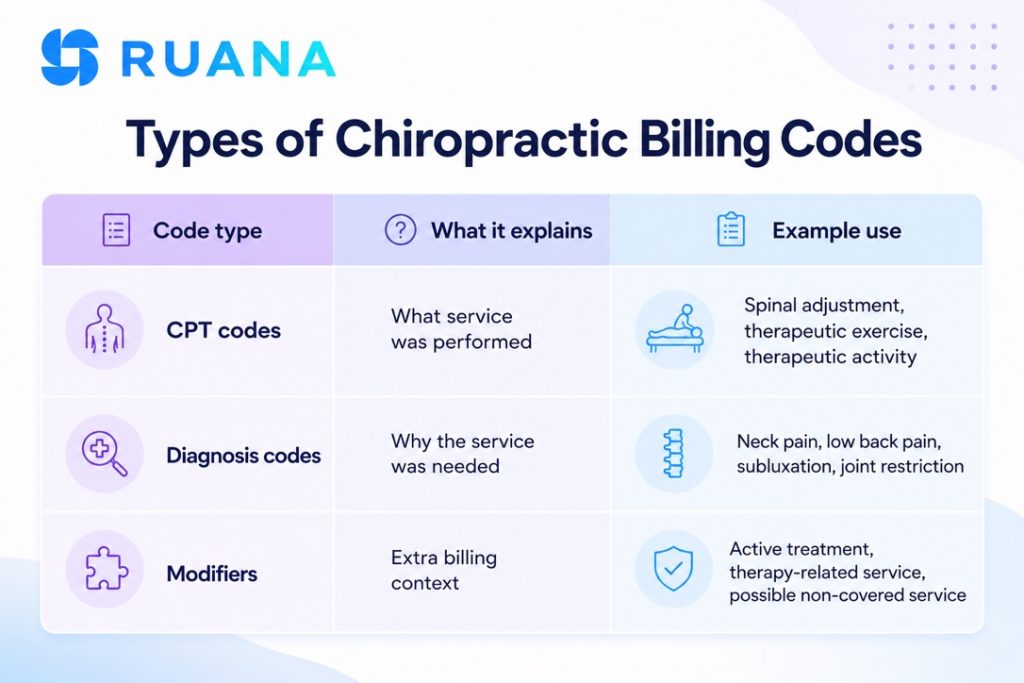
Most chiropractic billing depends on three main types of codes: CPT codes, diagnosis codes, and modifiers. Each one answers a different question.
CPT (Current Procedural Terminology) codes describe the procedure or service provided during the visit. In chiropractic care, these may include chiropractic manipulative treatment codes, commonly known as CMT (Chiropractic Manipulative Treatment) codes, along with certain therapy or rehab-related procedure codes when appropriate.
Diagnosis codes explain the clinical reason for the visit. These codes help connect the service to the patient’s condition. A payer does not only want to know that an adjustment was performed. It also needs to understand why that adjustment was medically necessary.
Modifiers add more detail to the claim. They can show whether the treatment was active care, whether a service followed specific payer rules, or whether the patient was notified that a service may not be covered.
The simplest way to think about it is this:
CPT codes say what you did.
Diagnosis codes say why you did it.
Modifiers add billing context when the payer needs more information.
For chiropractic billing to hold up, all three should tell the same story as the clinical note. If the SOAP note, CPT code, diagnosis code, and modifier all point in the same direction, the bill is easier to review, easier to explain, and less likely to create unnecessary back-and-forth.
Common Chiropractic CPT Codes for Billing
Chiropractic CPT codes are used across most chiropractic offices for daily adjustments, therapy services, rehab exercises, and certain patient care procedures.
The key is to align the codes with the SOAP notes. The diagnosis should explain why the service was needed, with the billing matching it.
In chiropractic billing, the most common CPT codes usually fall into two groups:
Chiropractic manipulative treatment codes, often called CMT codes
Procedure codes beyond adjustments, such as therapeutic exercise or therapeutic activity
Both can be part of a chiropractor’s bill, but they need to be documented clearly and billed according to payer rules.
Chiropractic Manipulative Treatment Codes
The CMT codes are the core chiropractic CPT codes used for spinal adjustments. They are based on the number of spinal regions treated during the visit.
CPT code
What it describes
Common use
98940
Chiropractic manipulative treatment, spinal, 1–2 regions
A focused adjustment involving one or two spinal regions
98941
Chiropractic manipulative treatment, spinal, 3–4 regions
A broader spinal adjustment involving three or four regions
98942
Chiropractic manipulative treatment, spinal, 5 regions
A full-spine adjustment involving all five spinal regions
98943
Chiropractic manipulative treatment, extraspinal, 1 or more regions
Adjustment of areas outside the spine, such as the shoulder, hip, knee, rib, jaw, or extremity regions
💡Note: The coverage may vary for some private insurances. Some payers may cover extraspinal adjustments, therapy codes, or rehab-related services, while others may limit reimbursement based on plan rules. That is why the code alone is never the full answer. The payer policy, diagnosis, modifier, and note all matter.
Chiropractic Procedure Codes Beyond Adjustments
Many chiropractic visits include additional services like therapeutic exercises, functional movement training, manual therapy, etc. This requires an additional set of codes to be used.
Some of the common procedure codes used in chiropractic billing may include:
CPT code
What it generally describes
Example use
97110
Therapeutic exercise
Strength, flexibility, range of motion, or endurance exercises
97530
Therapeutic activities
Functional movement training, such as bending, lifting, reaching, or task-based movement
97140
Manual therapy techniques
Soft tissue work, mobilization, or manual techniques when separately supported
97012
Mechanical traction
Traction therapy, when clinically appropriate
99202–99205
New patient evaluation and management
Initial evaluation, when billed according to E/M rules
99212–99215
Established patient evaluation and management
Follow-up E/M service, when separately necessary and documented
Choosing the right code from the list matters because payers may look closely at therapy codes to identify the exact service provided. If the note only says “exercises performed,” it may not be enough. The documentation should show what the patient did, why it was needed, how much time was spent, and how the service connects to the patient’s condition or functional limitation.
Quick Chiropractic Billing Cheat Sheet
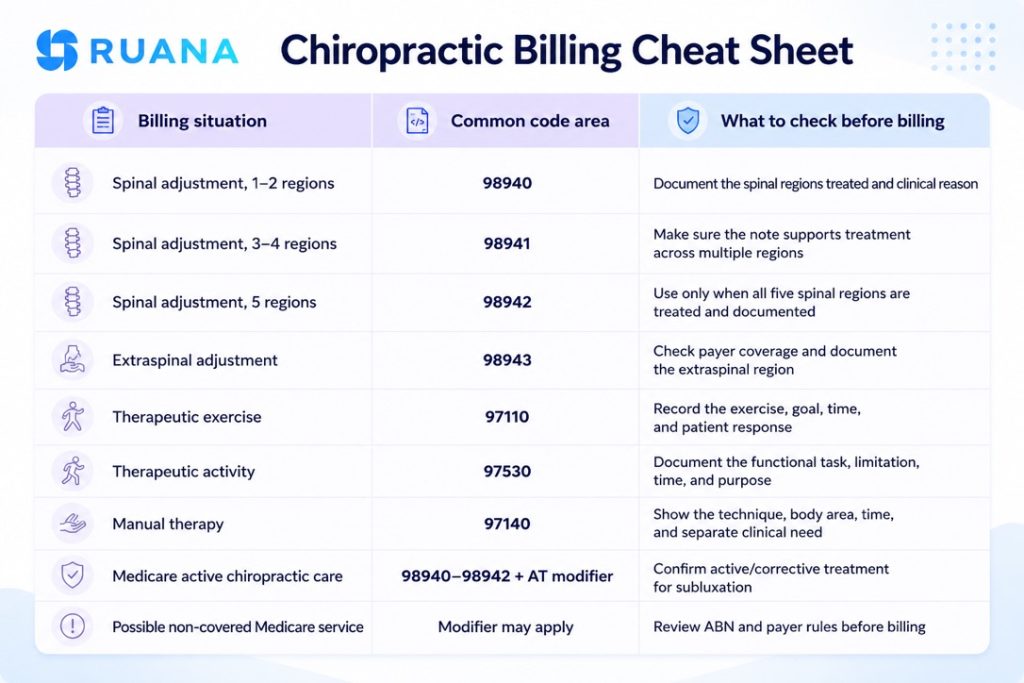
💡Save this cheat sheet with the common chiropractic billing codes for future reference:
What This Cheat Sheet Cannot Replace
This table is useful for quick reference, especially for front desk teams, billing staff, and providers who want a cleaner way to review common chiropractic codes for billing.
Still, it should be used as a guide, not as a final billing rulebook.
Two clinics may use the same CPT code for similar services, but the billing outcome can still differ based on the patient’s insurance plan, diagnosis codes, modifier use, documentation quality, and medical necessity requirements.
A good billing process does not start with “Which code can we use?” It starts with a better question: “What did we do, why did we do it, and does the note support it?”
Chiropractic Diagnosis Codes: Why CPT Codes Are Not Enough
A CPT code tells the payer what service was performed.
A diagnosis code explains why that service was needed.
This distinction matters because a billing procedure code by itself doesn’t prove medical necessity. For example, if a visit includes a lumbar adjustment, the diagnosis should clearly connect to the patient’s lumbar complaint, clinical findings, or documented condition. If the diagnosis is too general, does not match the treated region, or fails to support the level of care provided, the claim becomes easier to question.
This is where many chiropractic billing issues begin. The provider may have treated the patient appropriately, but the billing record does not tell the full clinical story.
Chiropractic diagnosis codes are usually selected from ICD-10-CM. These codes may describe conditions such as:
Diagnosis code category
What it may describe
Subluxation-related codes
Segmental or joint dysfunction, depending on payer requirements
Pain-related codes
Neck pain, low back pain, thoracic pain, joint pain
Radiculopathy-related codes
Nerve-related symptoms affecting the spine or extremities
Movement restriction, stiffness, difficulty with certain activities
The same idea applies to ongoing treatment. If the patient is improving, the documentation should reflect that progress. If the treatment plan changes, the diagnosis and visit note should still support the services being billed. Chiropractic diagnosis codes are not something to set once and forget. They should be reviewed as the patient’s condition changes.
Thus, in more practical terms, clean chiropractic billing depends on three things working together:
CPT code: What did the chiropractor do?
Diagnosis code: Why was the service medically necessary?
Clinical code: Does the documentation support both?
When those three pieces line up, the claim is stronger.
Chiropractic Billing Codes for Medicare
Medicare chiropractic billing is much narrower than most patients expect. For chiropractors, the key rule is simple: Medicare does not cover every service provided in a chiropractic office.
Medicare Part B generally covers manual manipulation of the spine when it is used to correct a subluxation and when the care is medically necessary. That means the visit note must support active treatment, not routine wellness care or maintenance care.
In most cases, the claim can be denied if the code is correct, but the note doesn’t show medical necessity.
For billing purposes, this makes documentation especially important. The note should show:
What Medicare looks for
What the note should support
Subluxation
The spinal level or region being treated
Medical necessity
Why treatment is needed now
Active care
How care is expected to improve the condition
Direct relationship
How the manipulation relates to the patient’s complaint
Progress
Whether the patient is improving or needs continued care
CPT Code 97530 vs 97110: What Is the Difference?
CPT codes 97530 and 97110 are both commonly used in chiropractic billing, especially when a visit includes rehab, corrective exercise, or movement-based care. The difference comes down to what the patient is doing and why the service is being provided.
A simple way to separate them:
97110 focuses on physical improvement: strength, flexibility, range of motion, and endurance.
97530 focuses on functional performance: how the patient moves, works, lifts, bends, reaches, or performs daily tasks.
97110 is often more exercise-based.
97530 is usually more activity-based and task-based.
Both require time-based documentation, usually including what was done, how long it took, why it was needed, and how the patient responded.
For example, if a patient performs guided lumbar stabilization exercises to improve core strength, 97110 may be the better fit. If the same patient practices safe lifting mechanics after a low back injury, 97530 may be more appropriate because the service is tied to a functional task.
The mistake to avoid is choosing between these codes based on reimbursement alone. The correct code should follow the actual service. If the note only says “therapeutic exercise performed,” it may not be enough. The documentation should explain the exercise or activity, the body area involved, the patient’s limitation, the treatment goal, and the time spent.
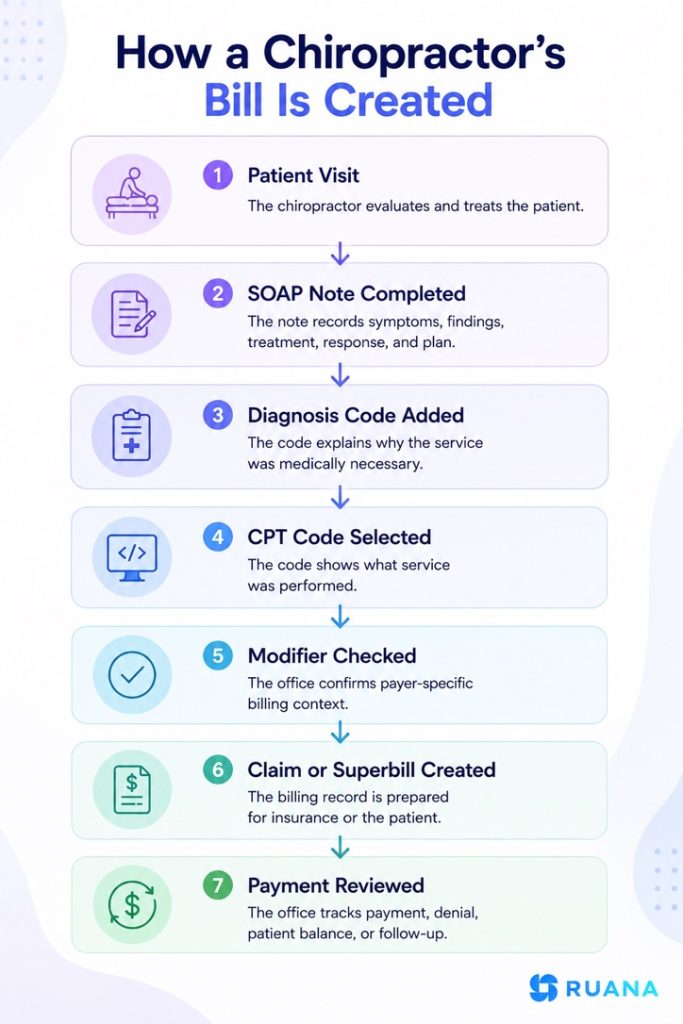
How a Bill Is Usually Created: From Visit Note to Claim or Superbill
This may look simple, but each step affects the next one.
First, the chiropractor completes the visit note. The note should show the patient’s complaint, exam findings, treatment performed, body regions treated, response to care, and plan. If the visit includes a spinal adjustment, the note should support the spinal regions billed. If the visit includes therapeutic exercise or activity, the note should support the time, goal, and clinical reason for that service.
Document patient visits using traditional SOAP notes with a clean, distraction-free interface.
Next, the diagnosis code is selected. This explains why the service was needed. A CPT code can say that an adjustment was performed, but the diagnosis code explains why that adjustment made sense for the patient’s condition.
Then the CPT code is selected based on the service performed. For chiropractic manipulative treatment, that may be 98940, 98941, or 98942, depending on the spinal regions treated. For rehab-related services, it may be a code like 97110 or 97530, depending on whether the work was exercise-based or function-based.
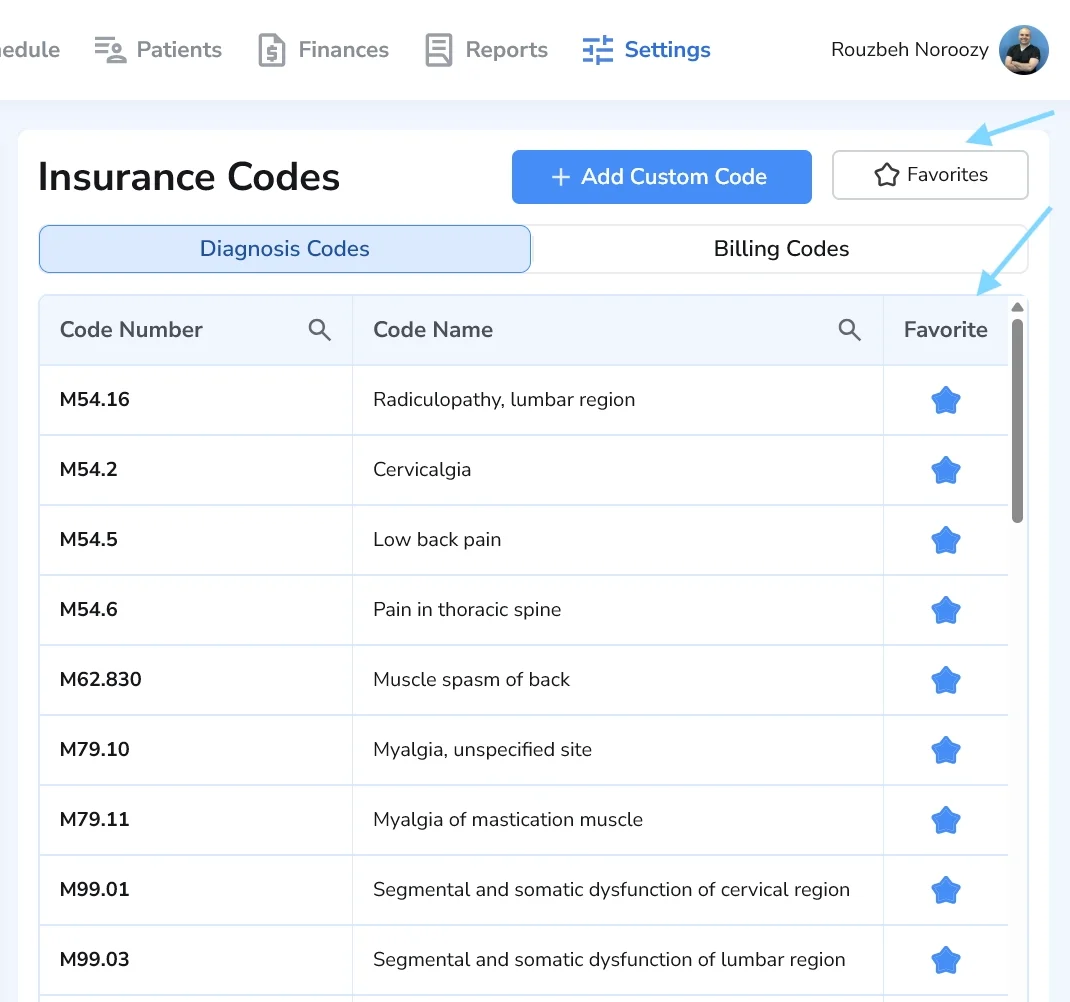
Clinical efficiency: Managing a personalized library of frequently used insurance, diagnosis, and billing codes in Ruana.
After that, the modifier is checked. This is especially important for Medicare and some insurance plans. For example, Medicare active treatment generally requires the AT modifier when billing for covered spinal manipulation. Other modifiers may apply depending on payer rules, therapy services, or possible non-covered care.
Finally, the office creates either a claim or a superbill. A claim is usually sent to the payer for processing. A superbill is usually given to the patient so they can submit it to insurance for possible reimbursement.
Our key takeaway here is simple: clean chiropractic billing is not about memorizing more codes. It is about making sure the visit note, billing codes, and payer requirements all tell the same story.
For small chiropractic offices, this is where the right practice management software can make billing much easier. When SOAP notes, diagnosis codes, CPT codes, superbills, patient records, and payment details are connected in one workflow, the front desk has less to chase down, and the provider has fewer gaps to fix later.
Ruana helps chiropractic teams keep those steps organized in one place, from documentation to billing. Instead of moving between disconnected tools or rebuilding the same visit information twice, clinics can create cleaner records, prepare bills faster, and make patient billing conversations much easier.
Does Medicare Pay for Chiropractor Services?
The practical answer is: yes, but only in a limited way. Medicare can pay for chiropractor services, but only when the visit fits Medicare’s narrow coverage rules. A clean Medicare chiropractic claim needs the right CPT code, the right modifier, a diagnosis that supports the treatment, and a note that clearly shows why the service was medically necessary.
Is 97140 a Chiropractic Code?
97140 is not a chiropractic adjustment code, but chiropractors may use it when manual therapy is performed and properly documented. It generally applies to hands-on techniques such as manual traction, mobilization, or soft tissue work.
Can You Bill 97140 and 97012 Together?
Sometimes, but only when both services are actually performed, medically necessary, separately documented, and allowed by the payer. 97140 is manual therapy, while 97012 is mechanical traction. The documentation should clearly support each service, including why traction was needed and what manual therapy was provided.
Can a Chiropractor Bill 97124?
CPT 97124 is generally used for massage therapy techniques. So a chiropractor may bill 97124 only when massage therapy is within their scope of practice, the payer allows it, and the service is documented correctly.
About the Authors
★★★★★4.9 · 329 Reviews
Rouzbeh NoroozyChiropractor & Co-Founder · Palmer West · UC Berkeley · 14 Years of ExperienceRouzbeh Noroozy is a chiropractor with 14 years of clinical experience and co-founder of Ruana practice management software. He completed his undergraduate studies at the University of California, Berkeley and graduated from the renowned Palmer College of Chiropractic West in California. As a practicing clinician and clinic owner, he understands firsthand the administrative challenges practices face — and which digital tools genuinely help streamline day-to-day operations.
Anastasiia NoroozyMedical Graduate & Co-Founder · 8 Years of ExperienceAnastasiia Noroozy is a medical graduate and co-founder of Ruana with 8 years of experience working directly with patients at the clinic in Cologne. She manages the day-to-day flow of the practice and knows every patient-facing process from the inside out — from intake and scheduling to follow-up care. Her hands-on clinical and operational experience directly shapes how Ruana is built to work in the real world.
Our team will review your inquiry and get back to you as soon as possible.
Privacy Settings
To provide the best experiences, we use technologies like cookies to store and/or access device information. Consenting to these technologies will allow us to process data such as browsing behavior or unique IDs on this site. Not consenting or withdrawing consent, may adversely affect certain features and functions.
Functional
Always active
The technical storage or access is strictly necessary for the legitimate purpose of enabling the use of a specific service explicitly requested by the subscriber or user, or for the sole purpose of carrying out the transmission of a communication over an electronic communications network.
Preferences
The technical storage or access is necessary for the legitimate purpose of storing preferences that are not requested by the subscriber or user.
Analytics
The technical storage or access that is used exclusively for statistical purposes.The technical storage or access that is used exclusively for anonymous statistical purposes. Without a subpoena, voluntary compliance on the part of your Internet Service Provider, or additional records from a third party, information stored or retrieved for this purpose alone cannot usually be used to identify you.
Marketing
The technical storage or access is required to create user profiles to send advertising, or to track the user on a website or across several websites for similar marketing purposes.
To provide the best experience for our practitioners, we use cookies to personalize content, analyze our traffic, and support our marketing efforts. By clicking 'Accept', you consent to our use of these technologies. You can manage your preferences at any time.
Functional
Always active
The technical storage or access is strictly necessary for the legitimate purpose of enabling the use of a specific service explicitly requested by the subscriber or user, or for the sole purpose of carrying out the transmission of a communication over an electronic communications network.
Preferences
The technical storage or access is necessary for the legitimate purpose of storing preferences that are not requested by the subscriber or user.
Analytics
The technical storage or access that is used exclusively for statistical purposes.The technical storage or access that is used exclusively for anonymous statistical purposes. Without a subpoena, voluntary compliance on the part of your Internet Service Provider, or additional records from a third party, information stored or retrieved for this purpose alone cannot usually be used to identify you.
Marketing
The technical storage or access is required to create user profiles to send advertising, or to track the user on a website or across several websites for similar marketing purposes.