
Finding the right software lets you spend more time on care and less time on admin.
Admin work doesn’t generate revenue. Every hour you spend manually confirming bookings, writing up session notes by hand, or following up on missed appointments is an hour you’re not earning. And an experience your clients aren’t getting.
That’s where the right massage therapy software changes the equation. A purpose-built platform handles scheduling, documentation, billing, and client communication automatically, giving you back the time and headspace to actually grow your practice.
This guide breaks down the best massage therapy software options available in 2026: what each platform does well, who it’s built for, and how to choose the one that fits your specific practice.
The global massage therapy market is on track to reach $126.8 billion by 2035 (Grand View Research), and practices that invest in professional systems now are the ones positioned to capture that growth. Generic calendar apps won’t cut it at that level.
Key Takeaways — Massage Therapy Software 2026
- The right massage therapy software pays for itself by reducing no-shows and recovering lost booking revenue.
- 24/7 online booking is now a baseline expectation. Over 43% of appointments are booked outside business hours (AMTA).
- Digital SOAP notes protect your practice legally and dramatically cut post-session documentation time.
- Platforms built for clinical workflows handle HIPAA-aligned data storage, intake forms, and compliance safeguards automatically.
- Memberships and session packages are the fastest path to predictable monthly revenue without adding more working hours.
- All-in-one platforms outperform stacked single-purpose tools. Fewer logins, fewer sync errors, cleaner client records.
The 2026 Landscape: Why Generic Tools Fall Short
The average massage therapist juggles scheduling, client intake, session documentation, billing, and follow-up communications, all while delivering hands-on care. That workload doesn’t fit inside a generic appointment app built for hair salons or dental offices.
In 2026, clients arrive expecting a smooth digital experience: online booking from their phone, automated reminders, and paperless intake forms they complete before stepping through the door. If your process still requires a phone call to confirm an appointment, you’re already losing bookings to practices that removed that friction.
Regulations around health data have also tightened. Keeping handwritten notes or storing client health information in an unsecured app is a real liability. Platforms designed for therapeutic practices handle encryption, backups, and data security as core features, not afterthoughts.
The case for purpose-built software isn’t about bells and whistles. It’s about running a professional practice that clients trust, that protects you legally, and that scales without requiring you to hire an extra admin just to keep up.
Filling Your Calendar with Online Booking That Actually Works
An empty slot is revenue you can never recover. Online booking removes every obstacle between a potential client and a confirmed appointment. No phone tag, no back-and-forth emails, no calendar conflicts from manual entry.
The best massage therapy platforms offer round-the-clock self-scheduling that syncs in real time. Clients pick their preferred therapist, treatment type, and session duration. The appointment locks in without anyone on your end lifting a finger. When a cancellation opens up, an automated waitlist fills the slot before it goes to waste.
Ruana’s booking system runs 24/7 directly from your website, email signature, or social media pages. Every booking syncs instantly to your practice calendar. No double-bookings. No phone tag. Explore Ruana’s online booking tools for massage practices to see exactly how it works.
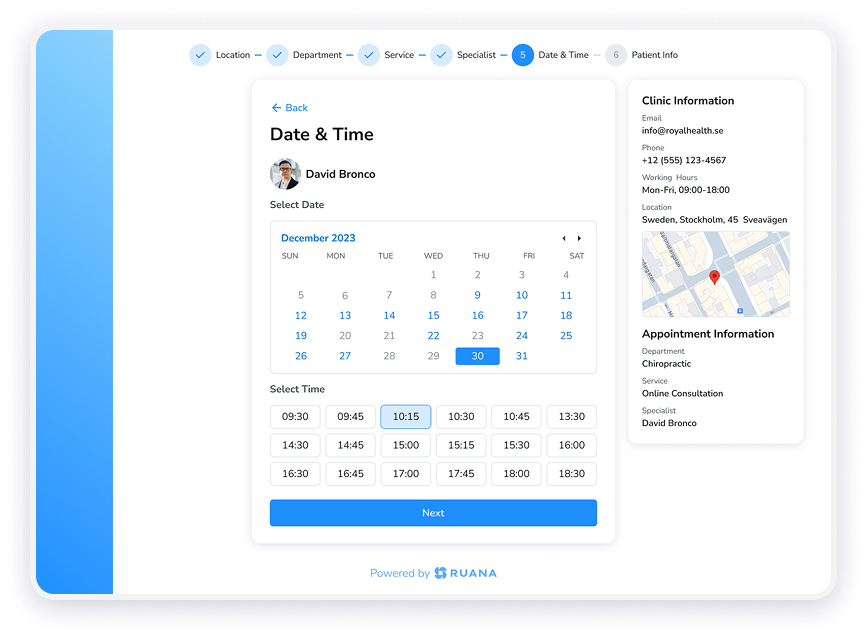
Ruana’s self-scheduling flow — clients book in under two minutes, anytime.
Cutting No-Shows Before They Cost You
A missed appointment doesn’t just cost you one session fee. It costs you that slot, the revenue you could have earned if someone else had it, and the admin time spent chasing the client down. No-shows are a structural problem. They require a structural solution.
Automated reminders sent via SMS and email are the single most effective intervention. Research consistently shows that practices using multi-step automated reminders reduce missed appointments by more than 80%. The sequence matters: a 48-hour reminder gives clients time to reschedule, and a same-day message takes forgetfulness off the table.
“Setting up automated text reminders through Ruana was the single biggest operational change I’ve made in five years of practice. Cancellations dropped within the first two weeks. It genuinely paid for a year of software in one month.”
Michael Webb, Massage Therapy Clinic Owner
Ruana sends automated SMS and email reminders on a schedule you set. Clients confirm or cancel directly from the message, keeping your calendar updated without you lifting a finger. See how Ruana’s automated reminders work for massage therapists.
Clinical Documentation: SOAP Notes, Intake Forms, and Compliance
Thorough session documentation isn’t optional in therapeutic massage practice. It’s both a professional standard and, in many jurisdictions, a legal requirement. When you’re seeing six or eight clients a day, documentation that takes eight minutes per session adds up to a serious chunk of your working week.
Purpose-built platforms include SOAP note templates designed around actual massage workflows. Subjective, Objective, Assessment, and Plan fields are formatted for your modalities: Swedish, deep tissue, sports, prenatal, myofascial, trigger point, and more. Staff complete notes faster, and the records stay consistent across every therapist in your practice.
Digital intake forms matter just as much. When clients complete health questionnaires, consent forms, and contraindication disclosures online before their first visit, you walk into the session already informed. The paperwork is already in their file. Cloud storage with full encryption keeps everything secure and reachable from any device.
Ruana’s SOAP charting tools include ready-made massage templates alongside a fully customizable chart builder. The Advanced SOAP Notes tier adds an Automatic Notes feature — therapists program one-click buttons that insert full treatment sentences and exam findings instantly, cutting repetitive typing out of every session. Review Ruana’s SOAP notes and charting tools to see the full capabilities.
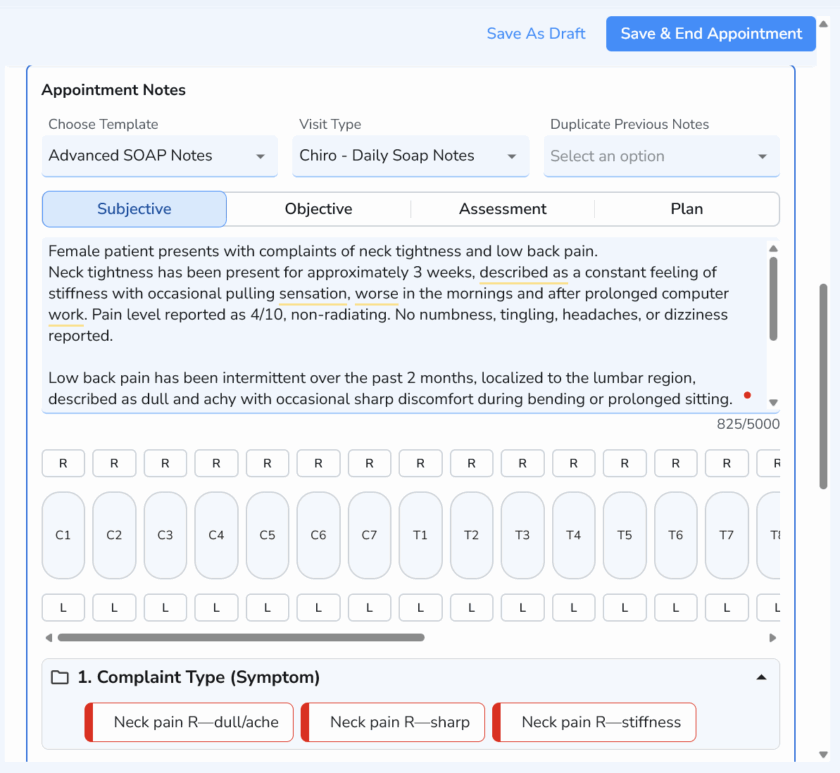
Ruana’s SOAP builder — complete a full session note in under three minutes.
Turning One-Time Clients into Loyal Regulars
A client who books once and doesn’t return represents a real cost. You spent time and effort acquiring them, and you captured none of the long-term value they could have generated. The practices that scale are the ones that systematize retention, not just acquisition.
Software-driven retention works on three levels. Session packages and memberships create commitment upfront. A client who bought a six-session bundle has already committed money to future sessions. Monthly membership plans generate predictable recurring revenue that keeps your baseline income stable regardless of seasonal fluctuations.
Ruana supports packages, memberships with defined billing cycles, and session tracking that monitors remaining credits and expiration dates. Every renewal, cancellation, and balance update happens inside the same system as your bookings and SOAP notes. For a full view of what’s included at each tier, see Ruana’s massage therapy pricing and features.
See Ruana in action — online booking, scheduling, SOAP notes, and more in one workflow.
The 10 Best Massage Therapy Software Platforms for 2026
Not every platform on this list was built with therapeutic massage as the primary use case. Some were designed for fitness studios and added massage as a secondary category. Others were originally medical-grade systems that lack the scheduling flexibility solo and small-clinic operators need. The distinctions matter. Here’s what you need to know about each one.
1 Ruana — Best All-In-One Massage Therapy Software for Growing Practices
Editor’s Pick · Best Overall 2026
Ruana
Ruana is built specifically for massage therapists and multi-therapist clinics — by practitioners, for practitioners. It puts online booking, automated SMS and email reminders, digital SOAP notes with customizable templates, paperless intake forms, professional invoicing, session packages, memberships, and financial reporting into one platform that runs entirely in your browser. No downloads required.
Solo + Multi-Therapist · From $35.99/mo · 14-day free trial
What separates Ruana from the rest of this list is that it was designed from the ground up for clinical workflows, not adapted from a fitness or salon product. Built by practitioners, for practitioners, it reflects how a real massage practice actually operates day to day. The Automatic Notes feature, part of Advanced SOAP Notes, lets therapists pre-program insertion buttons that drop full treatment sentences into a note with a single click. For a practice seeing six clients a day, that saves real time every single day.
Every plan includes free data import, a dedicated onboarding call, and ongoing support via chat and email. No implementation contracts, no hidden migration fees. Start a 14-day free trial — no credit card required.
2 Mindbody
Mindbody
Mindbody’s biggest strength is its consumer marketplace. It puts larger practices in front of new clients searching for wellness services. Franchises and wellness chains benefit from that brand exposure. For independent practices and smaller clinics, the price is hard to justify, and the platform’s complexity often exceeds what a solo or two-therapist operation actually needs.
3 ClinicSense
ClinicSense
ClinicSense invests heavily in its documentation stack. SOAP notes, intake form tools, and secure data management are its standout features. It works well for clinics where thorough record-keeping is the top priority. The platform’s marketing and retention features are more limited, so practices that need automated re-engagement tools alongside documentation will find gaps.
4 MassageBook
MassageBook
MassageBook is approachable and affordable, a reasonable first step for therapists just opening their practice. Scheduling and basic client reminders work well, and SOAP notes are available on paid tiers. It outgrows itself fast though. Add a second therapist or want proper reporting and you’ll be looking to switch sooner than expected.
5 Fresha
Fresha
Fresha’s no-monthly-fee model appeals to practices watching startup costs closely. Rather than a flat subscription, it charges on payment processing and select premium features. The math works well at low booking volumes but becomes less competitive as the practice scales. Transaction fees on a full weekly schedule add up faster than a flat monthly software cost.
6 Vagaro
Vagaro
Vagaro offers above-average intake form customization and branding flexibility, which suits practitioners offering niche or specialized modalities that require detailed pre-session health screening. The interface carries a lot of features that broader wellness businesses use but massage-only practices don’t need, adding navigation complexity without much added value for a focused clinic.
7 Zenoti
Zenoti
Zenoti operates at the enterprise end of the market. Multi-location reporting, royalty calculations, and centralized brand management for franchise groups are its core strengths. Implementation is structured, the pricing reflects the enterprise tier, and the feature set is built for organizations with dedicated IT resources. Independent practitioners and small clinics are not the target audience.
8 Square Appointments
Square Appointments
Square Appointments works smoothly if you’re already using Square hardware and payment processing. The booking and checkout flow is clean and familiar. Where it falls short is clinical documentation: SOAP notes are absent, and the intake form capabilities are minimal. It functions well as a scheduling and payment tool, not as a practice management system.
9 Schedulicity
Schedulicity
Schedulicity handles group booking logistics well. Recurring team appointments, multi-therapist coordination, and bulk schedule management are its strengths. It fits corporate on-site massage programs that need to coordinate several practitioners across an employer’s premises. Clinical documentation depth is limited, making it less suited to practices where SOAP notes and health records are central to the workflow.
10 Booker by Mindbody
Booker by Mindbody
Booker serves the specific overlap between massage services and physical product sales. Spas that sell retail alongside sessions benefit from having inventory management, POS, and scheduling inside one system. For clinics focused purely on therapeutic massage without meaningful product revenue, the retail layer adds cost and complexity you won’t use.
Matching Software to Your Practice Model
The right software for a solo mobile therapist is a different product than what a four-room clinic with two front-desk staff needs. Buy a platform built for a different model and you’ll pay for features you never touch. Or worse, go without the ones you need every day.
Use the table below to identify which features are essential for your specific setup, and which platforms actually deliver them.
| Practice Type |
Essential Features |
Useful Add-Ons |
Platform to Consider |
| Solo Therapist |
Online booking, SOAP notes, invoicing |
Email reminders, packages |
Ruana Solo Plan |
| Multi-Therapist Clinic |
Multi-staff scheduling, reporting, SOAP notes |
Memberships, waitlists, analytics |
Ruana Professional |
| Mobile Therapist |
Mobile-optimized booking, scheduling buffers |
Travel-time buffers, reminders |
Ruana, MassageBook |
| Sports & Athletic |
Advanced SOAP notes, progress tracking, packages |
Care plan tools, session history |
Ruana Professional |
| Corporate / On-Site |
Group booking, HR invoicing, recurring appointments |
Multi-therapist coordination |
Schedulicity, Ruana |
| Massage Franchise |
Multi-location dashboards, royalty tracking |
Centralized branding, enterprise reports |
Zenoti, Mindbody |
| Wellness / Holistic |
Flexible intake forms, modality-specific SOAP notes |
Automated follow-ups, packages |
Ruana, Vagaro |
| Spa + Retail |
POS, product inventory, booking |
Membership programs, loyalty tools |
Booker, Vagaro |
If your practice falls into the solo or multi-therapist clinic category, which covers the majority of independent massage businesses, Ruana’s massage therapy platform was built specifically for you, with a pricing structure that scales from your first client to a full multi-room operation.
Making the Switch: How to Migrate Without the Headache
The number one reason massage therapists stay on software they’ve outgrown is fear of disruption. The migration feels like a big project. It is. But it’s a contained project with a clear endpoint, not an ongoing source of friction like using the wrong platform every single day.
A successful migration starts with data. Your client profiles, appointment history, and existing clinical records need to transfer cleanly to the new system. Any platform worth considering offers free data import. If it doesn’t, walk away.
A real onboarding call matters just as much. You should walk away from that call with your booking page live, your SOAP templates configured for your modalities, your reminder schedules set, and a clear picture of how the billing and reporting tools work. Generic tutorial videos don’t replace a real conversation about your specific workflow.
The cleanest approach: run both systems in parallel for one to two weeks. Route new bookings into the new platform while you work through existing committed appointments in the old one. By the time those appointments complete, you’re fully transitioned without a gap in service.
Ruana includes free data import and a personalized setup call at every plan level. No additional charge, no technical expertise required on your end. Book a live Ruana demo or support call to see the platform in your specific workflow before you commit to anything.
Massage Therapy Software: Practical Takeaways
- Identify your practice model first: solo, multi-therapist, mobile, or corporate. Then filter your shortlist to platforms built for that exact setup.
- Activate online booking before anything else. 43% of appointments are now booked outside business hours. Every day without self-scheduling is a day you’re losing clients who won’t call.
- Configure a two-step reminder sequence: 48-hour advance notice plus a same-day message. Your no-show rate will drop within the first month.
- Choose a platform with SOAP note templates designed for massage modalities, not a generic health form repurposed from a medical billing tool.
- Launch at least one membership or session pack within your first 60 days on a new platform. Recurring revenue stabilizes cash flow faster than any marketing campaign.
- Verify free data migration and dedicated onboarding before you sign up for anything. These aren’t extras. They’re table stakes for a professional platform.
- Confirm that client health data is stored on encrypted, cloud-based infrastructure. Unsecured or locally stored records are a real liability under current data privacy standards.
- Use your software’s reporting dashboard every month. Appointment trends, revenue by service type, and client visit frequency are the three numbers that tell you whether your practice is actually growing.
See Ruana in action before you commit to anything. Watch the full demo, then start your free trial — no credit card needed.
Start Your 14-Day Free Trial →
No credit card required. Setup in minutes.
Frequently Asked Questions About Massage Therapy Software
What separates massage therapy software from a regular booking app?
+
Massage therapy software is built around a clinical workflow. It includes SOAP note templates tailored to therapeutic modalities, intake forms with contraindication fields, secure health data storage, and compliance tools aligned with privacy regulations like HIPAA. A general booking app handles calendar management but doesn’t touch documentation, compliance, or the clinical record-keeping that a therapeutic practice legally requires.
How much can automated reminders actually reduce no-show rates?
+
Industry data shows that practices using automated multi-step reminders can cut missed appointment rates by over 80%. Ruana’s automated SMS and email reminders run on a schedule you set, with no manual follow-up needed on your end. A 48-hour reminder paired with a same-day message is enough to eliminate most no-shows before they happen.
Which platform has the most capable SOAP note tools for massage therapists?
+
Ruana and ClinicSense are the two strongest options for clinical documentation. Ruana’s Advanced SOAP Notes tier includes an Automatic Notes feature: therapists pre-program insertion buttons that drop full treatment sentences, exam findings, and session summaries into a note with a single click, significantly cutting documentation time after each session. ClinicSense also offers solid SOAP note tools but has more limited booking automation features.
Can I move my existing client records to a new platform without losing data?
+
Yes. Reputable platforms offer structured data import services that transfer client profiles, appointment history, and existing records without manual re-entry. Ruana includes free data import as a standard part of onboarding. Before committing to any platform, confirm what file formats they accept for import, whether clinical notes transfer intact, and whether there are any costs tied to the migration.
Do I need separate billing software, or can massage therapy software handle invoicing?
+
All-in-one platforms like Ruana handle invoicing, payment tracking, and billing directly alongside your bookings and clinical records. No separate tool required. Keeping everything in one system means your financial records, session history, and client profiles stay in sync automatically. You get one source of truth instead of reconciling data between multiple disconnected apps at the end of each month.
How secure is cloud-based health record storage for massage practice management?
+
Cloud-based platforms built on enterprise infrastructure are generally more secure than local storage alternatives. Ruana runs on AWS with encryption applied both in transit and at rest, with automatic backups and access controls built in. The key questions to ask any platform: what encryption standard is applied, how frequently data is backed up, who has access to stored records, and whether the system was built with healthcare data regulations in mind from the start.
What pricing model works best for a small massage practice in 2026?
+
A flat monthly subscription, like Ruana’s Solo plan starting at $35.99/month, gives you predictable costs regardless of booking volume. Transaction-based models like Fresha can look attractive at first but often become more expensive as your practice fills up. Enterprise licensing works for franchise operations but is over-built and overpriced for independent clinics. For most independent massage therapists, a flat monthly fee with a clear feature tier is the most cost-efficient option.
How quickly can a new massage therapist get set up on practice management software?
+
With a platform like Ruana, cloud-based, no downloads, and supported by a dedicated setup call, most solo therapists are fully operational within one to three days. That includes a live booking page, configured SOAP templates, active reminder schedules, and at least one invoice or package set up. The timeline extends when migration involves cleaning up disorganized data from a previous system, but the platform itself doesn’t require technical expertise to configure.
What’s the best way to improve client retention using massage software?
+
Two software-driven levers move client retention the most. First, session packages and monthly memberships create upfront commitment. Clients who bought a bundle have already allocated budget for future sessions. Second, consistent communication, from confirmations to follow-up messages and milestone check-ins, keeps your practice front of mind. Industry benchmarks from AMTA show that well-run massage practices hit retention rates of 70 to 75%, and the ones reaching those numbers are using these tools systematically.
Is massage therapy software worth the monthly cost for a solo practitioner?
+
At $35.99 per month for a platform like Ruana, the math is straightforward. If automated reminders prevent even one no-show per month, the software pays for itself. Factor in the time saved on documentation, billing, and manual scheduling follow-up, typically several hours per week for a solo therapist, and the case for a professional platform is clear. Trying to piece together free tools that weren’t built for clinical practice management costs more in lost time than the subscription ever would.
About the Authors
Rouzbeh Noroozy
Chiropractor & Co-Founder · Palmer West · UC Berkeley · 14 Years of Experience
Rouzbeh Noroozy is a chiropractor with 14 years of clinical experience and co-founder of Ruana practice management software. He completed his undergraduate studies at the University of California, Berkeley and graduated from the renowned Palmer College of Chiropractic West in California. As a practicing clinician and clinic owner, he understands firsthand the administrative challenges practices face — and which digital tools genuinely help streamline day-to-day operations.
Anastasiia Noroozy
Medical Graduate & Co-Founder · 8 Years of Experience
Anastasiia Noroozy is a medical graduate and co-founder of Ruana with 8 years of experience working directly with patients at the clinic in Cologne. She manages the day-to-day flow of the practice and knows every patient-facing process from the inside out — from intake and scheduling to follow-up care. Her hands-on clinical and operational experience directly shapes how Ruana is built to work in the real world.