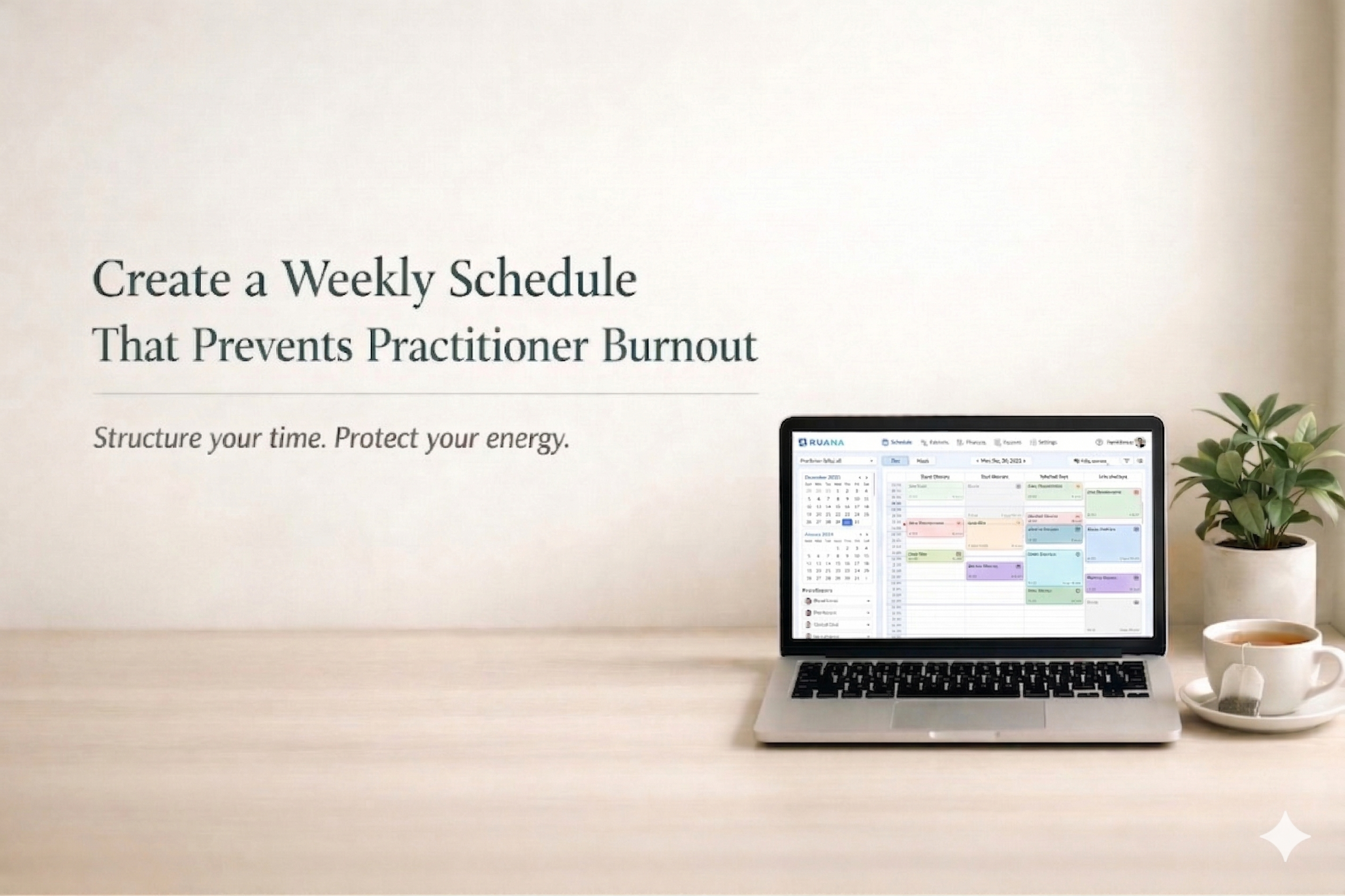
Practitioner burnout prevention starts with one surprisingly simple tool: your weekly schedule. For chiropractors, massage therapists, mental health therapists, and more, burnout is not a personal failure – it is often a structural one. When your calendar has no boundaries, no breathing room, and no clear end point, exhaustion follows. However, a well-designed weekly schedule can change everything.
This guide walks you through exactly how to build a week that sustains your energy, protects patient care quality, and keeps your practice financially healthy – without running yourself into the ground.
Table of Contents
- Why Practitioners Burn Out
- Warning Signs Your Schedule Is Burning You Out
- How to Design Your Ideal Practice Week
- Block Your Admin Time — Treat It Like a Patient Appointment
- The Power of Buffer Time Between Appointments
- Reduce No-Shows to Protect Your Energy
- Protect Your Documentation Time
- Build Recovery Into Your Week
- Scheduling Tips by Practitioner Type
- How the Right Software Makes This Easier
- FAQ
Why Practitioners Burn Out – And Why It’s Often a Schedule Problem
Burnout in health and wellness practice is widely documented. Studies from occupational health research consistently show that practitioners in client-facing roles face higher rates of emotional exhaustion than the general workforce. The causes, however, are rarely mysterious. In most cases, they trace back to a few structural patterns in how the week is organized.
The most common culprits include:
- Back-to-back appointments with no transition time – leaving no room to decompress between patients or reset mentally before the next session
- Admin work bleeding into personal time – documentation, invoicing, and scheduling handled after hours because there is no dedicated time during the day
- Unpredictable no-shows and last-minute cancellations – which create both financial stress and chaotic rhythm in the day
- No protected days off – practitioners who book themselves seven days a week rarely sustain this for long
- Over-commitment without review – gradually accepting more patients than is sustainable, without ever reassessing capacity
The encouraging news is that these are all structural problems. Therefore, they have structural solutions. You do not need to see fewer patients to prevent burnout – you need to see them within a schedule that is designed to support you as well as them.
Warning Signs Your Schedule Is Burning You Out
Before redesigning your week, it helps to recognize the signals that your current schedule is not working. These are not signs of weakness — they are data points about structure.
Common warning signs include:
- You feel dread on Sunday evening thinking about Monday’s schedule
- You regularly skip lunch or eat at your desk between patients
- You are completing notes after 8pm several times per week
- You have not taken a full day off in more than two weeks
- Unexpected cancellations feel like a relief rather than an inconvenience
- You find it harder to be fully present with patients later in the day
- Your response to patient questions has become shorter and less considered
If several of these resonate, your schedule needs intervention – not willpower. The sections below give you a practical framework for rebuilding it.
How to Design Your Ideal Practice Week
Designing a sustainable practice week is not simply about fitting more breaks in. It requires intentional architecture. Think of your week as having three types of time, each serving a distinct purpose.
1. Clinical Time – When You Treat Patients
This is the core of your practice. However, it needs boundaries. Most experienced practitioners recommend treating no more than six to seven patient-facing hours per day if you plan to do this five days a week. Additionally, consider grouping similar session types together – for example, keeping longer intake appointments in the morning and shorter follow-ups in the afternoon – so your mental effort follows a predictable arc.
2. Admin Time – When You Run Your Business
Documentation, invoicing, reviewing intake forms, and responding to appointment requests all fall here. Furthermore, this time must be scheduled explicitly – not just left to “whenever it fits.” One or two 45-minute admin blocks per day, built into your calendar like appointments, will prevent these tasks from consuming your evenings.
3. Recovery Time – When You Restore Yourself
This includes lunch, short walks, mental decompression between sessions, and full days off. Recovery time is not wasted time. In contrast, it is the investment that makes clinical time possible. Practitioners who protect recovery time consistently report higher patient satisfaction, better clinical recall, and longer career sustainability.
Example: A massage therapist sees 6 clients per day, back-to-back, five days a week. After three months, she begins dreading Mondays, and her session notes become minimal. After restructuring to 5 clients per day with one 45-minute admin block and a proper lunch hour, her energy stabilizes – and her documentation quality improves noticeably. The sixth session was costing more than it earned.
Block Your Admin Time – Treat It Like a Patient Appointment
One of the most powerful shifts you can make in practitioner burnout prevention is treating admin time as non-negotiable. Most practitioners are excellent at protecting patient appointment slots. They would not double-book a patient or cancel without reason. However, they routinely sacrifice their own admin time – pushing it to evenings, weekends, or skipping it entirely.
The result is predictable: documentation piles up, invoicing gets delayed, and business decisions are made with incomplete information.
Here is a practical daily approach:
- Morning micro-block (15 minutes): Review today’s appointments, confirm any outstanding intake forms, scan the day’s schedule for gaps
- Mid-day admin block (45 minutes): Complete notes from the morning, process invoices, review any appointment requests
- End-of-day close (20 minutes): Finalize documentation, check tomorrow’s calendar, log any outstanding items
When these blocks are in your calendar as firm appointments, you stop “finding time” and start having time. As a result, the quality of your documentation improves, your invoicing becomes consistent, and you leave the clinic at a reasonable hour.
The Power of Buffer Time Between Appointments
Buffer time is one of the most undervalued tools in practitioner schedule design. A 10 to 15-minute gap between appointments does several important things:
- Gives you time to complete brief notes while the session is fresh
- Allows for mental transition – especially important in mental health and counselling settings
- Accommodates sessions that run slightly over without cascading delays
- Creates a moment of genuine rest between physically demanding treatments like chiropractic adjustments or deep tissue massage
Many practitioners resist buffer time because it feels like lost revenue. However, consider the true cost of running behind all day – the apologetic body language with late-running patients, the rushed documentation, the exhaustion that accumulates by mid-afternoon. Buffer time is a clinical investment.
A practical approach is to set your appointment durations slightly shorter than the actual session. For example, if a massage session typically runs 60 minutes, schedule it at 50 minutes and build the 10-minute buffer into your booking settings. This way, the buffer is automatic rather than aspirational.
For practitioners offering multiple appointment types – consultations, follow-ups, assessments – practice management software that supports customizable appointment durations can make this process much smoother.
Reduce No-Shows to Protect Your Energy (and Revenue)
Few things are more disruptive to a well-structured day than a no-show. Beyond the financial impact, an unexpected gap in your schedule – especially after you have mentally prepared for that patient – creates a particular kind of frustration. Over time, high no-show rates erode confidence in your schedule structure and make it tempting to over-book as a hedge.
The most effective practitioner burnout prevention strategy for no-shows is systematic reminders. Research consistently shows that automated appointment reminders can reduce no-show rates substantially. Both SMS and email reminders play an important role.
- SMS reminders have an industry-estimated open rate of around 98%, meaning patients are very likely to see them. A text reminder sent the day before gives patients time to cancel and reschedule if needed – which is far better than a silent no-show.
- Email reminders provide a reliable, automatic confirmation that captures the appointment date and time. Many patients appreciate having something in their inbox to refer back to.
Using both together creates a layered approach that maximizes reach across different patient preferences. The goal is not to burden patients with messages – it is simply to make it easy for them to remember, confirm, or reschedule. This protects your day and keeps your schedule running as designed.
Protect Your Documentation Time
For many practitioners, documentation is the hidden driver of burnout. Patient notes, treatment plans, and progress records are clinically and legally important – but they are also time-consuming. When documentation spills into evenings and weekends, it erodes the recovery time your week depends on.
There are several strategies that consistently work.
A note completed within five minutes of a session is faster, more accurate, and less stressful than one completed three hours later. Building this habit requires protecting the buffer time discussed earlier – but once established, it transforms documentation from a burden into a routine.
Use Templates Strategically
A well-designed SOAP note template for your most common appointment types can reduce documentation time dramatically. If you treat similar presentations repeatedly – lumbar complaints in a chiropractic setting, anxiety management in a counselling practice – a solid template means you are completing and refining, not starting from scratch each time.
Leverage Advanced Documentation Features When Available
Some practice management platforms now offer advanced note functionality that supports faster clinical documentation. For practitioners with a high volume of similar sessions, these tools can reduce per-session documentation time significantly.
Build Recovery Into Your Week – Not Just Your Vacations
Many practitioners plan recovery at the macro level – a holiday in the summer, perhaps a long weekend in the autumn. However, sustainable practice requires recovery at the weekly and daily level too.
Here are principles that experienced practitioners across disciplines return to consistently.
The One Protected Day Rule
Keep at least one full day per week completely free of patient appointments. This does not mean you cannot do anything practice-related on that day – administrative tasks, planning, or continuing education may fit there. However, no clinical work. This break allows your nervous system to reset in a way that short rests cannot.
The Hard Stop Rule
Decide on a time at which you will stop seeing patients each day, and protect it. Whether that is 5pm, 6pm, or 7pm depends on your practice model – but it must be consistent. Patients booked after that time will encounter a closed schedule, not a practitioner who is progressively depleting their reserves.
The Lunch Rule
A genuine lunch break – away from your desk, away from your phone – is not a luxury. It is a physiological necessity for sustained afternoon performance. Practitioners who eat at their desks between patients report significantly higher end-of-day fatigue than those who take even a 30-minute genuine break.
Review Your Capacity Monthly
Your capacity is not fixed. It changes with seasons, with personal circumstances, and with the complexity of your patient caseload. A monthly 30-minute review of your schedule – looking at total clinical hours, admin hours, and recovery time – gives you data to make adjustments before burnout symptoms appear.
Scheduling Tips by Practitioner Type
While the principles above apply broadly, different disciplines have specific scheduling considerations worth addressing.
Chiropractors
Chiropractic adjustments are physically demanding. Back-to-back manual therapy across a full day accumulates physical strain that is easy to underestimate. Many chiropractors find that limiting consecutive adjustment sessions to four or five – with a genuine break before continuing – prevents both physical injury and mental fatigue. Additionally, grouping new patient consultations (which require more time and documentation) on specific days rather than mixing them throughout the week creates a more predictable workload.
For chiropractic-specific practice management tools and scheduling support, see chiropractic practice management software.
Massage Therapists
Physical fatigue accumulates quickly in massage practice. The professional consensus is that six to seven one-hour sessions per day is a reasonable ceiling for most practitioners – and fewer if sessions are deep tissue or sports massage. Furthermore, 10-minute recovery gaps between sessions allow for postural reset, brief note completion, and hand and forearm rest. Many massage therapists also build one half-day into their week with no hands-on work, reserving it for admin, continuing education, or genuine rest.
Explore scheduling tools built for massage practices at massage therapy software.
Mental Health Practitioners
Emotional labour is the primary burnout driver in counselling, psychotherapy, and psychiatric nursing. Vicarious trauma, secondary traumatic stress, and compassion fatigue are well-documented risks. Effective scheduling strategies include limiting high-intensity cases (trauma processing, crisis management) to no more than two or three per day, with lighter sessions scheduled between them. Additionally, a 15-minute break after particularly intense sessions – not immediately booking the next patient – creates essential emotional buffer.
Mental health practitioners also benefit from scheduling clinical supervision, peer consultation, or personal therapy as calendar commitments rather than aspirations – these are professional maintenance, not extras.
See practice management tools designed for mental health at mental health practice management software.
Dietitians, Nutritionists, and Occupational Therapists
These practitioners often combine clinic sessions with report writing, case coordination, and non-clinical professional obligations. The key scheduling challenge is preventing clinical hours from expanding to fill time that should be dedicated to documentation and coordination. Blocking non-negotiable admin time at the start of each session day – before the first patient – ensures it happens rather than being perpetually deferred.
Acupuncturists and Osteopaths
Combination disciplines that involve both physical treatment and extended patient history-taking benefit from structuring their calendars so that initial consultations are grouped on specific days or morning slots. This way, the more cognitively demanding intake work is completed when mental energy is highest, and follow-up sessions — which require less documentation and mental preparation – fill later slots.
How the Right Software Makes Burnout Prevention Easier
Managing your weekly schedule sustainably becomes much easier when your practice runs on the right platform. Ruana is built specifically for chiropractors, massage therapists, mental health therapists, and more.
Here is what Ruana helps you protect:
- Your schedule: 24/7 online booking with customizable appointment types, so patients book into the slots you have designed – not wherever there is a gap
- Your time: Automatic email and SMS reminders reduce no-shows so your carefully built schedule stays intact
- Your documentation: SOAP Notes, and Advanced SOAP Notes with automatic buttons on the Professional Plan – so notes are completed quickly and accurately
- Your finances: Digital invoicing and financial analytics give you a clear picture of practice revenue without hours of manual reconciliation
- Your data: Hosted on secure AWS servers with enterprise-grade encryption and security measures built to support GDPR and HIPAA requirements
Plans start at $45.99/month for solo practitioners. The Professional Plan is $65.99/month, with additional practitioners available at $19.99/month each.
Try Ruana free for 14 days — no credit card required →
FAQ: Weekly Scheduling and Practitioner Burnout Prevention
How many patients per day is sustainable for a solo practitioner?
This varies by discipline and session length, but most occupational health research suggests 6–8 sessions per day as a reasonable ceiling for full-time practitioners in hands-on roles. Mental health practitioners often report 5–6 sessions as more sustainable, given the emotional demands. The key is to assess your own energy levels at the end of each day over a two-week period and adjust accordingly.
How do I stop patients from booking outside my preferred hours?
The most effective approach is to configure your booking availability to only show the time slots you want patients to fill. Rather than leaving your entire calendar open, set specific windows when online booking is available. This removes the social pressure of saying no individually and creates a consistent, professional schedule by default.
Is it unprofessional to have a hard stop time for appointments?
Not at all. In fact, most patients respect practitioners who have defined working hours – it conveys professionalism and reliability. A practitioner who is consistently available until 9pm out of a sense of obligation is also more likely to show fatigue and reduced quality of care. Setting clear hours is a quality-of-care decision, not just a lifestyle one.
What is the best way to reduce no-shows without confrontational follow-up?
Automated appointment reminders – both SMS and email – are the most effective non-confrontational approach. An SMS reminder sent 24 to 48 hours before an appointment gives patients sufficient time to cancel and reschedule if needed, without requiring any manual effort from your team. Combined with a clear cancellation policy communicated at booking, this approach can reduce no-show rates substantially.
How do I know if my current schedule is contributing to burnout?
Look for these signals: regularly completing documentation after 8pm, skipping lunch more than twice per week, finding unexpected cancellations feel like relief rather than frustration, and difficulty being fully present with afternoon patients. If two or more of these apply consistently, your schedule needs structural adjustment, not just willpower.
Does practice management software really make a difference to burnout?
It can – particularly around documentation time and administrative burden. Practitioners who move from paper-based or fragmented digital systems to an integrated platform typically report significant reductions in end-of-day admin time. When notes, booking, reminders, and invoicing are in one place, the coordination cost drops. That recovered time can go directly back into recovery and sustainable scheduling.
What features should I look for in practice management software to support work-life balance?
Look for customizable booking availability (so you control when patients can schedule), automated SMS and email reminders (to reduce no-shows passively), clinical documentation templates (to minimize post-session admin), and financial reporting (so you have a clear picture of practice health without manual work). A platform like Ruana brings all of these together for health and wellness practitioners, with a 14-day free trial to explore without commitment.
Managing your schedule sustainably is one of the most important professional skills a practitioner can develop. When your week is designed well, you protect your patients, your practice, and yourself. The right tools make that design easier to build – and easier to maintain.
Related reading: → Chiropractic Practice Management Software → Massage Therapy Software → Mental Health Practice Management Software → Ruana Plans & Pricing → Ruana Practice Management