Types of Progress Notes: SOAP, DAP, BIRP, and DART Explained for Practitioners
29.04.26
Still writing progress notes at the end of the day, trying to remember what actually happened in each session?
The format you choose shapes how fast you document, how consistent your notes stay, and how easily you can track patient progress over time.
As your fellow practitioners, we know the real struggle behind structuring your findings fast enough without breaking the workflow. The types of progress notes you choose affect how long notes take, how consistent they are, and how useful they become over time.
TL;DR
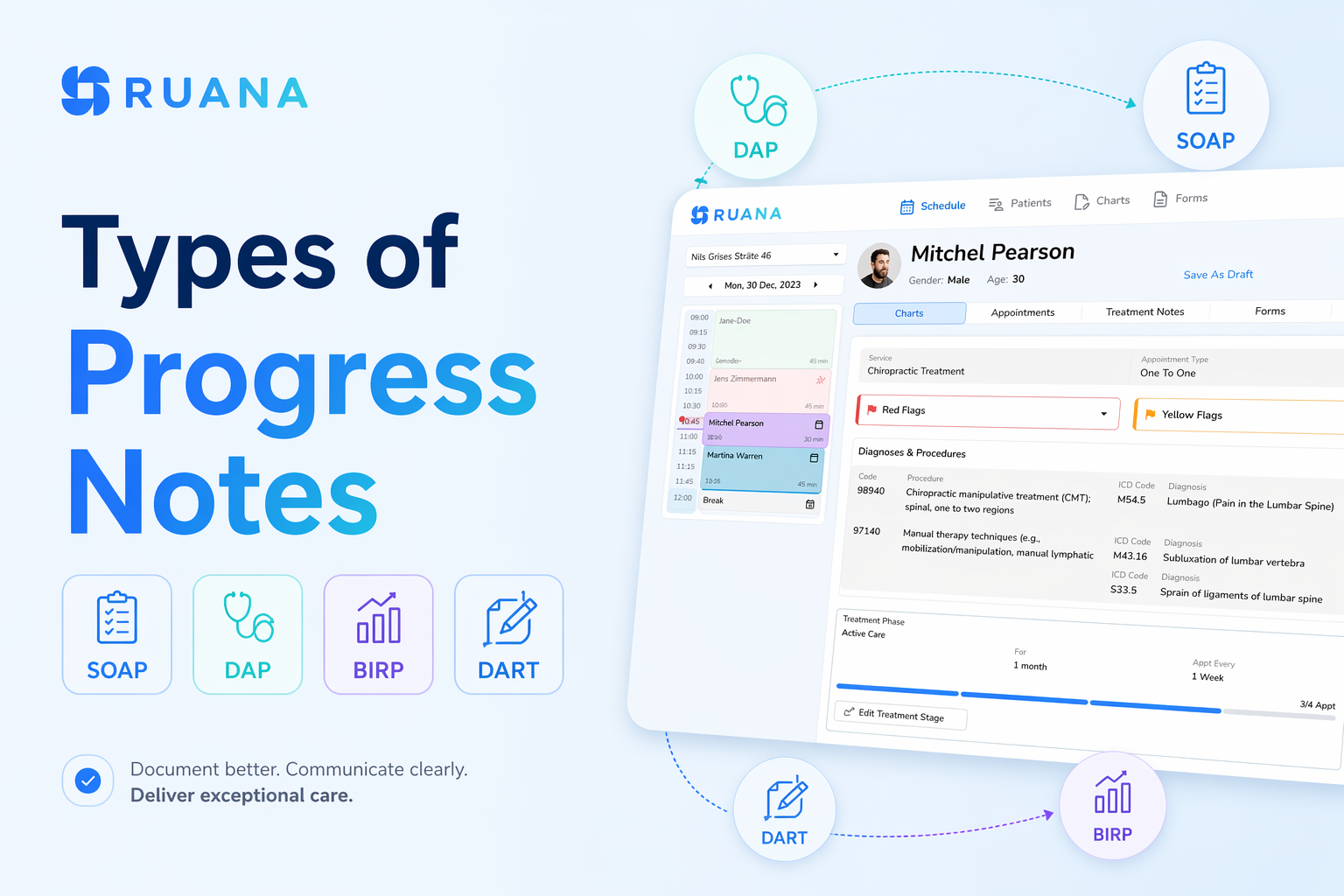
There are four main types of progress notes: SOAP, DAP, BIRP, and DART
Each format trades off speed vs structure vs level of detail
SOAP notes are the most widely used because they balance clarity and consistency
Simpler formats (like DAP or DART) are faster but less structured
The best choice depends on your patient volume, session style, and documentation needs
In real-world clinics, most practitioners move toward structured systems that make notes faster, not just shorter
Progress notes are the record of what happened during a patient session. In simple terms, the progress notes medical definition refers to documenting patient status, treatment, and next steps after each visit.
For chiropractors, massage therapists, and wellness practitioners, this is not optional documentation, but a part of how care is delivered, tracked, and continued over time.
What Progress Notes Usually Include
Most notes follow a structured flow, even if the format differs (for example, SOAP progress notes or narrative formats like DAP):
The patient’s current complaint or update
Clinical observations or treatment performed
Your assessment of progress or response
The plan for the next session
This structure is what allows practitioners to quickly understand what happened without rereading long text blocks.
Why They Matter in Daily Practice
Learning how to write progress notes efficiently changes how the entire day runs. Notes are no longer something you postpone, but something you complete between sessions without losing focus.
Well-written notes help you:
Stay consistent across repeat visits
Reduce time spent recalling past sessions
Support billing and documentation requirements
Keep patient care organized as volume grows
In practice, the difference is simple. Structured notes support your workflow, while the unstructured ones slow it down.
The Main Types of Progress Notes (Side-by-Side Overview)
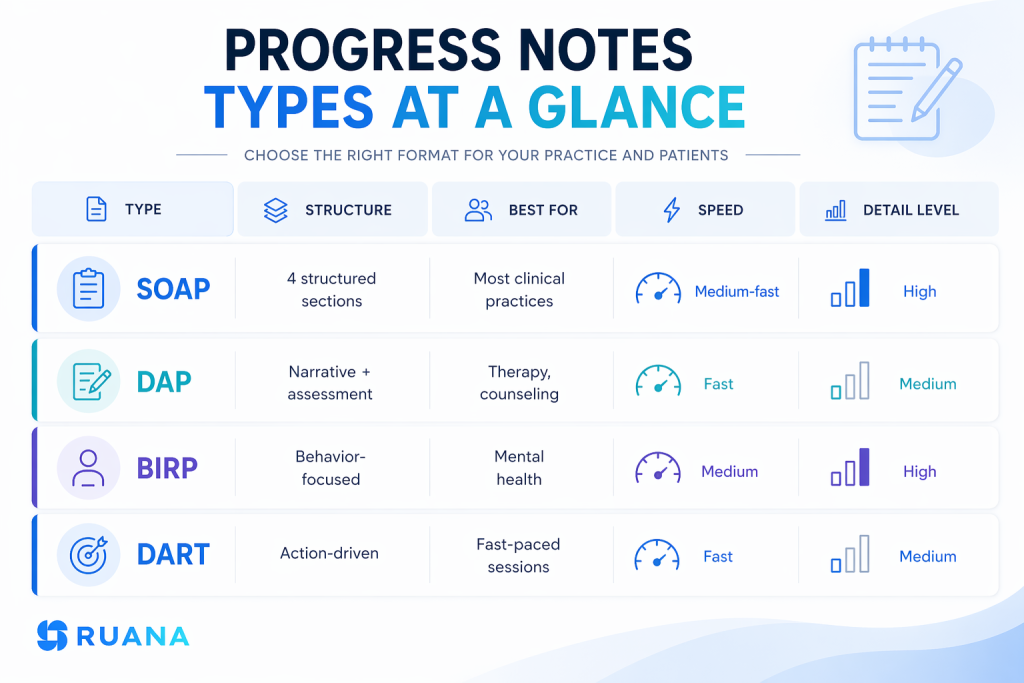
Before getting into each format in detail, let’s see how the main types compare at a glance.
Most practitioners choose between four common formats: SOAP, DAP, BIRP, and DART. Each one follows a different structure and is designed for a slightly different workflow.
At a high level, the difference comes down to:
How structured is the format?
How quickly can notes be completed?
How much clinical detail is captured?
What type of practice does it fit best?
This is why you’ll see both highly structured formats like SOAP progress notes and more flexible options like DAP notes used in day-to-day practice.
If you’re deciding how to write patient progress notes, this table gives you a starting point.
💡A quick hint
SOAP offers the most consistency and is widely used across clinical settings. DAP and DART prioritize speed and simplicity. BIRP focuses more on behavior and intervention tracking.
SOAP Notes (Most Widely Used Standard)
Among all formats, SOAP notes remain the most widely used. When people ask “What is a SOAP note?”, they are usually referring to a structured way of documenting sessions that balances clarity with consistency.
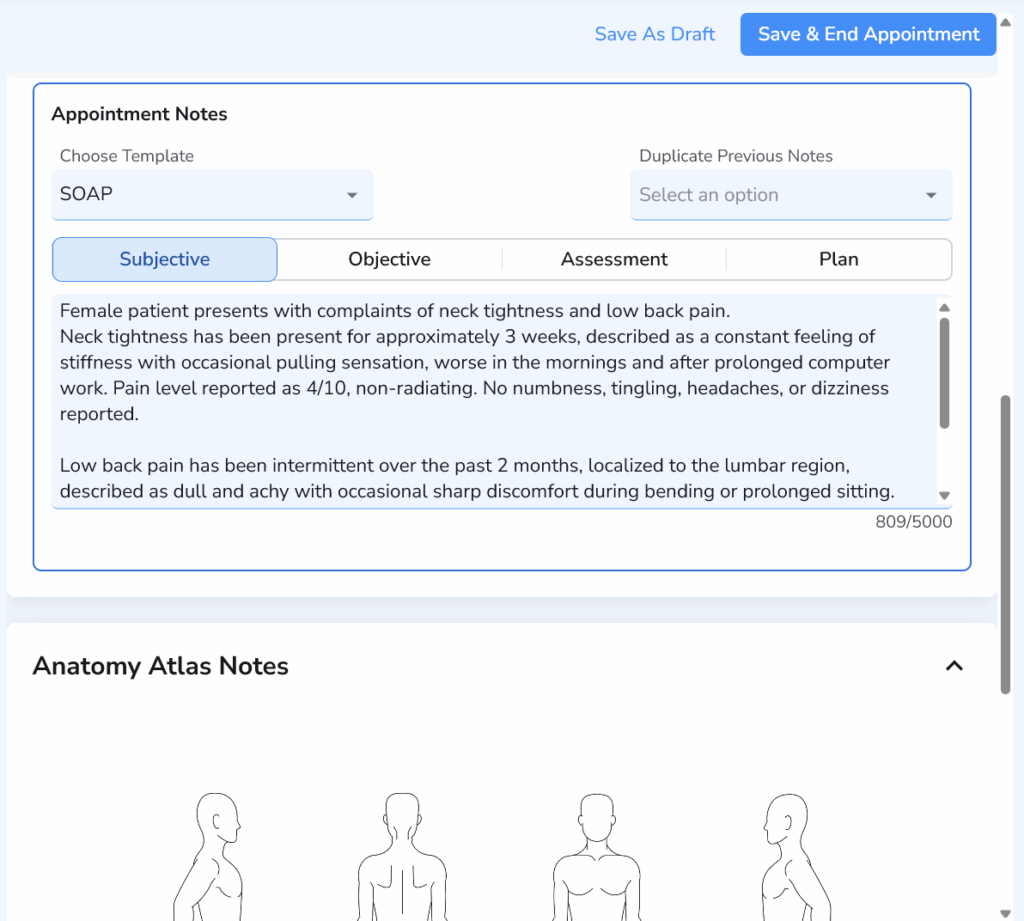
Document patient visits using traditional SOAP notes with a clean, distraction-free interface.
These notes are built around four sections:
Subjective: what the patient reports
Objective: what you observe or measure
Assessment: your clinical interpretation
Plan: what happens next
This structure is what makes SOAP progress notes reliable across repeat visits. Each session builds on the previous one without losing context.
How Structured Systems Change the Workflow
The biggest shift happens when SOAP is not treated as free-text writing, but as a guided process.
Instead of starting from a blank page:
Each note is connected to the patient’s full record, including past visits, intake forms, and contraindications
You start from a template that already matches the case
You adjust details instead of rebuilding the entire note
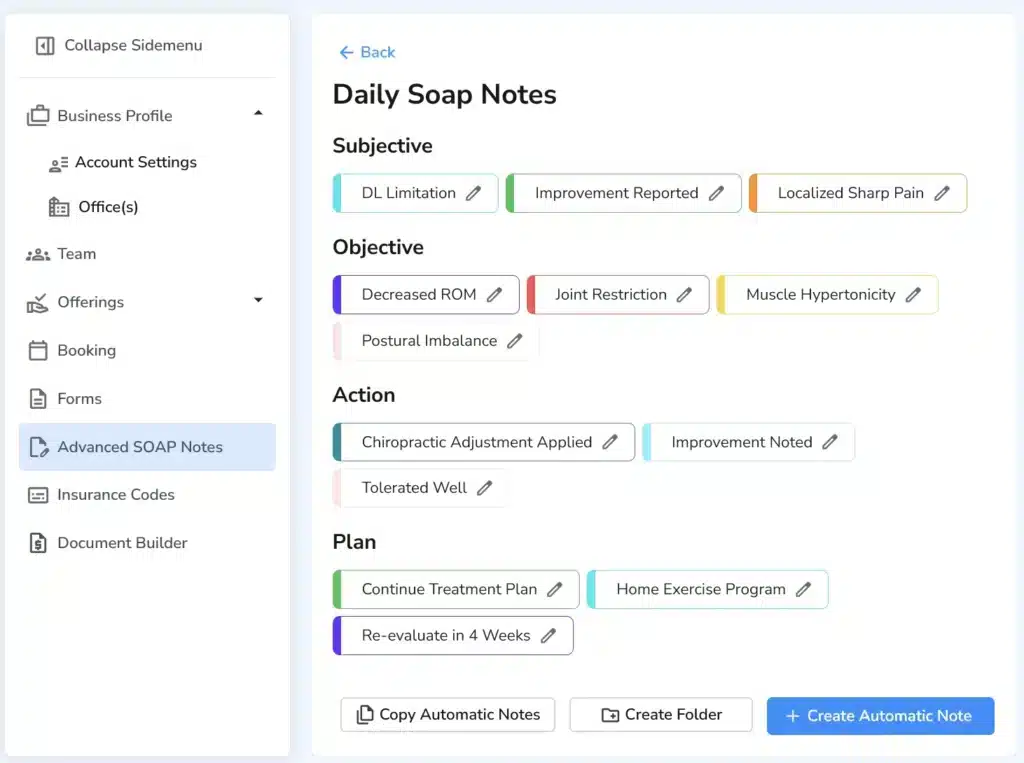
Frequently used phrases are inserted with preset inputs instead of retyping
Clinical documentation at the speed of care: Using smart, color-coded tags to build comprehensive SOAP notes in Ruana.
This approach changes how notes are completed. The structure stays the same, but the time required drops significantly.
In practice, this is why many clinics stick with SOAP long-term. Not because it is the simplest format, but because it becomes efficient once the workflow around it is optimized.
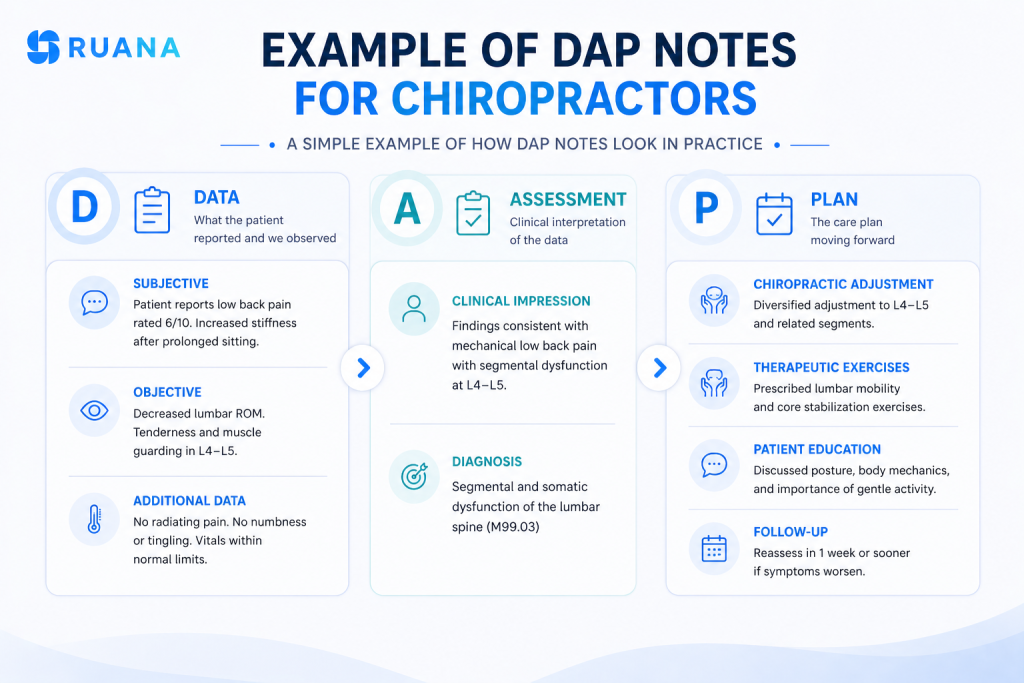
DAP notes are a more flexible alternative to SOAP. When practitioners ask “What are DAP notes?”, the answer is simple: a streamlined format that combines observation and interpretation into a shorter narrative.
DAP stands for:
Data: what happened during the session (patient input + observations)
Assessment: your clinical interpretation
Plan: next steps
Unlike SOAP, DAP does not strictly separate subjective and objective details. Everything is captured in a more fluid, narrative style.
DAP notes are commonly used when speed matters and the session does not require heavy structural detail. They suit shorter, less complex visits where the practitioner needs to capture the main information clearly without breaking the flow of the day.
They also work well for practitioners who prefer a more natural writing style. Instead of separating every detail into strict categories, DAP allows the note to read more like a concise clinical summary. This can be useful in settings where documentation needs to stay clear, but is not reviewed against highly rigid requirements.
BIRP Notes (Behavior-Focused Documentation)
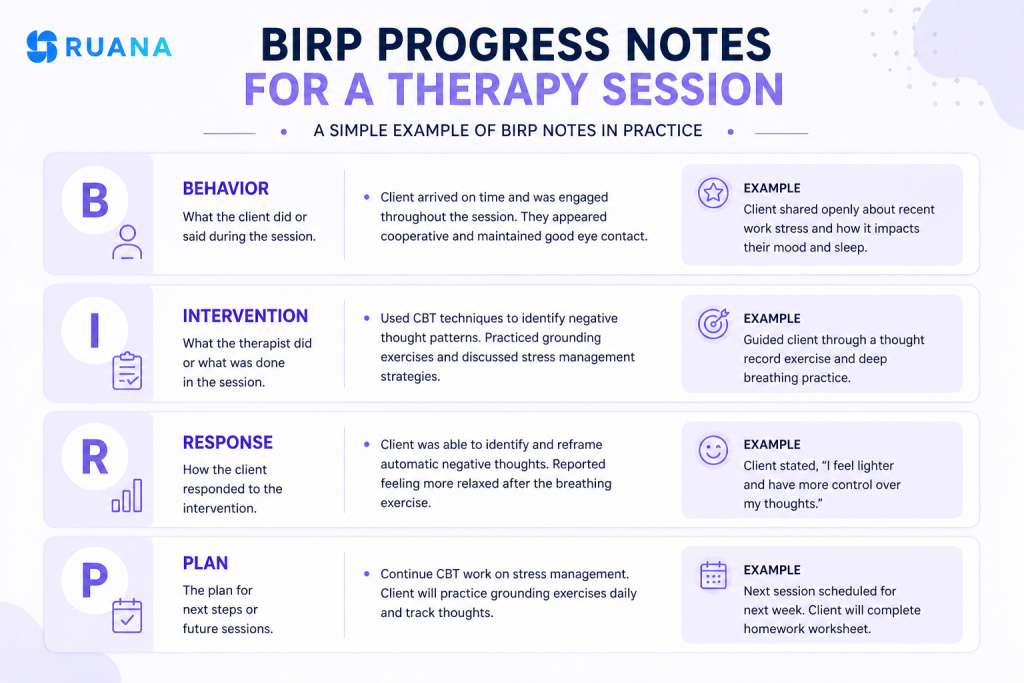
BIRP notes are designed for tracking behavior, intervention, and response. If you are wondering “What does BIRP notes stand for?”, it refers to:
Behavior: what the patient is doing or reporting
Intervention: what the practitioner does during the session
Response: how the patient reacts
Plan: next steps
This structure makes BIRP especially useful in mental health and behavioral settings.
The format focuses less on general observation and more on interaction. A typical BIRP notes example will clearly show what was done and how the patient responded, making it easier to track changes over time.
Strengths and Limitations
BIRP provides clarity around cause and effect. You can quickly see what intervention led to what response.
At the same time, it may feel too detailed for physical treatment workflows like chiropractic or massage therapy. For many practitioners in those fields, the format adds complexity without a clear benefit.
When using a BIRP notes template, consistency improves. Without one, notes can become uneven, especially across different practitioners.
DART Notes (Fast, Action-Oriented Format)
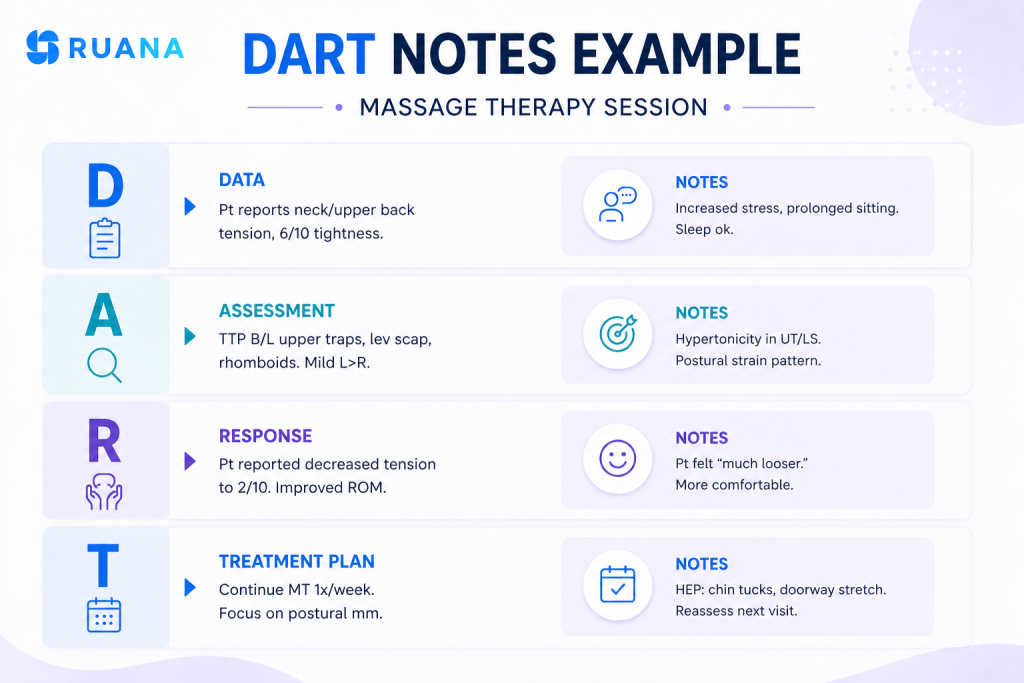
DART notes are built for speed. They prioritize quick documentation while still capturing the core elements of a session, which makes them relevant when thinking about how to write patient progress notes efficiently.
The term stands for:
Data: key information from the session
Assessment: your interpretation of the patient’s condition or progress
Response: how the patient reacted
Treatment: what was provided or performed
DART is typically used in fast-moving environments where documentation cannot interrupt the flow of the day. It works well for high-volume practices and back-to-back sessions where the note needs to stay focused, clear, and quick to complete.
What to Expect from This Format
DART notes are efficient, but they are not designed for heavy narrative detail. They capture the core session flow clearly, but may offer less long-term structure than other types of progress notes.
For practitioners focused on how to write progress notes quickly, this format can be practical. Still, for ongoing care plans and repeat visits, SOAP progress notes usually give a clearer clinical picture over time.
3 Common Mistakes When Using Progress Notes
Different types of progress notes may fail due to unclear format, rushed workflow, or delayed documentation that relies too much on memory instead of real-time input.
1. Writing Too Much Without a Clear Structure
Don’t over-document without a clear format.
Practitioners who try to include every detail often end up with long and hard-to-scan text notes. This slows down both writing and reviewing, especially across multiple sessions. Instead of improving clarity, it often hides the most important clinical information.
2. Inconsistency Between Sessions
Choose one type and stick to it.
Notes lose value when the format changes from one visit to the next. If one session follows SOAP notes and the next is written as a loose narrative, it becomes difficult to track progress over time.
Inconsistent patterns can quickly create gaps in understanding, especially when reviewing patient history quickly. It also makes collaboration harder in multi-practitioner settings. A consistent format is what turns notes into reliable clinical records.
3. Delaying Notes Until the End of the Day
Don’t wait until the end of the day to complete notes.
The problem here is that details start to fade, and notes become less accurate or more generic. It also increases mental load, turning documentation into a backlog instead of part of the workflow. Notes are most useful when completed immediately after each session, while the information is still fresh.
SOAP vs DAP vs BIRP vs DART: Which One Should You Use?
Now you know that each format solves a slightly different problem. The right choice depends on how your sessions run, how much structure you need, and how fast you need to document.
Type
Best Use Case
SOAP
Ongoing care, repeat visits, structured clinical tracking
DAP
Faster documentation, narrative-style sessions
BIRP
Behavioral tracking, intervention, and response-focused care
There is no single “best” format. Most practitioners start with simpler notes and move toward more structured systems as patient volume and complexity increase.
How to write various types of progress notes effectively?
Start with a consistent structure and keep entries focused on what matters: patient input, your observations, your clinical interpretation, and next steps. Avoid long narratives. The goal is clarity and speed, not volume. Well-structured notes make it easier to review past sessions and maintain continuity of care.
What is a SOAP note?
A SOAP note is a structured format that organizes documentation into four parts: Subjective, Objective, Assessment, and Plan. It is widely used because it separates patient-reported information from clinical findings and decisions, making notes easier to follow over time.
What are DAP notes?
DAP notes (Data, Assessment, and Plan) are a simplified format that combines observations into a short narrative, followed by assessment and plan. They are often used when practitioners need to document sessions quickly while keeping the notes readable and concise.
What does BIRP stand for in clinical notes?
BIRP stands for Behavior, Intervention, Response, and Plan. It is commonly used in behavioral and mental health settings to track what was done during a session and how the patient responded to it.
What are DART notes?
DART notes follow a structure of Data, Assessment, Response, and Treatment. They are designed for fast documentation in high-volume settings, focusing on capturing key actions and outcomes without extensive detail.
About the Authors
★★★★★4.9 · 329 Reviews
Rouzbeh NoroozyChiropractor & Co-Founder · Palmer West · UC Berkeley · 14 Years of ExperienceRouzbeh Noroozy is a chiropractor with 14 years of clinical experience and co-founder of Ruana practice management software. He completed his undergraduate studies at the University of California, Berkeley and graduated from the renowned Palmer College of Chiropractic West in California. As a practicing clinician and clinic owner, he understands firsthand the administrative challenges practices face — and which digital tools genuinely help streamline day-to-day operations.
Anastasiia NoroozyMedical Graduate & Co-Founder · 8 Years of ExperienceAnastasiia Noroozy is a medical graduate and co-founder of Ruana with 8 years of experience working directly with patients at the clinic in Cologne. She manages the day-to-day flow of the practice and knows every patient-facing process from the inside out — from intake and scheduling to follow-up care. Her hands-on clinical and operational experience directly shapes how Ruana is built to work in the real world.
Our team will review your inquiry and get back to you as soon as possible.
Privacy Settings
To provide the best experiences, we use technologies like cookies to store and/or access device information. Consenting to these technologies will allow us to process data such as browsing behavior or unique IDs on this site. Not consenting or withdrawing consent, may adversely affect certain features and functions.
Functional
Always active
The technical storage or access is strictly necessary for the legitimate purpose of enabling the use of a specific service explicitly requested by the subscriber or user, or for the sole purpose of carrying out the transmission of a communication over an electronic communications network.
Preferences
The technical storage or access is necessary for the legitimate purpose of storing preferences that are not requested by the subscriber or user.
Analytics
The technical storage or access that is used exclusively for statistical purposes.The technical storage or access that is used exclusively for anonymous statistical purposes. Without a subpoena, voluntary compliance on the part of your Internet Service Provider, or additional records from a third party, information stored or retrieved for this purpose alone cannot usually be used to identify you.
Marketing
The technical storage or access is required to create user profiles to send advertising, or to track the user on a website or across several websites for similar marketing purposes.
To provide the best experience for our practitioners, we use cookies to personalize content, analyze our traffic, and support our marketing efforts. By clicking 'Accept', you consent to our use of these technologies. You can manage your preferences at any time.
Functional
Always active
The technical storage or access is strictly necessary for the legitimate purpose of enabling the use of a specific service explicitly requested by the subscriber or user, or for the sole purpose of carrying out the transmission of a communication over an electronic communications network.
Preferences
The technical storage or access is necessary for the legitimate purpose of storing preferences that are not requested by the subscriber or user.
Analytics
The technical storage or access that is used exclusively for statistical purposes.The technical storage or access that is used exclusively for anonymous statistical purposes. Without a subpoena, voluntary compliance on the part of your Internet Service Provider, or additional records from a third party, information stored or retrieved for this purpose alone cannot usually be used to identify you.
Marketing
The technical storage or access is required to create user profiles to send advertising, or to track the user on a website or across several websites for similar marketing purposes.