

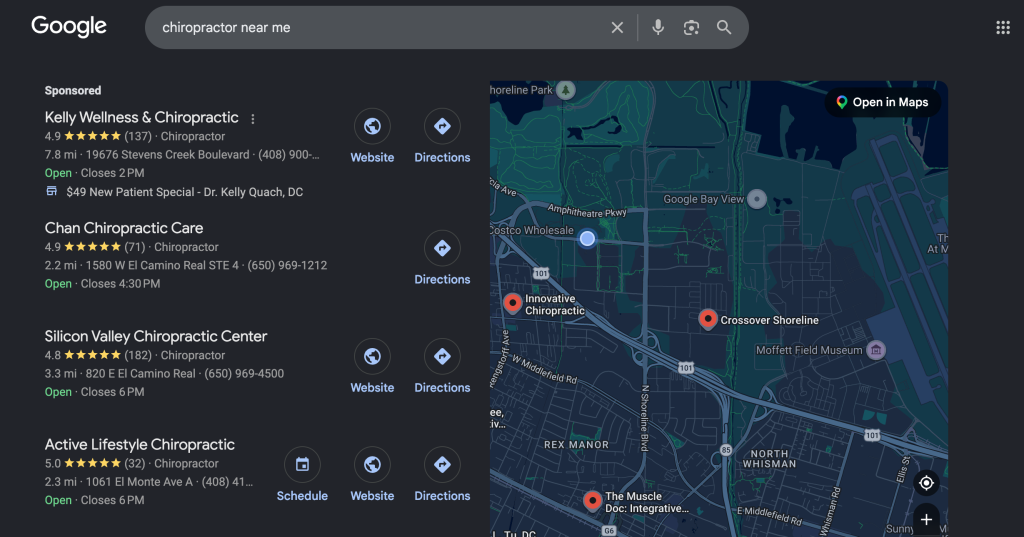
When someone needs a chiropractor, they usually do not start by searching for a specific practice. They search Google for terms like “chiropractor near me,” “chiropractor for back pain,” or “chiropractor in [city].” The practices that appear at that moment have a much better chance of earning the click, the call, and eventually the appointment.
That is what SEO for chiropractors is really about: making sure your practice can be found when potential patients are actively looking for the services you provide. It includes your Google Business Profile, website pages, local rankings, patient reviews, content, backlinks, and the technical health of your website.
The difficult part is not finding SEO tactics. There are dozens of them. The difficult part is knowing what actually deserves your attention first in your chiropractic marketing workflow.
We’ve built this guide to take a more practical approach. We will also break down how to do SEO for a chiropractic practice step by step, starting with the local search foundation and moving through keywords, service pages, reviews, content, backlinks, and measurement.
Table of Contents
- What Is Chiropractic SEO?
- Why Local SEO Matters So Much for Chiropractors
- How to Do SEO for Chiropractors: 8 Steps
- Don’t Forget the Technical Side of SEO for Chiropractors
- Chiropractic SEO Requires Extra Attention to Trust
- Turn SEO Traffic Into Chiropractic Appointments
- Bringing It Together

What Is Chiropractic SEO?
In simple terms, chiropractic SEO is the process of improving your practice’s visibility in search results so people looking for chiropractic care in your area can find you more easily.
For most practices, this means appearing in two main places: Google’s local results, including the Map Pack, and the regular organic results below them.
Yet, different searches can call for different types of pages:
| What a Potential Patient Searches | Where Your Practice Can Appear |
|---|---|
| “chiropractor near me” | Google Map Pack and local results |
| “chiropractor in Austin” | Local results, homepage, or location page |
| “prenatal chiropractor Austin” | Relevant service page |
| “chiropractor for back pain” | Service or condition-focused page |
| “what happens at a chiropractic appointment?” | Educational blog content |
While it is hard to rank for every chiropractic-related search, your goal is to be visible for the rhe searches relevant to your services, location, and ideal patients. Then give those visitors a clear next step once they reach your website.
Why Local SEO Matters So Much for Chiropractors
For most chiropractic practices, SEO is fundamentally local. A patient in one city is unlikely to travel across the state for a routine chiropractic appointment, so Google needs to determine which nearby practices are the best match for each search.
That is why searches such as “chiropractor near me,” “chiropractor in Denver,” or “sports chiropractor near me” often trigger local results and the Google Map Pack before traditional organic listings.
According to Google’s official guidance, local rankings are primarily determined by three factors: relevance, distance, and prominence. Understanding these factors makes local SEO much easier to prioritize because some parts are within your control and others are not.
Relevance: How Well Does Your Practice Match the Search?
Relevance is Google’s assessment of how closely your practice matches what someone is looking for.
If a person searches for “prenatal chiropractor,” for example, Google needs enough information to understand whether your practice actually provides prenatal chiropractic services. A complete Google Business Profile and clear website content make that connection easier.
Google specifically recommends providing complete and detailed business information so it can better understand a business and match it with relevant searches.
For a chiropractic practice, that means keeping details such as your:
- practice category
- services
- address and service area
- phone number
- opening hours
- website
- business description
Accurate and up to date.
Your website supports that relevance as well. If an important service is only mentioned once in a long list, Google has less context than it would from a dedicated page explaining what the service involves, who it is for, and where your practice provides it.
Distance: How Close Is the Searcher to Your Practice?
Distance is the factor you have the least control over.
Google considers how far a potential result is from the person searching. If the user includes a location, such as “chiropractor in Scottsdale,” Google can use that location directly. If they do not specify one, Google uses available information about their location to estimate which businesses are nearby.
This has an important practical implication: SEO cannot make your practice genuinely local to every city around you.
Creating dozens of nearly identical pages for neighboring cities does not change where your clinic is physically located. A better strategy is to build strong visibility in the geographic areas you can realistically serve and create location pages only when there is a genuine business reason for them, such as operating a real second location.
For “near me” searches in particular, proximity will always play a role. The parts you can improve are how relevant and prominent your practice appears compared with other nearby options.
Prominence: How Established Does Your Practice Appear?
Prominence reflects how well-known and established a business appears.
Google says this can be influenced by information it finds about a business across the web, including links and reviews. It also states that having more reviews and positive ratings can help local rankings.
For chiropractors, prominence can therefore be strengthened through signals such as:
- genuine patient reviews
- links from reputable websites
- mentions from local organizations
- accurate business listings and directories
- a well-established website with useful chiropractic content
- consistent information about the practice across the web
Reviews deserve particular attention because they can influence both visibility and patient decision-making. Google allows businesses to request reviews through a direct link or QR code, but prohibits offering incentives in exchange for reviews.
💡The main takeaway is simple: you cannot move your practice closer to every person searching for a chiropractor. But you can make it much easier for Google to understand what your practice does and build stronger signals that it is a credible, established option in your local market.
That is where the rest of your SEO strategy for chiropractors should focus.
How to Do SEO for Chiropractors: 8 Steps
A strong SEO strategy doesn’t require doing everything at once.
Start with the places where patients already look for local care, make sure your website clearly explains your services, and then build authority over time with reviews, content, and relevant links.
Here’s a more practical order to follow.
1. Set Up and Optimize Your Google Business Profile
Your Google Business Profile (GBP) should be one of the first SEO priorities. It is what can help your practice appear in Google Maps and the local results shown for searches such as “chiropractor near me.”
Make sure the profile is verified and that the core information is complete and accurate:
- practice name, address, and phone number
- opening hours
- primary and relevant secondary categories
- chiropractic services you provide
- website and booking links
- business description
- current photos of the practice
2. Find the Chiropractic Keywords Patients Actually Search
Keyword research tells you how potential patients describe what they need. For chiropractors, it is useful to separate keywords by intent rather than treating them as one large list, because each type of search expects a different kind of page.
Four buckets cover almost everything a chiropractic practice should target.
- Location keywords describe where the patient wants care.
- Service keywords describe the treatment itself.
- Problem and condition keywords describe a symptom rather than a solution.
- Informational keywords describe curiosity or hesitation.
Here is how the buckets map to your site:
| Keyword type | Example search | Page that should rank |
|---|---|---|
| Location | chiropractor in Austin | Homepage or location page |
| Service | prenatal chiropractic care | Service page |
| Problem/condition | sciatica treatment near me | Condition page |
| Informational | is chiropractic safe in pregnancy | Blog article |
Sorting keywords this way turns research into an actual plan. Instead of a spreadsheet of 400 terms with no obvious next move, you get a short list of pages to build and a clear reason for each one to exist. It also stops two pages on your site from competing for the same search, which happens often when a practice writes several similar articles without deciding which page owns which term.
3. Build a Page for Each Important Chiropractic Service
Most chiropractic websites have a single “Services” page listing eight or ten treatments with a sentence or two each. It is tidy, and it ranks for almost nothing.
The problem is that one page cannot be the best result for several different searches. Someone looking for prenatal chiropractic care and someone looking for spinal decompression have different questions, different concerns, and different reasons to choose you. A page covering both at once answers neither in depth, and Google has little reason to prefer it over a competitor’s dedicated page.
Individual service pages give you room to explain what the treatment involves, who it helps, what a first visit looks like, how long results typically take, and what it costs. That depth is what earns the ranking, and it is also what convinces a hesitant patient to book.
💡You do not need 20+ service landings at launch. Start with the two or three services that bring in the most revenue, publish them properly, and add the rest over time.
4. Optimize Your Existing Pages Before Publishing More Content
Publishing new content is more appealing than fixing old content. It is also usually the wrong order.
Your website may already have pages that rank on the second or third page of results for terms worth having. Moving one of those from position 14 to position 6 often takes an afternoon of editing, while a brand-new article needs months to build any traction at all.
Work through the pages you already have and check:
- Title tags that state the service and the location, written for a person rather than a keyword slot
- Meta descriptions that give someone a reason to click instead of repeating the title
- One H1 per page, matching what the page is genuinely about
- Headings that follow a logical order, so the page can be scanned in ten seconds
- Content depth, particularly on thin service pages that never got past two paragraphs
- Image alt text and file sizes, since clinic photos are often uploaded straight from a phone at several megabytes
- Internal links pointing to related services, conditions, and your booking page
- A visible call to action above the fold and again at the end
5. Build a Consistent Patient Review Process
Google states that having more reviews and positive ratings can improve local rankings, and reviews influence which practice a patient picks even after they have found you.
The practices that accumulate reviews are typically the ones with a repeatable habit for asking.
What that habit usually looks like:
- Ask in person at the end of a good visit, when the patient has just said something positive
- Follow up with a short message containing a direct review link or a QR code at the front desk
- Give the task an owner, whether that is the front desk or the practitioner
- Reply to every review, including the critical ones, in a calm and professional voice
- Track the count and the average rating monthly so you can see whether the habit is holding
Google permits asking for reviews and supplying a direct link, but prohibits offering any incentive in exchange. Discounts, free adjustments, and prize draws all risk removal of the reviews and penalties on the profile. HIPAA also constrains how you respond publicly, so avoid confirming that a reviewer is a patient or referencing anything clinical. Acknowledge, apologise if warranted, and move the conversation offline.
💡Recommended Reading
6. Keep Your Practice Information Consistent Across the Web
Your practice name, address, and phone number appear in more places than you probably realise: Google Business Profile, Apple Maps, Bing Places, Yelp, Healthgrades, insurance directories, chiropractic associations, the local chamber of commerce, and any site that has ever listed you.
Inconsistencies creep in quietly. A practice moves and updates its website but not its Yelp listing. A phone number changes and three directories keep the old one. Someone writes “Suite 200” in one place and “Ste. 200” in another.
These conflicts make it harder for Google to confirm which details are correct, and they send patients to disconnected numbers or wrong addresses.
Fix it once, properly:
- Decide the exact format of your name, address, and phone number, down to punctuation
- List every site where the practice appears, using a search for your phone number to find forgotten ones
- Correct each listing to match the canonical version
- Recheck once or twice a year, and immediately after any move, rename, or number change
7. Publish Content That Supports Your Services
Blog content works when it answers the questions patients actually ask and then leads somewhere. It fails when it exists to hit a publishing quota.
The strongest topics come from your own consultation room. Whatever patients ask before agreeing to treatment is worth writing about, because those questions represent the hesitation standing between a search and a booking.
Every article should link to the service or condition page it relates to. Content that never points anywhere generates traffic and no appointments, which is a common and expensive mistake.
Depth beats frequency. Four thorough articles a quarter that genuinely answer a question will outperform two thin posts a month.
8. Earn Local and Relevant Backlinks
Google names links among the signals that contribute to prominence, which is one of the three local ranking factors.
For a chiropractic practice, the useful links are local and relevant rather than numerous. A link from the town’s running club matters more than a hundred from generic directories, and buying links is a straightforward way to damage the site.
Realistic sources:
- Local business associations and the chamber of commerce
- Sports clubs, gyms, yoga studios, and running groups you sponsor or treat
- Charity events, health fairs, and community sponsorships
- Local news coverage, including quotes given as a professional source
- Chiropractic associations and accreditation bodies
- Complementary practices such as physiotherapists, massage therapists, and podiatrists who refer to you
- University or college athletics programmes you work with
Most of these come from relationships that already exist. Sponsorship pages, partner listings, and event write-ups are frequently missing a link simply because nobody asked for one.
Don’t Forget the Technical Side of SEO for Chiropractors
Technical problems rarely win rankings on their own, but they can quietly cap everything else you do. Treat this as a checklist to run once and then review a few times a year.
| Check | What to look for |
|---|---|
| Mobile usability | Most chiropractic searches happen on a phone. Tap targets, readable text, and a phone number that dials on tap. |
| HTTPS | A valid certificate site-wide, with no mixed-content warnings. |
| Crawlability and indexing | No page you want ranked is blocked by robots.txt or a stray noindex tag. Confirm in Search Console. |
| XML sitemap | Current, listing only live canonical pages, submitted to Search Console. |
| Broken pages | No 404s in the navigation or internal links, with redirects in place for anything moved. |
| Duplicate content | Especially where location pages have been copied and lightly edited. Consolidate or rewrite. |
| Page speed and Core Web Vitals | Compress clinic photography, which is the usual culprit on practice websites. |
| Structured data | LocalBusiness markup with name, address, phone, hours, and URL. Use the most specific subtype available. |
Chiropractic SEO Requires Extra Attention to Trust
Chiropractic content sits close to health advice, and that changes the standard it is held to.
Google describes a set of signals it uses to assess “experience, expertise, authoritativeness, and trustworthiness, or what we call E-E-A-T,” and adds that “of these aspects, trust is most important.”

In practice, that means the details many practice websites skip are the ones carrying the most weight:
- Name the author. Attribute clinical content to the practitioner who wrote or reviewed it, not to “Admin” or the practice name alone.
- Show the credentials. Qualifications, licence, years in practice, and areas of focus, on a real bio page that other pages link to.
- Demonstrate first-hand experience. Describing what you actually see in your clinic is something a content mill cannot replicate, and experience is the first E in E-E-A-T for a reason.
- Cite properly. Reference research and professional bodies where you make clinical claims.
- Date your content. Show when a page was published and when it was last reviewed.
- Stay within your scope. Avoid guaranteed outcomes, cure claims, and anything your regulator would object to. Overclaiming damages trust with patients and regulators alike.
- Make the practice easy to verify. A real address, a working phone number, named practitioners, and clear policies all support trust.
Turn SEO Traffic Into Chiropractic Appointments
SEO can bring prospective patients to your website. Yet, your booking experience determines what happens next.
That gap is where most chiropractic SEO effort is lost. A patient searching at nine in the evening finds your page, reads it, decides you look right, and then meets a phone number and opening hours that start at eight the next morning. Some will call. Many will go back to the results and book with whoever let them do it immediately.
Ruana is practice management software built for chiropractors, massage therapists, and mental health practitioners, and it closes that gap:
- Online booking, 24/7, with no account required, so the visitor your ranking earned can book at the moment they decide
- Availability you control, including daily appointment caps, working-hour limits, and protected blocks for documentation, so open booking never overruns the day
- Intake forms sent automatically ahead of the visit, arriving completed instead of being filled in on a clipboard in the waiting room
- Automated email reminders, with optional SMS, to protect the appointment that search worked to produce

The link between SEO and software is simpler than it looks. Rankings determine how many people arrive. Booking determines how many of them become patients.
Bringing It Together
SEO for chiropractors is not a single project with an end date. It is a set of habits: a Google Business Profile kept current, pages that explain each service properly, reviews collected consistently, content that answers real patient questions, and links earned through genuine local involvement.
If you only have time for a few things this quarter, start with the profile, the two or three service pages tied to your highest-value treatments, and a review process someone actually owns. Those three produce more movement than anything else on this list.
And keep the last step in view. Ranking is only the first half of the job. What a patient can do when they land on your page decides whether the ranking was worth having.