How to Manage Massage Therapy Packages and Memberships Without Billing Confusion
19.11.26
Managing massage therapy packages and memberships doesn't have to be complicated. Discover practical tips for tracking prepaid sessions, handling cancellations, avoiding billing mistakes, and keeping your massage practice organized.
A client arrives for their massage and mentions they’ve already paid for a five-session package. You open their record, but you’re not entirely sure whether today’s appointment is their third or fourth visit. Meanwhile, another client wants to know if the massage they missed last month is still included in their membership.
Sound familiar?
Massage therapy packages can make it easier for clients to book regular appointments and pay for sessions in advance. But once you start offering prepaid visits, memberships, and different service options, tracking everything becomes another part of running your practice. And the more clients you have, the harder it gets to rely on memory, spreadsheets, or handwritten notes.
The good news is that managing massage therapy packages doesn’t have to be complicated. With clear package rules, accurate session tracking, and a consistent checkout process, you can offer flexible options without creating unnecessary work for yourself or your front desk.
In this guide, we’ll cover how to structure massage packages and memberships, track prepaid sessions, avoid common billing mistakes, and make the process easier for you and your clients.
What Are Massage Therapy Packages and Memberships?
In simple terms, a massage therapy package lets a client buy several sessions together, usually for a set price. Instead of paying for each appointment separately, the client buys a bundle and uses the included visits over time.
For example, a client might purchase five 60-minute massages for $450 instead of paying $100 per session. As the client attends appointments, the number of remaining visits decreases until the package is used up.
A massage therapy membership works a little differently. Rather than purchasing a fixed number of visits in one transaction, the client joins an ongoing arrangement that provides certain benefits over a defined period. This might mean one 60-minute massage each month, access to discounted additional services, or a specific number of appointments during a billing cycle.
Both approaches can encourage clients to book regularly. However, the way you track sessions, collect payments, and handle unused visits will be different.
Massage Packages vs. Memberships: A Quick Comparison
Massage packages
Massage memberships
How clients pay
Usually one upfront payment
According to recurring billing terms
How sessions work
Fixed number of prepaid visits
Benefits assigned to a billing period
What you track
Visits used and remaining
Usage, billing periods, and plan status
Common challenge
Knowing how many sessions are left
Managing unused visits and renewals
Best suited for
Clients wanting a defined bundle
Clients preferring an ongoing arrangement
Neither option is automatically better. The right choice depends on the services you offer, how frequently your clients return, and how much administration you’re prepared to manage. For smaller practices, starting with one or two straightforward packages is often easier than introducing several membership tiers at once.
Why Massage Practices Offer Packages
If you’ve been working as a massage therapist for a while, you’ve probably noticed that some clients book regularly while others only schedule another appointment when they remember or find the time. Even clients who enjoy their sessions may go several weeks or months without rebooking. Packages give those clients a simple option to purchase multiple visits in advance. Instead of deciding whether to pay for another appointment each time, they already have sessions available.
From a business perspective, packages may also help you plan future appointments and receive payment earlier. The American Massage Therapy Association discusses packages and loyalty incentives as potential ways to encourage repeat visits and strengthen client relationships.
However, the important thing to remember is that selling a package means committing to provide the included services in the future. If a client pays for five massages, you need a reliable way to know when those massages have been delivered. You may have already collected payment, but the administrative responsibility continues until the package is used or otherwise resolved according to its terms. This is where many massage practices start running into problems.
How to Create Massage Therapy Packages That Are Easy to Manage
Before adding several packages to your service menu, start with the appointments clients already book most frequently. If most clients visit for a standard 60-minute massage, you probably don’t need to begin with five different combinations of Swedish massage, deep tissue massage, sports massage, and extended sessions. A simple package is easier to explain, sell, and track.
Start With a Clear Number of Sessions
Let’s imagine your massage practice normally charges $100 for a 60-minute appointment. You might consider offering these options:
Service option
Example price
Cost per session
Single 60-minute massage
$100
$100
3-massage package
$285
$95
5-massage package
$450
$90
10-massage package
$850
$85
These are illustrative prices, not industry averages or recommended rates. A client choosing the five-session package pays $450 upfront and receives five eligible massage appointments. Each completed visit is recorded against that package until no sessions remain.
The pricing looks simple, but you still need to make sure the discount is financially sustainable. Consider practitioner compensation, operating expenses, payment fees, and the time required to deliver each appointment. A larger package may bring more money into the practice at the time of purchase, but it also means more appointments you must provide later.
Decide Which Massage Services Are Included
This is one of the most important decisions you’ll make when setting up packages.
Imagine a client purchases five standard 60-minute massages but later books a 90-minute deep tissue session. Does that appointment count toward the package? Is there an additional charge? Or is the service excluded entirely? If you haven’t decided in advance, your receptionist may need to interrupt you during another appointment to clarify the price. A better approach is to define which services are covered and how upgrades work before the package becomes available. For example, your five-session package could include standard 60-minute massages. If you also want to allow deep tissue appointments for an additional $15 per visit, document that rule clearly and make sure your billing process supports it.
The fewer decisions your staff need to make at checkout, the easier your packages will be to manage.
How to Track Prepaid Massage Sessions
Now let’s look at the part that often causes the most confusion: keeping track of remaining sessions. When you only have a handful of package clients, it’s tempting to record visits in a notebook or spreadsheet. You might even remember most balances without looking them up. But what happens when you have 30 active packages? Or when several massage therapists work in the same clinic? A client books an appointment with another therapist. Someone forgets to update the spreadsheet. Another client cancels shortly before their visit. Suddenly, you’re trying to reconstruct a package balance from appointment history and old receipts.
Example: Tracking a Five-Session Massage Package
Let’s follow a fictional client named Sarah.
Sarah purchases five 60-minute massages for $450. She books her first session immediately and schedules two more appointments for the following month.
Here’s what her package record might look like:
Activity
Sessions remaining
Sarah purchases her package
5
Massage 1 completed
4
Massage 2 completed
3
Massage 3 booked for next week
3
Massage 3 completed
2
Massage 4 completed
1
Massage 5 completed
0
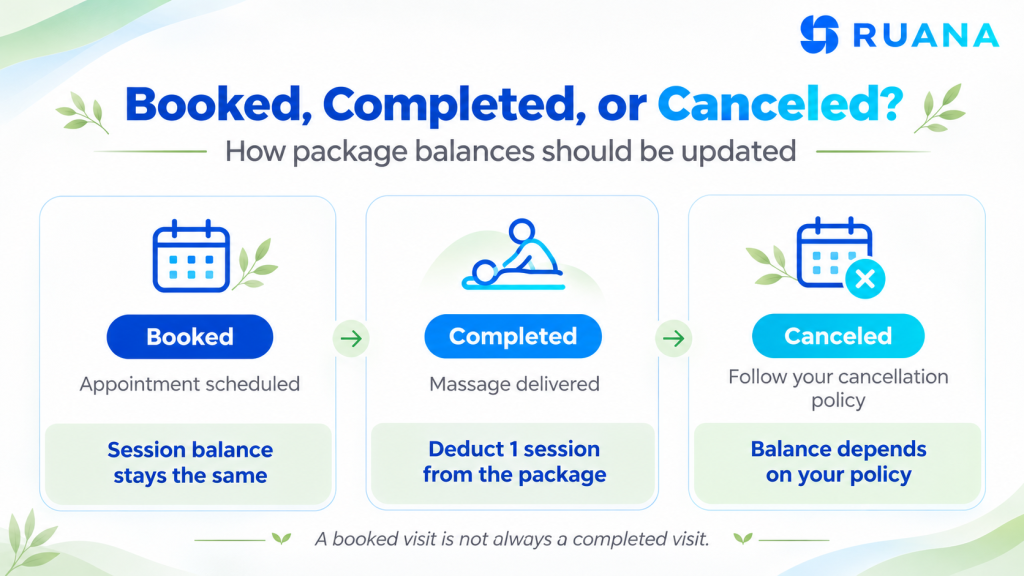
Notice that when Sarah books her third appointment, the package still shows three available sessions in this example. The visit is deducted only after the service has been completed and recorded.
This distinction matters because a booked appointment isn’t necessarily a completed massage.
Now imagine Sarah cancels her third appointment with sufficient notice under your clinic’s policy. Because the service wasn’t provided and the policy doesn’t require forfeiting package credit, her remaining balance stays the same. When she returns the following week, your receptionist can check the package balance without searching through earlier invoices or asking Sarah how many visits she remembers using. That’s the kind of consistency you want.
What Every Package Record Should Show
Whether you manage packages manually or through practice management software, there are a few details you should always be able to find:
Client name and package purchased
Date of purchase and payment status
Number of sessions originally included
Eligible massage services
Completed visits and remaining balance
Any additional fees, changes, or agreed conditions
Expiration information, if legally applicable
You don’t necessarily need a complicated system. You need one reliable record that everyone responsible for package management can use.
How to Avoid Billing Confusion at Checkout
Checkout should be one of the simplest parts of a massage appointment. Your client has received their treatment, you confirm the payment details, and they either schedule another visit or head home. But packages can make that process awkward if staff aren’t sure what’s included.
Consider Sarah again. She has two prepaid sessions remaining, but today she booked a service that costs more than her original package covers. If your receptionist doesn’t know about the difference, they might accidentally apply the package without collecting the additional fee. Another staff member might charge Sarah for the full massage, even though part of the service should be covered. Neither situation creates a good experience.
Use the Same Checkout Process Every Time
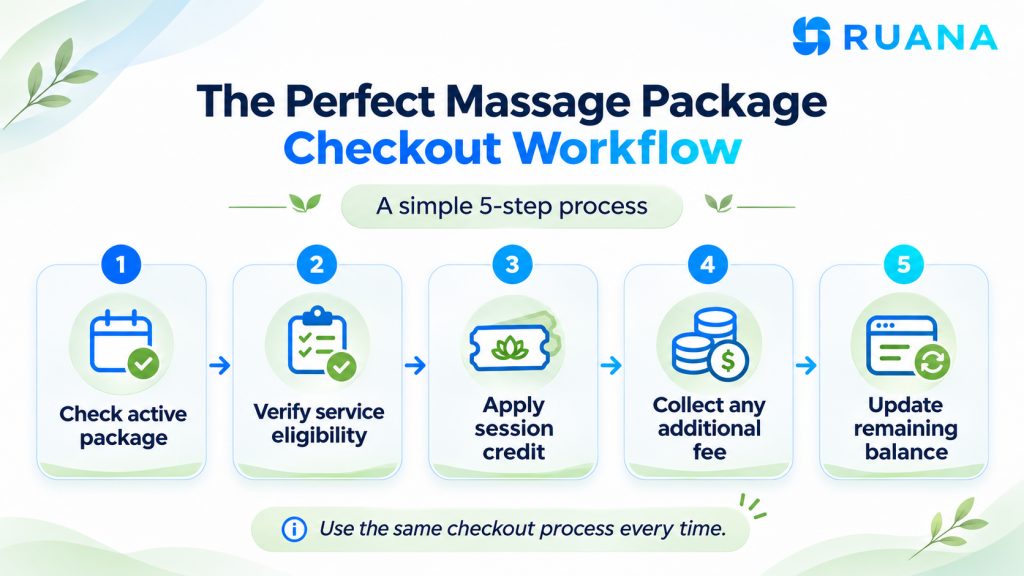
Before finalizing a package appointment, confirm three things: whether the client has an active package, whether today’s service is eligible, and whether any additional payment is required.
If the appointment is covered, record the appropriate package redemption. If there’s an upgrade fee or a service outside the package, explain the charge and record it correctly. The process should be consistent whether you’re checking out a regular client, a new package buyer, or someone who has booked with a different massage therapist. It’s also important to distinguish the original package purchase from subsequent session redemptions. Sarah has already paid $450 for her bundle. Completing her second massage doesn’t mean she should automatically be charged another $90.
💡 Prepaid doesn’t mean unrecorded. You still need to track every completed appointment so the remaining balance stays accurate.
For the financial side of the practice, keep the necessary payment records and discuss the accounting treatment of prepaid services with your accountant.
Managing Massage Therapy Memberships
Memberships can help practices with clients who prefer a consistent monthly arrangement.
For example, you might offer a membership that includes one 60-minute massage per month. Clients understand what they receive, and your practice has a defined structure for ongoing appointments. However, memberships require more than simply assigning a client to a plan. You also need to consider when each billing period begins, how you collect payments, whether unused sessions carry over, and what happens when someone pauses or cancels their membership.
What Happens When a Client Misses a Month?
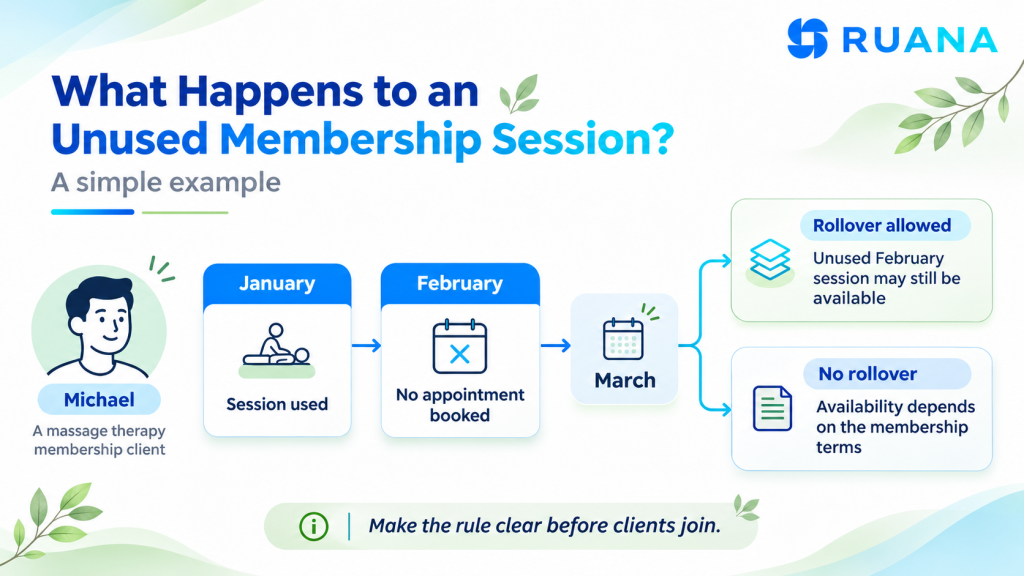
Imagine a client named Michael has a membership that includes one massage each month. In January, he attends his appointment. In February, he travels and doesn’t book a session. When March arrives, he asks whether he now has two massages available.
There isn’t one universal answer. If your membership allows unused sessions to roll over, Michael may have an additional visit available. If your terms don’t provide for rollover, the rules may be different, subject to applicable consumer law. The important thing is that Michael should have known the policy when he joined. Your team should also have an accurate membership record showing the applicable billing period and available benefits.
Don’t Confuse Membership Tracking With Automatic Payments
One detail worth understanding is that membership management and recurring payment collection aren’t always the same feature.
Some practice management systems allow you to create membership plans and track included visits without automatically charging a client’s payment card each month.
Ruana currently supports configuring membership plans, defining covered services, and tracking membership usage. According to its membership setup guide, it does not automatically charge credit cards for memberships, so the practice must handle payment collection through its available payment workflow. Before introducing memberships, make sure your team knows exactly how payment collection and session tracking work together.
Cancellations, Expiration Dates, and Unused Sessions
Even when your packages are well organized, clients won’t always use every appointment exactly as planned. People get sick, travel, move, or need to change their schedules. Some may ask for a refund, while others want to extend the time available to use their remaining visits. That’s why package terms should explain more than just the price.
Make Your Cancellation Policy Easy to Understand
Let’s return to Sarah’s five-session package.
She books a massage for Friday but calls Thursday morning to cancel. Does she keep the session? Is there a cancellation fee? What happens if she simply doesn’t show up?
Your practice should have a clearly communicated policy for those situations, and it should be consistent with applicable law. For example, a clinic might apply its normal cancellation rules to package appointments. However, whether a late cancellation can result in a fee or the loss of a prepaid session depends on the agreement and legal requirements. Avoid making these decisions individually each time someone cancels. Clear terms help prevent misunderstandings and make the front desk’s job easier.
Be Careful With Package Expiration Dates
You may want to encourage clients to use their packages within a reasonable period, but expiration rules require care.
In the United States, certain prepaid arrangements may fall under federal or state gift-card and gift-certificate protections. The Consumer Financial Protection Bureau explains federal requirements relevant to covered products, while state rules may provide additional protection.
Whether those requirements apply to a particular massage package depends on how it is structured and sold.nBefore adding expiration dates, cancellation fees, or nonrefundable conditions, check the laws that apply to your practice. And remember that a software setting allowing an expiration date doesn’t automatically mean the date is legally enforceable.
A Practical Massage Package Management Checklist
If you’re planning to introduce packages or review the ones you’re already selling, use this checklist before making changes.
Before Selling a Package
Choose which massage services are included.
Define the number of sessions.
Calculate a sustainable package price.
Decide how upgrades and additional fees work.
Prepare clear cancellation and refund terms.
Check the legality of any expiration restrictions.
Make sure your team understands the package rules.
When a Client Purchases a Package
Record the purchase and payment status.
Assign the package to the correct client.
Confirm the original session allowance.
Explain which services are eligible.
Make the terms available to the client.
After Every Appointment
Confirm which service was completed.
Check whether it qualifies under the package.
Record the completed visit against the correct balance.
Collect and record any applicable additional payment.
Confirm the remaining session balance.
This checklist is deliberately simple. You can adapt it to your practice or use it to train reception staff when someone new joins the team. The goal is to ensure that every package follows the same process, no matter who handles the appointment.
How Practice Management Software Can Help
If you’re managing massage packages with spreadsheets or separate payment records, you may already know how time-consuming it can become. One staff member checks the appointment calendar. Another looks at the payment history. Someone else tries to work out how many prepaid sessions remain. The information exists, but it isn’t always easy to find when you need it. Practice management software can help by keeping those details connected.
With Ruana’s packages and memberships tools, massage therapists can create packages, define which services are included, set session allowances, and track usage within client records. For example, a five-session massage package can be connected to the services it covers. As sessions are used, the practice can monitor the client’s remaining balance without maintaining a separate spreadsheet. Ruana also supports optional additional fees for assigned services, which can be useful when a package includes an upgrade arrangement.
Because packages are part of the wider practice workflow, you can manage them alongside scheduling, client records, SOAP notes, and billing. This is particularly helpful in practices with several massage therapists, where everyone needs access to consistent information. The point isn’t that every massage practice needs a complicated membership program. It’s that whatever packages you choose to offer should be easy for your team to manage.
Frequently Asked Questions About Massage Therapy Packages
How many sessions should I include in a massage package?
Start with a number that matches how clients typically use your services. Three- or five-session packages may be easier to introduce than larger bundles, although there is no universally correct number. Consider client demand, pricing, and your practice’s capacity before deciding.
Should massage therapy packages be discounted?
They can be, but a discount isn’t essential. The price should reflect the cost of delivering each massage and the value you’re offering. A package that attracts more bookings but leaves little margin may not be sustainable.
Can clients use a package with different massage therapists?
That depends on your clinic’s rules and what the package includes. If you allow clients to book with different practitioners, make sure the package balance is accessible and consistently updated across the team.
What happens when a prepaid massage package is used up?
Once all eligible sessions are completed, the package has no remaining visit allowance. The client can purchase a new package or book an individual session according to your practice’s normal pricing and policies.
Can I offer massage memberships without automatic billing?
Yes. A practice can manage membership benefits and session allowances while collecting payments separately. However, it needs a reliable process to check payment status and ensure clients receive the correct benefits.
Final Thoughts
Massage therapy packages and memberships can give clients a convenient way to plan regular appointments, but they should make running your practice easier, not harder.
Start with a small number of clearly defined options. Make sure clients understand what they’ve purchased, keep accurate records of completed sessions, and establish consistent rules for upgrades, cancellations, and unused visits. Most importantly, don’t wait until a client questions their balance to figure out how your package tracking works.
When everyone in your practice can quickly see what’s included and how many sessions remain, checkout becomes easier and clients receive a more consistent experience.
About the Authors
★★★★★4.9 · 329 Reviews
Rouzbeh NoroozyChiropractor & Co-Founder · Palmer West · UC Berkeley · 14 Years of ExperienceRouzbeh Noroozy is a chiropractor with 14 years of clinical experience and co-founder of Ruana practice management software. He completed his undergraduate studies at the University of California, Berkeley and graduated from the renowned Palmer College of Chiropractic West in California. As a practicing clinician and clinic owner, he understands firsthand the administrative challenges practices face — and which digital tools genuinely help streamline day-to-day operations.
Anastasiia NoroozyMedical Graduate & Co-Founder · 8 Years of ExperienceAnastasiia Noroozy is a medical graduate and co-founder of Ruana with 8 years of experience working directly with patients at the clinic in Cologne. She manages the day-to-day flow of the practice and knows every patient-facing process from the inside out — from intake and scheduling to follow-up care. Her hands-on clinical and operational experience directly shapes how Ruana is built to work in the real world.
To provide the best experiences, we use technologies like cookies to store and/or access device information. Consenting to these technologies will allow us to process data such as browsing behavior or unique IDs on this site. Not consenting or withdrawing consent, may adversely affect certain features and functions.
Functional
Always active
The technical storage or access is strictly necessary for the legitimate purpose of enabling the use of a specific service explicitly requested by the subscriber or user, or for the sole purpose of carrying out the transmission of a communication over an electronic communications network.
Preferences
The technical storage or access is necessary for the legitimate purpose of storing preferences that are not requested by the subscriber or user.
Analytics
The technical storage or access that is used exclusively for statistical purposes.The technical storage or access that is used exclusively for anonymous statistical purposes. Without a subpoena, voluntary compliance on the part of your Internet Service Provider, or additional records from a third party, information stored or retrieved for this purpose alone cannot usually be used to identify you.
Marketing
The technical storage or access is required to create user profiles to send advertising, or to track the user on a website or across several websites for similar marketing purposes.
To provide the best experience for our practitioners, we use cookies to personalize content, analyze our traffic, and support our marketing efforts. By clicking 'Accept', you consent to our use of these technologies. You can manage your preferences at any time.
Functional
Always active
The technical storage or access is strictly necessary for the legitimate purpose of enabling the use of a specific service explicitly requested by the subscriber or user, or for the sole purpose of carrying out the transmission of a communication over an electronic communications network.
Preferences
The technical storage or access is necessary for the legitimate purpose of storing preferences that are not requested by the subscriber or user.
Analytics
The technical storage or access that is used exclusively for statistical purposes.The technical storage or access that is used exclusively for anonymous statistical purposes. Without a subpoena, voluntary compliance on the part of your Internet Service Provider, or additional records from a third party, information stored or retrieved for this purpose alone cannot usually be used to identify you.
Marketing
The technical storage or access is required to create user profiles to send advertising, or to track the user on a website or across several websites for similar marketing purposes.