Chiropractic Billing: A Practical Guide to Getting Paid Without Delays
01.05.26
Denied claims don’t happen by chance. They’re usually the result of small breakdowns in documentation, coding, or follow-up that add up over time.
Fix the workflow, and you fix the revenue.
Denied claims are one of the fastest ways for a chiropractic practice to lose revenue, often without realizing how much is slipping through.
A few rejected claims here, a delayed payment there, and suddenly the front desk is spending hours chasing money that should have already been collected. Chiropractic billing works better when it is treated as part of the clinic workflow, not as an admin task handled after the visit.
Because in most cases, the problem is rarely one big billing failure. It is usually a mix of incomplete notes, coding issues, payer rules, and follow-up that slips through during a busy week.
So, let’s break everything down into clear, actionable steps in our detailed chiropractic billing guide.
What Is Chiropractic Billing and How It Actually Works
In practice, chiropractic billing means connecting what happened during the session to the documentation, codes, and payer rules governing reimbursement. So, it’s the process of turning a patient visit into a paid claim.
Everything starts with the visit. The treatment is performed, notes are recorded, and the clinical details are documented. From there, you translate the details into diagnosis and procedure codes, which form the basis of the claim.
Most billing problems happen when those pieces do not line up. A vague note, unsupported code, missing detail, or untracked claim can slow payment or trigger a denial.
Key Metrics to Track
Most billing issues show up in the numbers before they become visible in cash flow. Tracking a few core metrics makes it easier to spot problems early and correct them before they compound.
Claim denial rate: The percentage of submitted claims that get rejected. A rising rate usually points to documentation or coding issues.
First-pass acceptance rate: How many claims are approved on the first submission? This reflects how clean your process is from the start.
Days in accounts receivable (AR): How long does it take to get paid? Longer cycles often indicate delays in submission or follow-up.
Average reimbursement per visit: Helps identify undercoding, missed charges, or payer-specific issues.
These metrics do not require complex reporting to be useful. Even basic tracking can show where the billing process is slowing down or leaking revenue.
How to Do Chiropractic Medical Billing (Step-by-Step Workflow)
Most billing issues come from small breakdowns between steps, where information gets lost, misinterpreted, or delayed. A clean billing process is built on consistency, so each step should feed directly into the next without rework, as shown below.
Patient Intake and Insurance Verification
Billing starts before the patient is treated.
The whole process can become reactive if the intake form appears incomplete or the insurance is not verified upfront. You will need accurate patient details, insurance coverage, and a clear understanding of what is actually reimbursed. That includes visit limits, exclusions, and whether the case qualifies as active care.
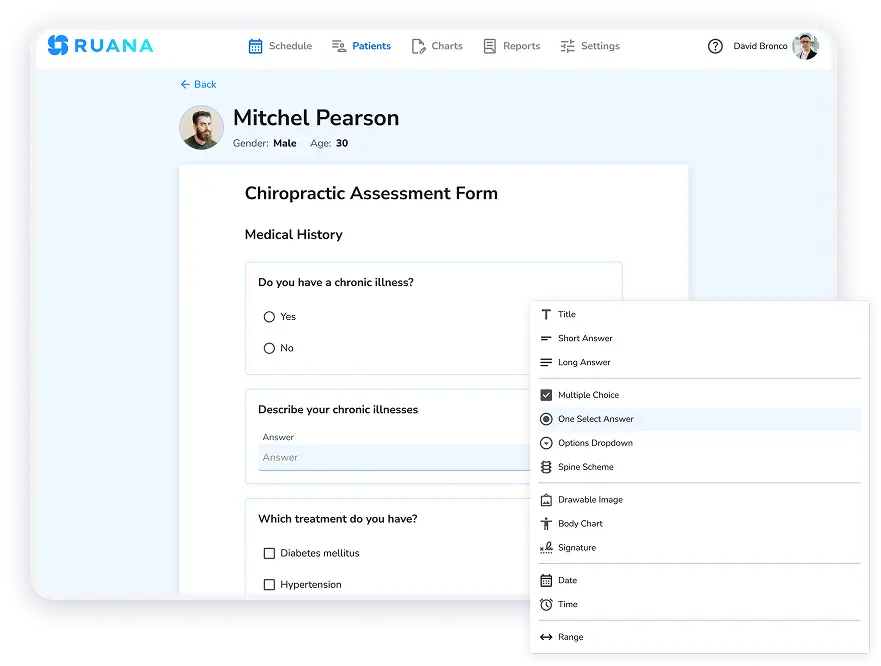
From our professional experience, this step works best when intake forms, scheduling, and patient records are connected. That said, instead of manually collecting patient data, which is often incomplete or hard to interpret due to rushed handwriting or limited time between sessions, chiropractors can rely on a structured digital intake process.
Easily create and customize digital forms for patients and practitioners.
Dedicated systems allow collecting information through standardized forms, storing, and linking everything directly to the patient record. It also gives the front desk immediate visibility into insurance details and patient history, which helps verify coverage before the visit instead of fixing issues after.
This is where most claims are won or lost. If the documentation does not clearly support the treatment, the claim becomes difficult to defend.
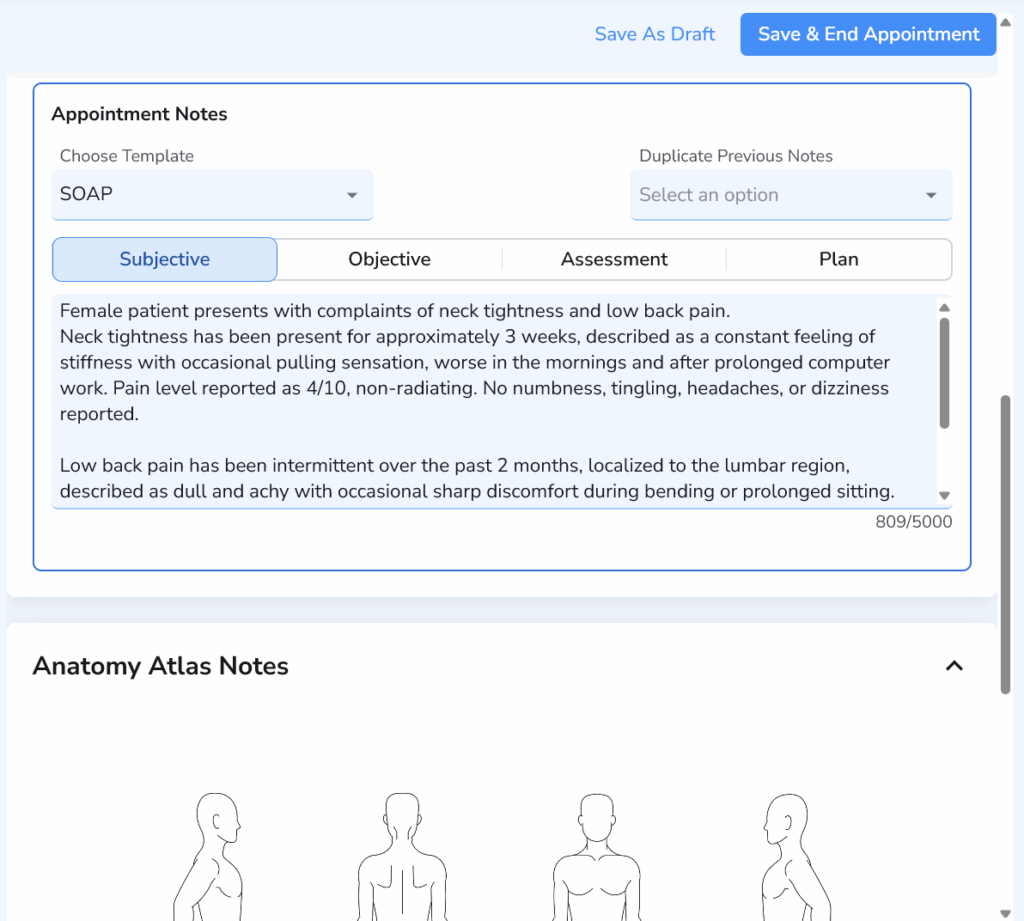
Chiropractic SOAP notes should clearly reflect what was done, why it was necessary, and how the patient responded. Repetitive or generic notes that lack custom patient details are one of the most common reasons for denials. This is especially true in chiropractic, where medical necessity is closely reviewed.
Document patient visits using traditional SOAP notes with a clean, distraction-free interface.
The process becomes more reliable when documentation is structured. Using consistent templates, pre-defined phrasing, and quick input methods helps maintain clarity without slowing down the practitioner. This is where dedicated practice management software helps streamline the processes.
Once the visit is documented, it needs to be translated into codes. This is where diagnosis (ICD-10) and procedures (CPT) must align with the clinical notes.
Errors here are rarely random, because they usually come from mismatches. A diagnosis that does not support the procedure. A repeated code pattern that raises flags. Or missing modifiers that change how a service is interpreted.
Charge entry should be a direct extension of documentation, not a separate task that relies on memory. The closer these two steps are connected, the fewer corrections are needed later.
Claim Submission and Follow-Up
Visibility becomes critical here.
You cannot send a claim and forget about it. Whether it is accepted, delayed, or denied, the response should trigger a clear next action. Without follow-up, even valid claims can sit unpaid. Therefore, practitioners who have a simple system for monitoring claim status and handling rejections tend to stay on top of billing.
The process does not need to be complex. What matters is that nothing disappears after submission.
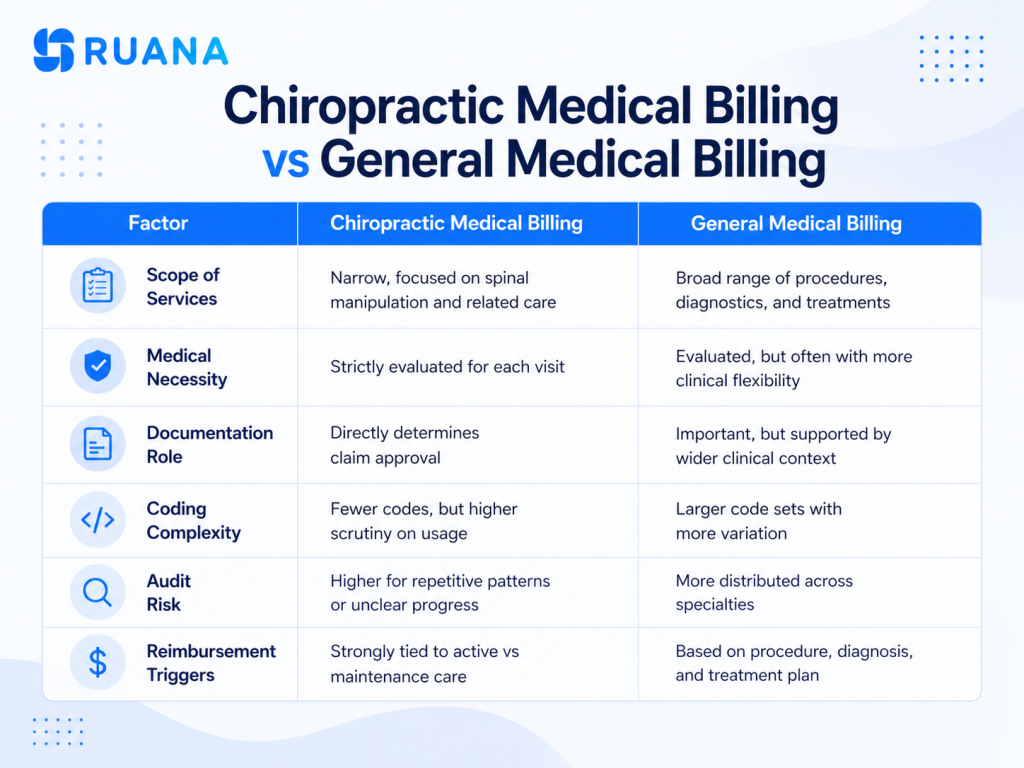
Chiropractic Medical Billing vs General Medical Billing
Chiropractic billing follows the same general structure as medical billing, but the rules around it are narrower and more strictly applied. The key differences show up in areas like:
Scope of care: Chiropractic billing is tied closely to spinal manipulation and related treatment.
Documentation pressure: Each visit must clearly support medical necessity.
Active vs. maintenance care: Payers often review whether the treatment is corrective or routine.
Pattern monitoring: Repeated codes or vague progress notes can raise audit concerns faster.
General medical billing providers have a broader range of procedures, diagnostic tools, and treatment pathways. The flexibility here allows for more variation in coding and reimbursement.
This is where many practices run into issues.
In chiropractic billing, documentation is not just a record of the visit, but the foundation of the claim. Payers often distinguish between active treatment and maintenance care, and that distinction directly affects whether a service is reimbursed. If the notes do not clearly support active care, the claim is at risk, even if the treatment itself was appropriate.
Billing Guidelines of Chiropractic Care You Can’t Ignore
Billing problems rarely come from not knowing the guidelines. Instead, what we often see among fellow chiropractors is the challenges in translating them into how visits are documented, coded, and tracked.
Below is what actually matters in practice.
Medicare Rules and Coverage Limits
Guideline:
Medicare Part B primarily covers spinal manipulation when it is medically necessary to correct a subluxation. Exams, X-rays (in many cases), and maintenance care are not reimbursed under standard chiropractic coverage.
How it affects your workflow:
You cannot treat documentation as routine. Each visit needs to clearly show why the adjustment is necessary and be tied to a defined condition. That means:
Notes should reference the subluxation and functional problem
The treatment plan should show a corrective goal, not general wellness
Any non-covered services need to be separated clearly to avoid claim confusion
If this is not done properly, claims may be denied even when the treatment itself was valid.
Maintenance Care vs Active Treatment
Guideline:
Only active treatment is reimbursable. Maintenance care is not, even if the patient continues to benefit from visits.
How it affects your workflow:
This distinction has to be visible in your notes, not just understood clinically. In practice:
Active care must show measurable progress or a defined treatment goal
If progress plateaus, the case may shift into maintenance, even if visits continue
Language in notes matters. “Ongoing relief” without improvement can signal maintenance care
This is one of the most common reasons for denied claims. The treatment may be appropriate, but the documentation does not prove it qualifies as active care.
Documentation Requirements for Each Visit
Guideline:
Every visit must support medical necessity with clear, specific documentation. Generic or repeated notes are a red flag.
How it affects your workflow:
You need a consistent structure for documenting visits without slowing down between patients. That usually means:
Recording subjective complaints, objective findings, and response to care
Updating progress instead of repeating previous notes
Connecting the treatment directly to the diagnosis
If notes start to look identical across visits, payers may question whether the care is justified, even if it is clinically sound.
Frequency Limits and Re-Evaluation Expectations
Guideline:
Payers expect treatment frequency to align with the condition and include periodic re-evaluations to justify continued care.
How it affects your workflow:
You cannot set a treatment schedule and leave it unchanged. Instead:
Visit frequency should reflect patient progress and condition severity
Re-evaluations should be documented at regular intervals
Treatment plans should be updated based on findings, not reused
Without this, care can appear excessive or unsupported, which increases the risk of denials or audits.
The pattern across all of these guidelines is consistent. Billing decisions are not made at the claim stage. They are made earlier, during documentation and daily workflow. Practices that align their notes, coding, and treatment plans with these rules tend to see fewer rejections and less time spent fixing preventable issues.
Common Chiropractic Billing Mistakes That Lead to Denials
Most denials usually follow patterns that repeat across practices. Small gaps in documentation, coding, or follow-up can quietly build up and lead to delayed or rejected claims.
The good news is that these issues are predictable and can be corrected once you know where to look.
Incomplete or Vague Documentation: Generic notes can hardly justify medical necessity. So, ensure that each visit clearly reflects what changed, why treatment was needed, and how the patient responded. Using a structured format helps keep documentation consistent without slowing you down.
Mismatch Between Diagnosis and Procedure Codes: When ICD-10 and CPT codes do not align, claims are often rejected or flagged for review. Keep documentation and coding closely aligned so the latter serves as a direct extension of your clinical notes, not a separate step done from memory.
Lack of Consistent Claim Follow-up: Claims that are submitted but not tracked can remain unpaid longer than expected. Even clean claims may require follow-up depending on the payer. Having a simple system to monitor claim status helps prevent revenue from slipping through.
Final Takeaways
The best solution to streamline chiropractic billing will be to align documentation, coding, and claim tracking, so the number of preventable denials drops noticeably.
Practices that streamline these processes tend to spend less time fixing errors and more time focusing on patient care. In many cases, that comes down to having a system that keeps everything connected, from intake and notes to billing and follow-up.
About the Authors
★★★★★4.9 · 329 Reviews
Rouzbeh NoroozyChiropractor & Co-Founder · Palmer West · UC Berkeley · 14 Years of ExperienceRouzbeh Noroozy is a chiropractor with 14 years of clinical experience and co-founder of Ruana practice management software. He completed his undergraduate studies at the University of California, Berkeley and graduated from the renowned Palmer College of Chiropractic West in California. As a practicing clinician and clinic owner, he understands firsthand the administrative challenges practices face — and which digital tools genuinely help streamline day-to-day operations.
Anastasiia NoroozyMedical Graduate & Co-Founder · 8 Years of ExperienceAnastasiia Noroozy is a medical graduate and co-founder of Ruana with 8 years of experience working directly with patients at the clinic in Cologne. She manages the day-to-day flow of the practice and knows every patient-facing process from the inside out — from intake and scheduling to follow-up care. Her hands-on clinical and operational experience directly shapes how Ruana is built to work in the real world.
Our team will review your inquiry and get back to you as soon as possible.
Privacy Settings
To provide the best experiences, we use technologies like cookies to store and/or access device information. Consenting to these technologies will allow us to process data such as browsing behavior or unique IDs on this site. Not consenting or withdrawing consent, may adversely affect certain features and functions.
Functional
Always active
The technical storage or access is strictly necessary for the legitimate purpose of enabling the use of a specific service explicitly requested by the subscriber or user, or for the sole purpose of carrying out the transmission of a communication over an electronic communications network.
Preferences
The technical storage or access is necessary for the legitimate purpose of storing preferences that are not requested by the subscriber or user.
Analytics
The technical storage or access that is used exclusively for statistical purposes.The technical storage or access that is used exclusively for anonymous statistical purposes. Without a subpoena, voluntary compliance on the part of your Internet Service Provider, or additional records from a third party, information stored or retrieved for this purpose alone cannot usually be used to identify you.
Marketing
The technical storage or access is required to create user profiles to send advertising, or to track the user on a website or across several websites for similar marketing purposes.
To provide the best experience for our practitioners, we use cookies to personalize content, analyze our traffic, and support our marketing efforts. By clicking 'Accept', you consent to our use of these technologies. You can manage your preferences at any time.
Functional
Always active
The technical storage or access is strictly necessary for the legitimate purpose of enabling the use of a specific service explicitly requested by the subscriber or user, or for the sole purpose of carrying out the transmission of a communication over an electronic communications network.
Preferences
The technical storage or access is necessary for the legitimate purpose of storing preferences that are not requested by the subscriber or user.
Analytics
The technical storage or access that is used exclusively for statistical purposes.The technical storage or access that is used exclusively for anonymous statistical purposes. Without a subpoena, voluntary compliance on the part of your Internet Service Provider, or additional records from a third party, information stored or retrieved for this purpose alone cannot usually be used to identify you.
Marketing
The technical storage or access is required to create user profiles to send advertising, or to track the user on a website or across several websites for similar marketing purposes.