But “well-regarded” and “right for your clinic” are not the same thing. A solo massage therapist paying per-practitioner fees for insurance modules they never touch is in a different situation than a six-provider chiropractic group that needs room management and electronic claims. Practices outgrow software, and they also over-buy it.
This guide covers 9 Jane App alternatives worth evaluating, with current pricing, what each one is actually built for, and where each falls short.
Table of Contents
- Jane App Alternatives at a Glance
- Why Look for an Alternative to Jane App?
- Evaluation Criteria: How We Choose Jane App Alternatives
- 9 Best Jane App Alternatives for Wellness Practitioners
- Which Jane App Alternative Should You Choose?
- Looking for a Simpler Jane App Alternative? Try Ruana
Jane App Alternatives at a Glance
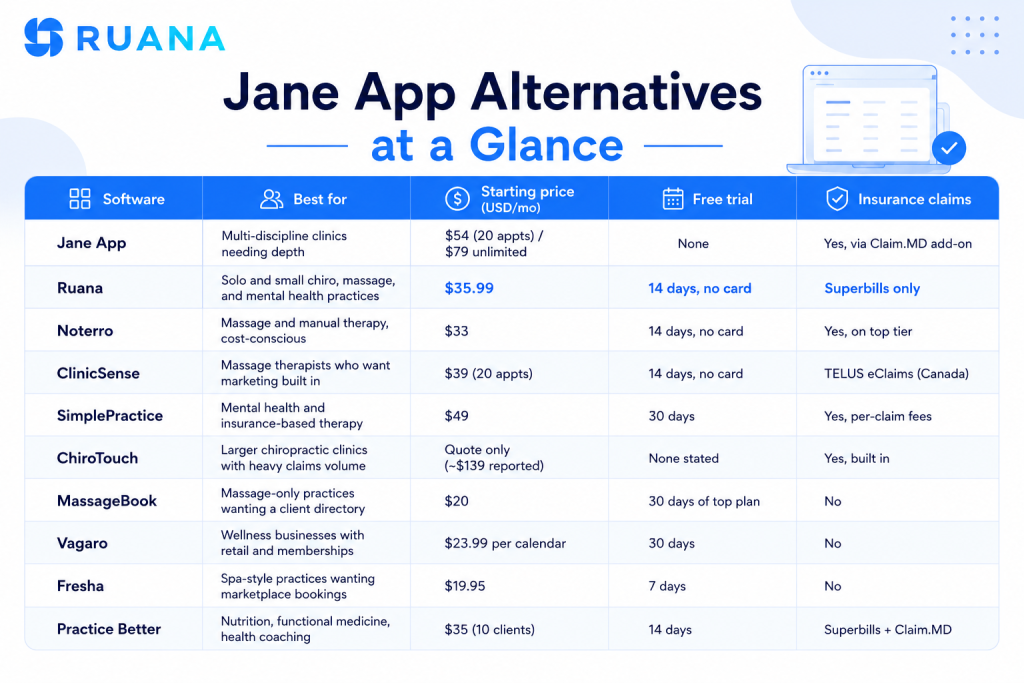
The right Jane App alternative depends on what your practice actually needs day to day. Some platforms are built around specific specialties, while others prioritize scheduling, billing, marketing, or broader practice management. Pricing can also change significantly as appointment volume, practitioners, or features increase.
The table below gives you a quick starting point before we look at each option in more detail.
Why Look for an Alternative to Jane App?
Most clinics that shop around are not unhappy with Jane App. They are looking for a different fit. The usual reasons based on publicly available reviews suggest:
- You want a simpler workflow for a small practice. Jane App is built to scale, which means depth you may not need. A solo practitioner running 25 appointments a week can spend more time configuring than treating.
- Your documentation needs are different. Some practitioners want highly structured, discipline-specific SOAP templates. Others want to write three lines and move on. Charting systems are opinionated, and the opinion has to match yours.
- You want pricing that fits your team size. Jane App’s per-practitioner model adds up differently depending on how your staff is structured. Flat or lower per-seat pricing changes the math for some clinics.
- You primarily run a chiropractic or massage practice. Single-discipline software can be tighter, suggesting fewer fields that you skip and fewer settings that do not apply to you.
- You need different billing or administrative workflows. If you bill insurance heavily, you may want claims built into the base product. If you never bill insurance, you may not want to pay toward that infrastructure at all.
- You want fewer steps between scheduling, documentation, and checkout. The number of clicks between “patient arrives” and “patient paid” is a real daily cost, and different products optimize it differently.
Evaluation Criteria: How We Choose Jane App Alternatives
Every product below was assessed on the same five points:
- Discipline fit. Who the software was actually built for, not who it markets to. Software built by and for massage therapists behaves differently from software adapted to them.
- Real cost at your team size. Headline price plus per-practitioner fees, add-ons, appointment caps, and metered SMS.
- Clinical workflow. How charting, intake, scheduling, and checkout connect and how many steps sit between them.
- Billing model support. Cash-pay, superbills, extended health, or full electronic claims. These are very different requirements, and few products do all of them.
- Honest limitations. What each product does not do. Every one of them has gaps, and the gaps matter more than the feature lists.
9 Best Jane App Alternatives for Wellness Practitioners
Here’s what we’ve found about each practice management software:
Ruana
Best for: Solo practitioners and small chiropractic, massage, and mental health practices that want the essentials without the configuration overhead.
Starting price
- $35.99/month for Solo (one practitioner, unlimited appointments)
- Professional is $55.99/month plus $19.99 per additional practitioner
- 14-day free trial, no credit card
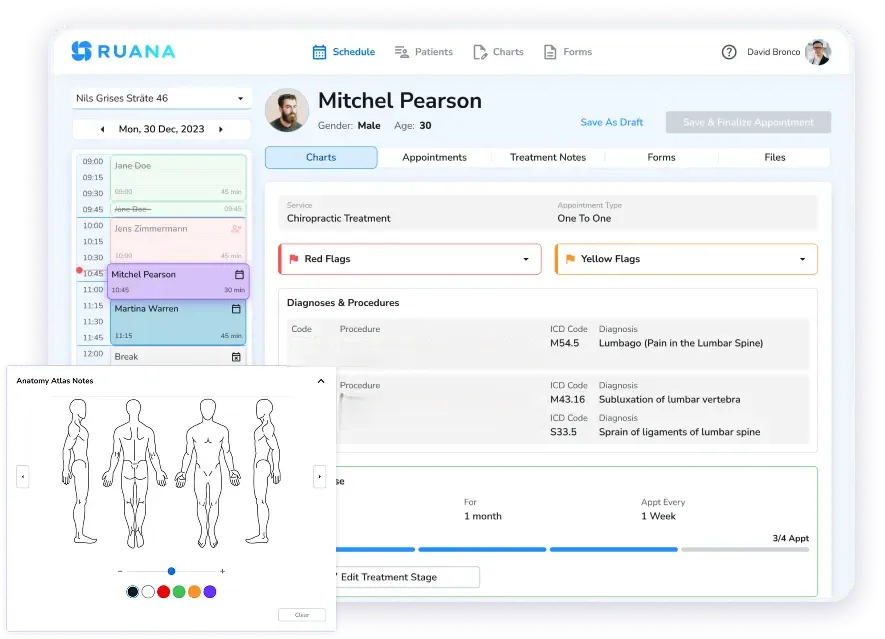
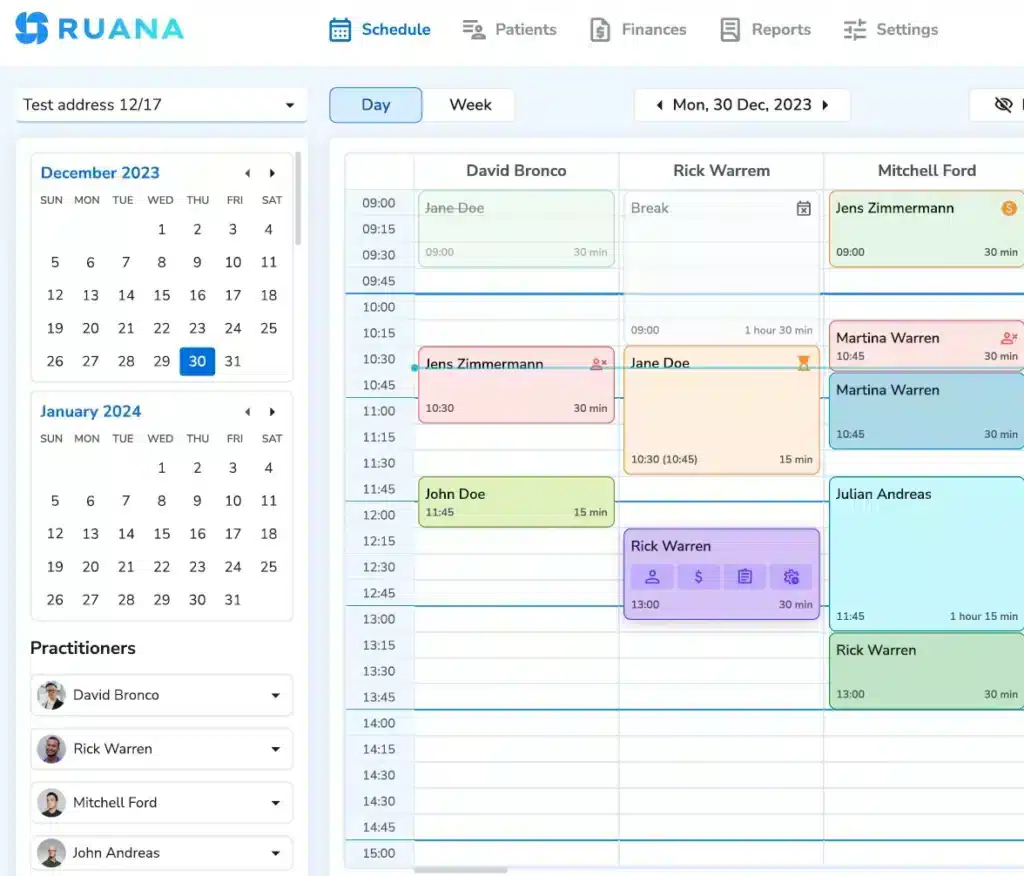
Key features: Ruana brings the core workflows of a small practice into one clean system, so you are not paying for complexity you are unlikely to use. Patients can book online 24/7, while the colour-coded calendar gives you practical control over working hours and daily appointment limits.
Once an appointment is booked, custom intake forms, reminders, SOAP notes with anatomical diagrams and shortcuts, invoicing, ICD-10 codes, and superbills keep the patient journey connected from booking through documentation and billing. Packages, memberships, financial reporting, and optional SMS reminders cover the business side as well, while HIPAA and GDPR compliance make it suitable for practices handling sensitive patient information.
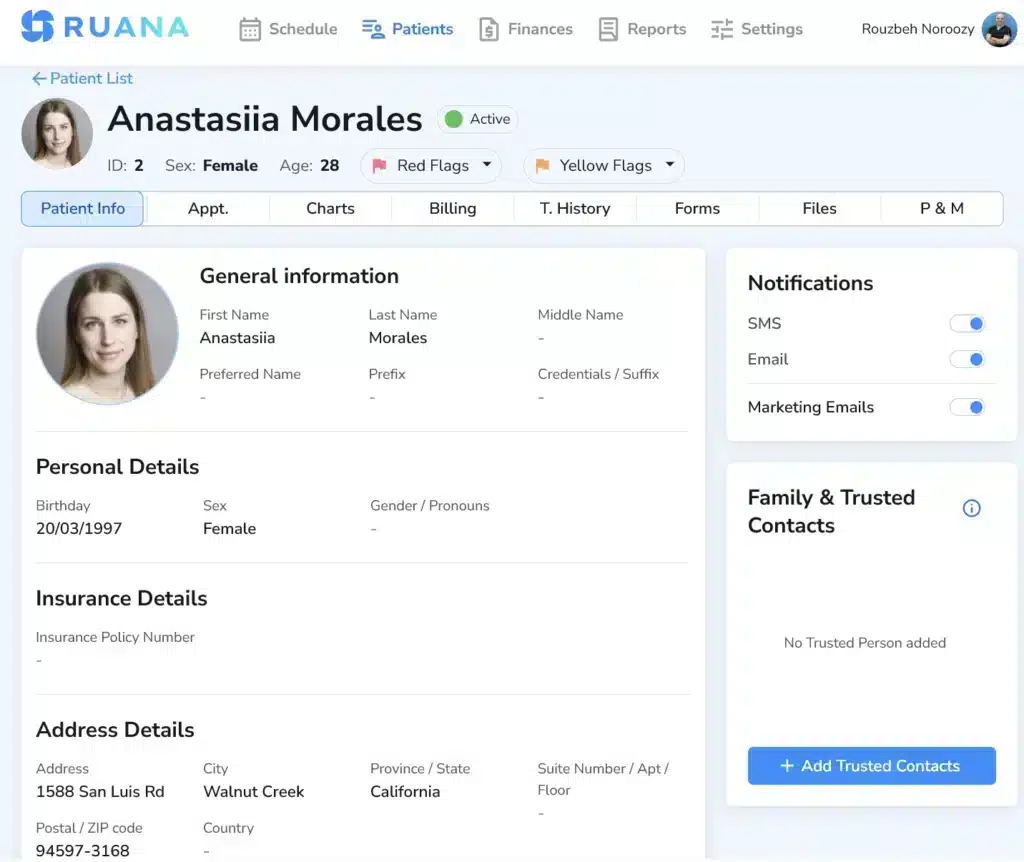
Where it stands out: Ruana was built by practitioners, and it shows in how little setup it demands. The pricing is the other differentiator: $19.99 per additional practitioner is roughly half what Jane charges for a full-time seat, and the entry plan has no appointment cap, unlike Jane’s $54 Balance plan, which stops at 20 appointments a month.
Potential limitation: Ruana does not currently support EDI, clearinghouse submissions, or the CMS-1500 form. It generates superbills and insurance-ready ICD-10 codes for clients to submit themselves, which works for cash-pay and extended-health practices but not for clinics that bill payers directly.
Jane App vs. Ruana: Jane is the deeper platform with telehealth on every plan, room and equipment management, and integrated claims through Claim.MD. Ruana is the lighter one, at roughly half the cost per practitioner and with a free trial Jane does not offer. If you are cash-pay or superbill-based and want fewer moving parts with neatly organized dashboards and smart scheduling, Ruana is the more sensible spend.

Noterro
Best for: Massage therapists and manual therapy clinics looking for Jane-level capability at a lower price.
Starting price
- Core $33/month
- Plus $55/month
- Max $77/month, each including one practitioner seat plus unlimited assistant seats
- Additional practitioners run $13.20 to $27.50 depending on tier
Where it stands out: Noterro covers most of what Jane does across its tiers at roughly 30 to 50% less pricing. It combines online booking, flexible charting, payments, and day-to-day clinic management in one platform.
Potential limitation: Telehealth is an integration rather than native video. Reviewers also flag limited forward-looking analytics and intake forms that can be too rigid for detailed health histories.
ClinicSense
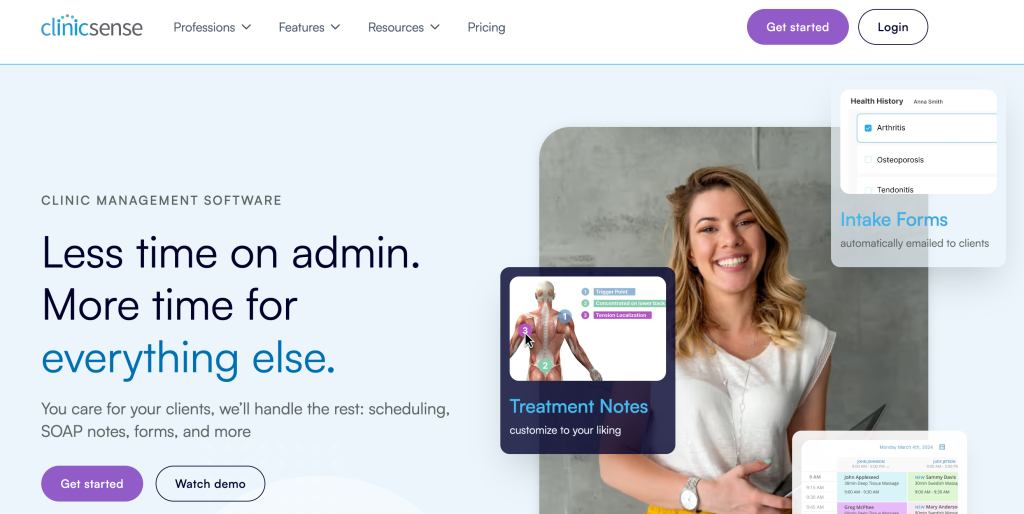
Best for: Solo and small massage practices that want marketing automation and no-show protection built in.
Starting price
- Lite $39/month (up to 20 appointments)
- Standard $69/month (up to 200 appointments), Premium $99/month (unlimited)
- Additional practitioners $20/month
Where it stands out: The marketing layer. Most practice-management tools stop at reminders, while ClinicSense actively works on rebooking and reviews. No-Show Guard, which holds a card or takes a deposit at booking, is a genuinely useful piece of infrastructure for practices losing revenue to late cancellations.
Potential limitation: Insurance support is limited to TELUS eClaims for Canadian extended health and there is no US claims workflow. The appointment caps on Lite and Standard are real ceilings, and SMS reminders and review automation are locked out of the entry plan.
SimplePractice
Best for: Therapists, counsellors, and mental health practices billing insurance in the US.

Starting price
- Starter $49/month
- Essential $79/month
- Plus $99/month, flat per account for solo practitioners
- Group practices on Plus pay $74/month per additional clinician
Where it stands out: Insurance workflow. Claims filing is built into the product rather than bolted on, with 10 free claims a month on Essential and 35 on Plus before per-claim fees. The 30-day trial is the longest here, and the Therapy Finder directory is a real client-acquisition channel for therapists.
Potential limitation: The Starter plan is heavily restricted with reminders only work for telehealth appointments, and there is no reporting, secure messaging, or calendar sync.
ChiroTouch
Best for: Established chiropractic clinics with high patient volume and heavy insurance billing.

Starting price
- Available upon request
Where it stands out: Depth in one discipline. ChiroTouch serves over 12,500 chiropractic clinics and its billing and claims tooling supports chiropractic coding and payer requirements. For a high-volume DC practice with a dedicated biller, that specialisation is worth real money.
Potential limitation: No pricing transparency, no stated free trial, and a demo gate before you can evaluate anything. Reviewers consistently report add-on fees, inflexible contracts, slow performance, difficult onboarding, and inconsistent support.
MassageBook
Best for: Massage-only practices that want new client acquisition alongside scheduling.

Starting price
- Transition $20/month
- Practice $59/month
- Clinic $99/month flat per account
- AMTA members get 25% off, ABMP members 10%
Where it stands out: The directory. MassageBook runs a consumer-facing marketplace where clients search for therapists, and a free listing plus a free booking-enabled website makes it as much a client-acquisition tool as a practice-management one.
Potential limitation: No insurance billing at all. The vendor confirms this and offers only manual workarounds for recording insurance payments.
Vagaro
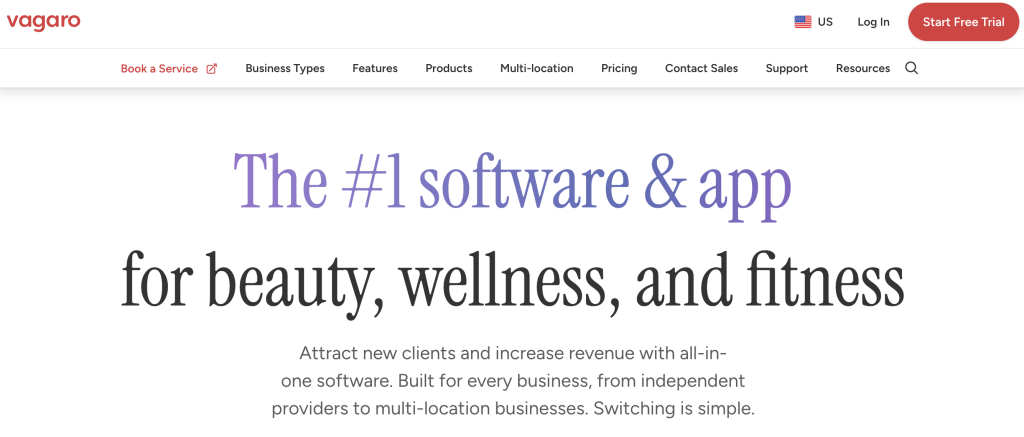
Best for: Wellness businesses running retail, memberships, and multiple service types under one roof.
Starting price
- $23.99/month for one bookable calendar, plus $10/month per additional calendar up to seven, after which additional staff are free.
- Multi-location pricing starts at $30. 30-day free trial.
Where it stands out: Business breadth. Vagaro handles retail, classes, memberships, payroll, and loyalty in a way clinical software generally does not, and the marketplace listing brings in bookings.
Potential limitation: Almost everything beyond the core is a paid add-on. Intake and charting forms, the website builder, live streaming, and having a branded app all come with a price tag.
Fresha
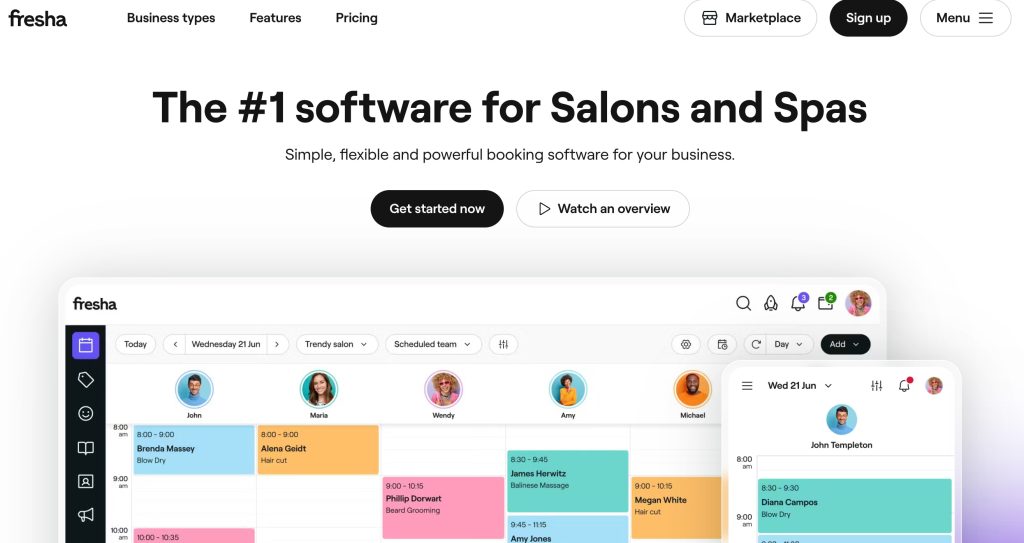
Best for: Spa-style and treatment-based wellness businesses that want marketplace-driven bookings.
Starting price
- Independent $19.95/month for a one-person business
- Team $14.95 per team member per month
- Enterprise pricing for 20+ team members is custom
Where it stands out: The marketplace. Fresha’s consumer platform sends new clients to businesses listed on it, charging a one-time 20% commission on a new client’s first completed appointment with a $6 minimum. Returning clients booking through the marketplace cost nothing. For a practice with spare capacity, that is a pay-for-results acquisition channel no other clinical EMR offers.
Potential limitation: No clinical charting, no telehealth, no insurance or superbills. Consultation forms are the extent of the documentation layer, which rules Fresha out for anyone with real record-keeping requirements.
Practice Better
Best for: Nutritionists, dietitians, functional medicine practitioners, and health coaches running programs alongside sessions.

Starting price
- Starter $35/month (10 clients)
- Professional $69/month (300 clients)
- Plus $99/month (unlimited clients, 3 admin users)
- Team $155/month with two practitioner licences
- Additional practitioners $50/month
Where it stands out: Nothing else on this list handles ongoing client programs the way Practice Better does. Food journaling, protocol builders, automated check-ins, evergreen programs, and integrations with Fullscript, Rupa Health, and That Clean Life make it a genuinely different category of tool for practices where the work happens between appointments.
Potential limitation: The client caps below Plus are severe. 10 clients on Starter and 300 on Professional make the lower tiers unusable for an established caseload, so most practices land on the $99 plan. SMS is not included at all below Plus.
Which Jane App Alternative Should You Choose?
There is no universally best Jane App alternative, and any article that names one is guessing about your practice.
The decision comes down to five things.
- Practice type narrows the field fastest. Favor software that is built specifically for your industry.
- Team size determines whether flat pricing or per-seat pricing wins.
- Documentation requirements are where clinical products separate from booking products.
- Billing model is the sharpest divide of all. Cash-pay and superbill practices have far more options than clinics submitting electronic claims.
- And then there is how much complexity you actually need. This is the one clinics get wrong most often, usually by buying for the practice they imagine having in three years rather than the one they run now. Paying for room management, group telehealth, and clearinghouse integration you do not use is not an investment in growth. It is a monthly cost with a configuration burden.
If you bill insurance electronically at volume, stay with a platform built for it. If you do not, the question becomes much simpler: what is the shortest path from booking to note to payment, and what does it cost per practitioner?
Looking for a Simpler Jane App Alternative? Try Ruana
For a lot of chiropractic, massage, and mental health practices, that shortest path is what has been missing. Ruana was built by a chiropractor with 13 years in practice and a medical professional who had both used software that assumed a clinic three times their size. So they’ve built the version they wanted instead.
That shows up in three places.
- Setup, where most clinics are running in 30 to 90 minutes rather than committing to weeks of onboarding.
- Daily workflow, where booking, intake, charting, and checkout sit closer together: intake forms go out automatically before the appointment, SOAP notes have anatomical diagrams and auto-complete built in, and invoicing with ICD-10 codes and superbills is a step rather than a project.
- Cost, where Solo is $35.99/month with no appointment cap and additional practitioners are $19.99, which is around half what comparable per-seat pricing runs elsewhere. Practitioners report saving five to eight hours of admin a week.
Ruana is deliberately not everything. It does not do EDI or clearinghouse claim submission, and two-way calendar sync is still on the roadmap. If you submit claims electronically every day, another product on this list will serve you better. But if you are cash-pay or superbill-based and want a system that stays out of the way, that trade is the point.
The new features are regularly added to Ruana to ensure all wellness providers using it have the full toolset to manage their daily clinical workflows.
The trial is 14 days, full access, no credit card. That is usually enough to know.
Start your free 14-day trial → · Compare plans and pricing →