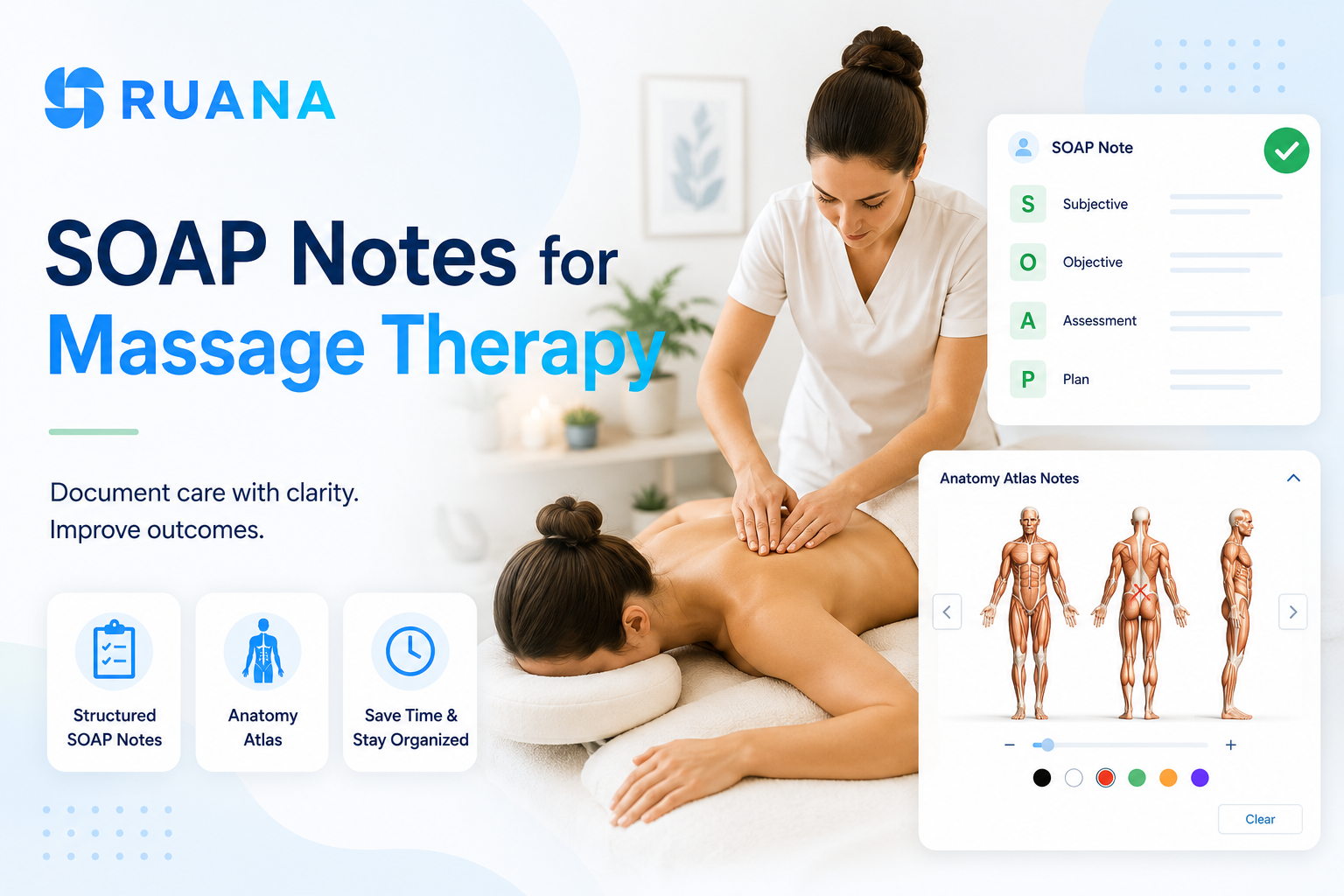
SOAP Notes for Massage Therapy: Complete Guide with Examples, Templates, and Best Practices
26.04.26
Learn how to write SOAP notes for massage therapy with practical examples, a simple template, and tips to document faster.
How much detail are you losing when you have only a few minutes between clients?
Many massage therapists like you write their patient SOAP notes in the gap between one session ending and the next one beginning. This usually means rushing and leaving out details that felt obvious in the moment but are hard to reconstruct later.
As a result, incomplete notes make it harder to track progress, repeat what worked, explain treatment decisions, and protect your practice if questions come up later. SOAP notes for massage therapy work best when they help you stay consistent from one session to the next, not when they become another task you are trying to finish on the clock.
So, here’s how to write notes in a way that is fast, consistent, and actually useful between massage sessions.
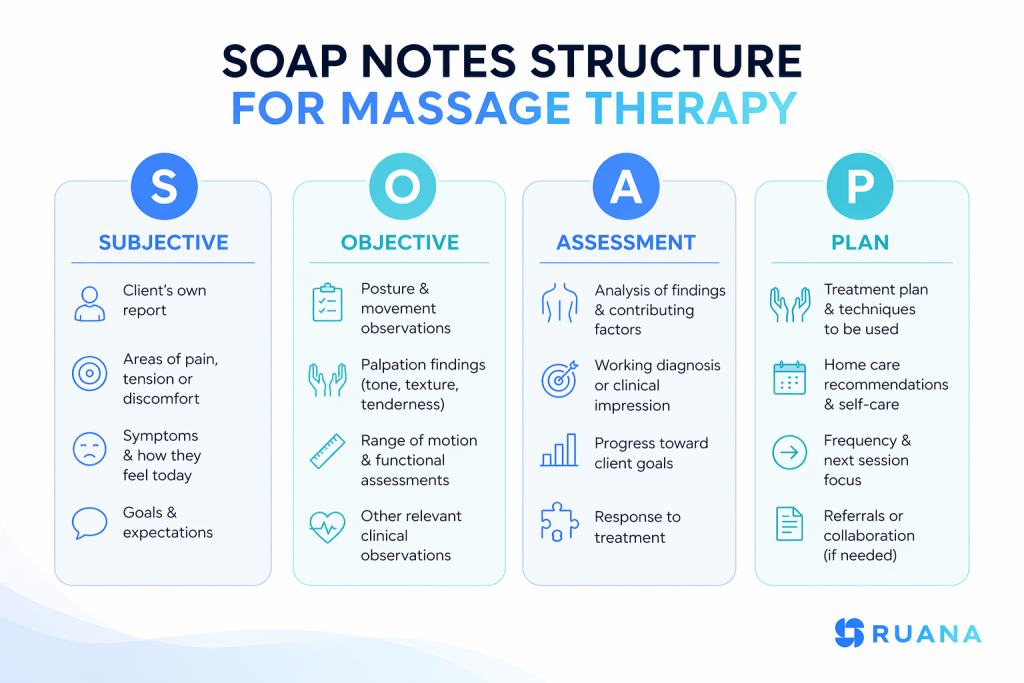
In simple terms, SOAP notes are the standard format massage therapists use to document a session in a way that stays clear, useful, and easy to review later. Standing for Subjective, Objective, Assessment, and Plan, they can help you capture the details from a client’s complaints, your observations, findings, and next steps.
In practice, that matters because treatment details fade fast once the next client walks in. A good SOAP note gives you a reliable record you can come back to without trying to rebuild the session from memory.
SOAP notes for massage therapy are not there to make documentation look formal, but to keep treatment consistent from one visit to the next. They are a good proof of the logic behind your decisions and make progress tracking easier over time.
SOAP Format Explained
Subjective: What the client tells you
Objective: What you observe and measure
Assessment: Your professional analysis
Plan: Your treatment strategy moving forward
This systematic approach ensures you capture all relevant information about each session while maintaining professional standards that satisfy regulatory requirements and insurance providers.
Why SOAP Notes Matter for Massage Therapists
We all know that SOAP notes fill out a client’s file. Yet, apart from that, they also help you stay consistent, protect your practice, and make each session easier to build on.
Here are a couple more reasons why your workflow needs them.
Continuity Between Sessions
Massage therapy works best when every session is built on the previous one. Having well-structured notes means clearly remembering what the client reported, what you found, what techniques were used, and how the body responded.
Liability Protection
Detailed treatment records protect you in case of client disputes or liability claims. There may be cases when clients state that their pain got worse after the session, or that they weren’t informed about what to expect afterwards. Properly documented SOAP notes demonstrate your professional approach and decision-making process in such situations.
Insurance Reimbursement and Compliance
In some settings, SOAP notes are part of what supports reimbursement or professional documentation requirements. That is especially true when massage therapy is tied to a broader treatment plan or provided in a clinic that works with medically oriented records.
This is when broad statements are usually not enough. The documentation has to show what was treated, what was found, and why care continued.
Communication With Other Providers
Finally, there may be cases when the treatment requires other specialists to get involved. For instance, a chiropractor, a physical therapist, or another care provider can easily understand the patient’s condition through your structured massage SOAP notes.
They give other professionals a quick way to understand the client’s complaints, your findings, and the direction of care. That, in turn, keeps treatment more coordinated and reduces gaps between providers.
How to Write SOAP Notes for Massage Therapy
If you want your SOAP notes to work for you, ensure that each section does one clear job. Don’t try to write a long clinical report. Instead, focus on capturing the session in a way that is quick to review, easy to continue next time, and detailed enough to support your decisions.
The following structure helps with that.
Step 1: Subjective: What the Client Reports
Capture your client’s side of the session here. This includes:
What they are feeling
When it started
What has changed
What seems to make it better or worse
In massage therapy, this part often gives context for the rest of the note.
Useful details to include here are the pain level, the location of discomfort, how long it has been going on, and any lifestyle factors that may be contributing to it, such as work posture, stress, sleep, training, or repetitive movement.
💡Example Subjective Entry:
“Client reports 7/10 tension in upper trapezius and levator scapulae, worse in mornings after sleeping. States stress at work has increased over the past two weeks. Goals include reducing shoulder tension and improving sleep quality.”
Step 2: Objective: What You Observe
This is where you document the physical findings instead of the client’s description of them. Try to make this section as detailed as possible, including information such as:
Posture
Range of motion
Visible guarding
Muscle tension
Trigger points
Palpation findings, etc.
This part should stay concrete. Focus on what you observed and what you did. That makes the note more useful later, especially when you need to compare one session to the next.
💡Example Objective Entry:
“Visible elevation of right shoulder. Limited cervical rotation to right (35°). Palpable tension and trigger points in upper traps and SCM. Applied Swedish massage techniques to neck/shoulders x 45 minutes. Client tolerated treatment well with visible relaxation response.”
Step 3: Assessment: What It Means
Start connecting the dots here.
This is not a medical diagnosis, but the process of documenting your professional interpretation of the pattern in front of you. Include anything that shows how the client is progressing, whether the response to treatment was positive, or what seems to be driving the issue.
The assessment in SOAP notes for massage therapy should be short, but still show your clinical reasoning. A weak assessment will just repeat the objective findings.
💡Example Assessment Entry:
“Increased upper crossed syndrome is likely related to prolonged computer work and elevated stress. Client showing positive response to myofascial release techniques. Tension patterns consistent with previous sessions, but intensity decreased from 8/10 to 5/10 post-treatment.”
Step 4: Plan: What You’ll Do Next
The final section of your massage therapy SOAP notes is where you leave records about what comes after today’s session. Include anything highlighting:
The treatment approach going forward
The areas you want to focus on
How often the client should return
Any home care you want them to follow
This part matters because it turns the note from a record of what happened into a guide for what happens next.
💡Example Plan Entry:
“Continue weekly sessions x 4 weeks focusing on upper trapezius and cervical muscles. Client to perform daily neck stretches (handout provided). Recommend ergonomic assessment of workstation. Re-evaluate progress at session 4.”
5 Proven Ways to Write Faster Without Cutting Detail
Beyond the structure itself, speed comes from how you capture and process information during and after the session.
Use Repeatable Phrasing
Start each section the same way every time. This reduces decision-making and keeps your notes consistent. Over time, your massage therapy SOAP notes examples will become easier to scan and compare.
Build a Personal Shorthand System
Create abbreviations for:
Muscle groups
Common complaints
Techniques you use often
For example, many therapists build a shorthand system like UT for upper trapezius, Lev scap for levator scapulae, c/o for complaints of, and MFR or TPR for myofascial release and trigger point release.
A note such as “Client c/o neck tightness. ↑ tone UT and Lev scap. MFR + TPR applied” is much faster to write than starting from scratch each time, while still staying clear enough to review later.
Capture Voice, Then Structure It
Some therapists find it faster to record a quick voice note right after the session and convert it into structured SOAP notes. This works well when the session is fresh in your mind, and details are easier to recall.
Systems that turn spoken input into structured notes can reduce the time spent rewriting everything manually, especially in busy clinics.
Use Templates Per Condition
Templates remove repetition. Instead of building each note from scratch, you start from a structure that already fits the case. You adjust details, not the entire note.
This is where the difference between generic tools and purpose-built systems shows up. With the right setup, your same SOAP notes for massage therapy do not feel repetitive. They become consistent and easy to maintain.
Keep Everything in One Workflow
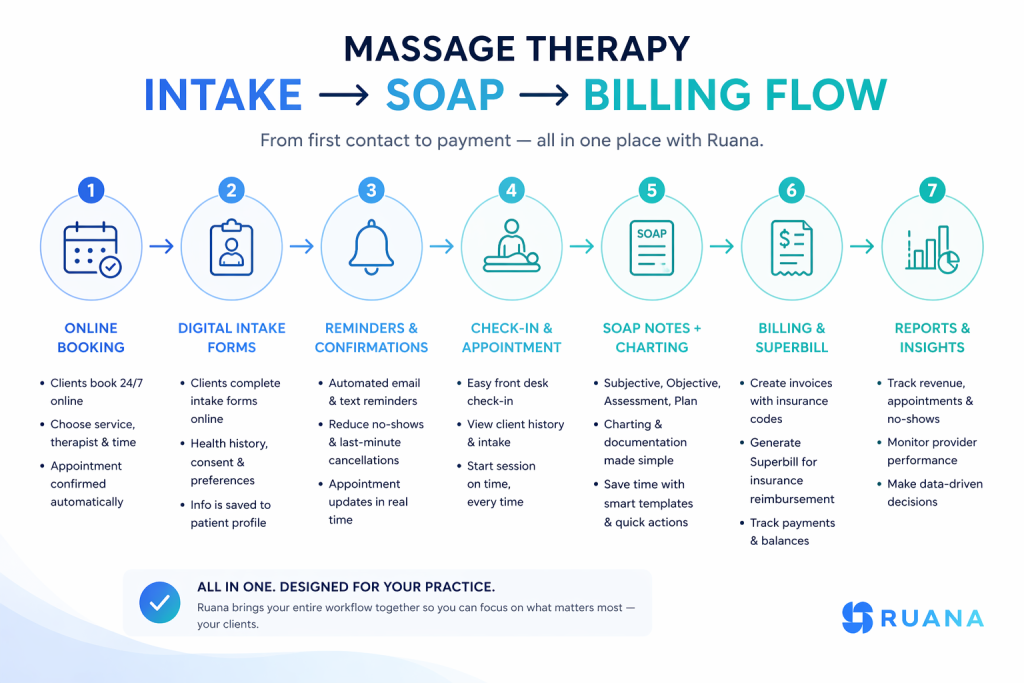
Switching between tools slows the process down. If intake forms live in one place, massage SOAP notes in another, and client history somewhere else, details get missed, and the session starts with extra catching up.
A smoother setup starts before the note itself. Digital intake forms can feed the client profile with health history, consent details, preferences, and current complaints. From there, your SOAP notes become part of the workflow instead of a separate task.
As shown above, billing and follow-up may come later, but the real gain starts when intake, documentation, and session flow are already connected.
Ready-to-Use SOAP Notes Templates for Massage Therapists
A good massage therapy SOAP notes template should make documentation faster without turning every session into the same note. The point of a template is not to remove judgment, but to give you a clean structure you can reuse, then adjust based on the client, the complaint, and the treatment goals.
That is what keeps soap notes for massage therapy consistent without making them feel robotic.
Simple Copy-Paste Template
Below is a basic massage therapy SOAP notes template you can copy, reuse, and adapt across different session types.
S: Subjective
Client reports:
Pain/tension level:
Location of discomfort:
When it started / changes since last session:
Aggravating or relieving factors:
Relevant stress, activity, sleep, or work factors:
O: Objective
Posture / visible findings:
ROM or movement findings:
Palpation findings:
Muscles or areas affected:
Techniques applied:
Client response during session:
A: Assessment
Main pattern or issue identified:
Change since previous session:
Response to treatment:
Working impression:
P: Plan
Areas to focus on next:
Recommended frequency:
Home care / stretches:
Follow-up or reassessment plan:
SOAP Notes Templates by Session Type
You can also build condition-specific massage SOAP notes so you are not writing the same structure from scratch every time.
Relaxation Massage SOAP Notes Template
Use this when the session is focused on stress relief, general tension, and relaxation rather than a specific pain complaint.
Subjective: stress levels, sleep quality, general areas of tension
Objective: overall muscle tension, relaxation response, and techniques used
Assessment: stress-related tension patterns, response to session
Plan: suggested session frequency, hydration, and home self-care recommendations
Therapeutic or Medical Massage SOAP Notes Template
Use this for pain-focused or function-focused sessions where the note needs more detail and clearer tracking over time.
Plan: training support, recovery recommendations, injury prevention focus
Digital vs Manual SOAP Notes
You can choose to manage either paper notes, which is honestly the messiest thing to do, or inside massage therapy software with SOAP notes. The second option allows therapists to reuse, search, and update information, especially when you are handling a high volume of sessions.
Integrated Workflows
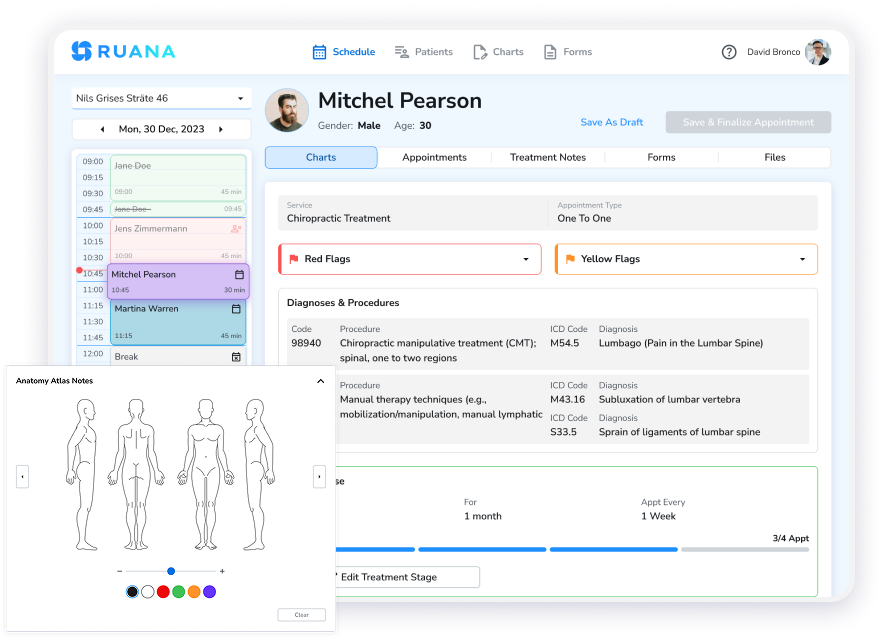
Choosing between manual or digital SOAP notes matters even more if your workflow overlaps with scheduling, massage therapy intake forms, or even chiropractic charting in a shared clinic setting. With a digitalized template, the workflow remains structured and consistent, without adding extra hassle to the day.
It also gives you a more practical starting point.
When digital intake forms already collect health history, consent details, and current complaints, part of the note is already taking shape before the session begins. That reduces repeated data entry and makes it easier to keep details accurate.
Speed Without Sacrificing Consistency
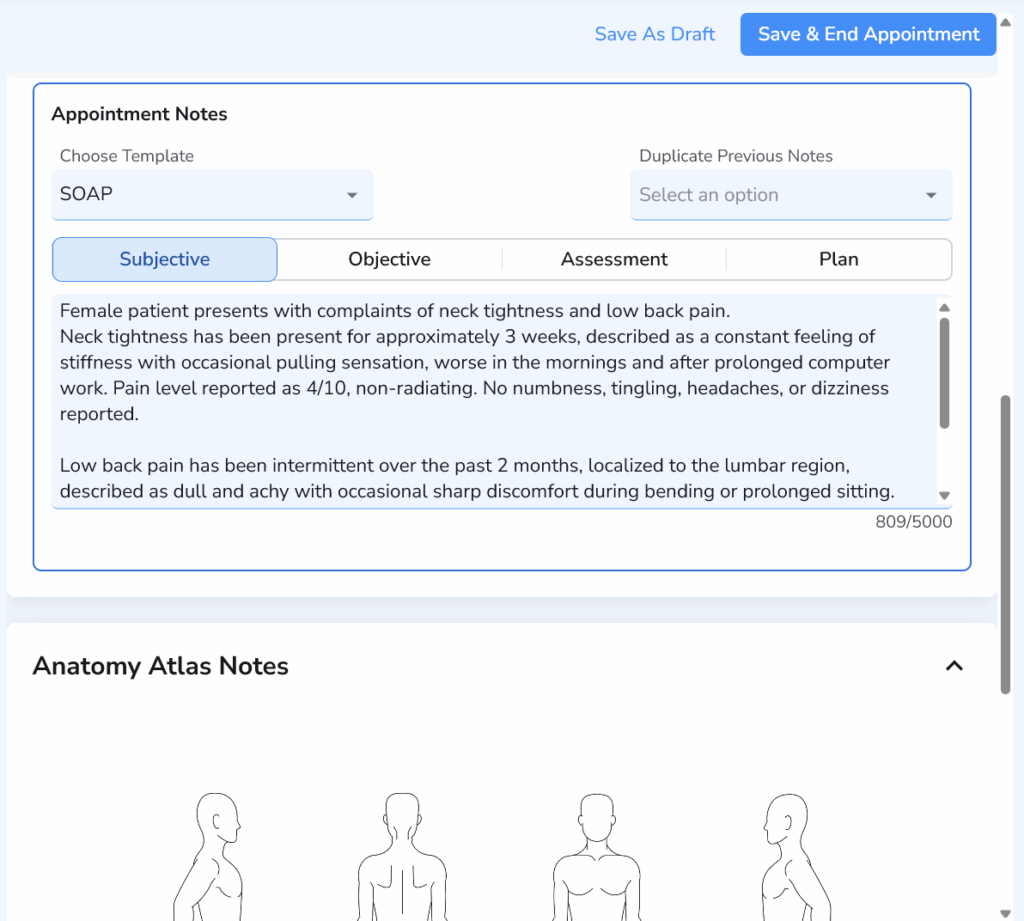
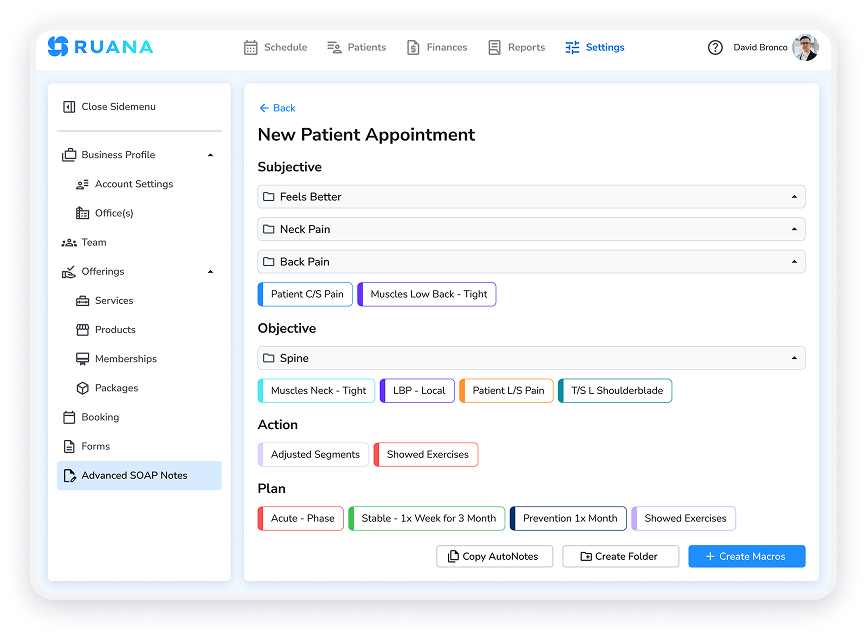
Instead of typing the same phrases over and over, therapists can rely on reusable note structures, quick actions, and condition-specific templates.
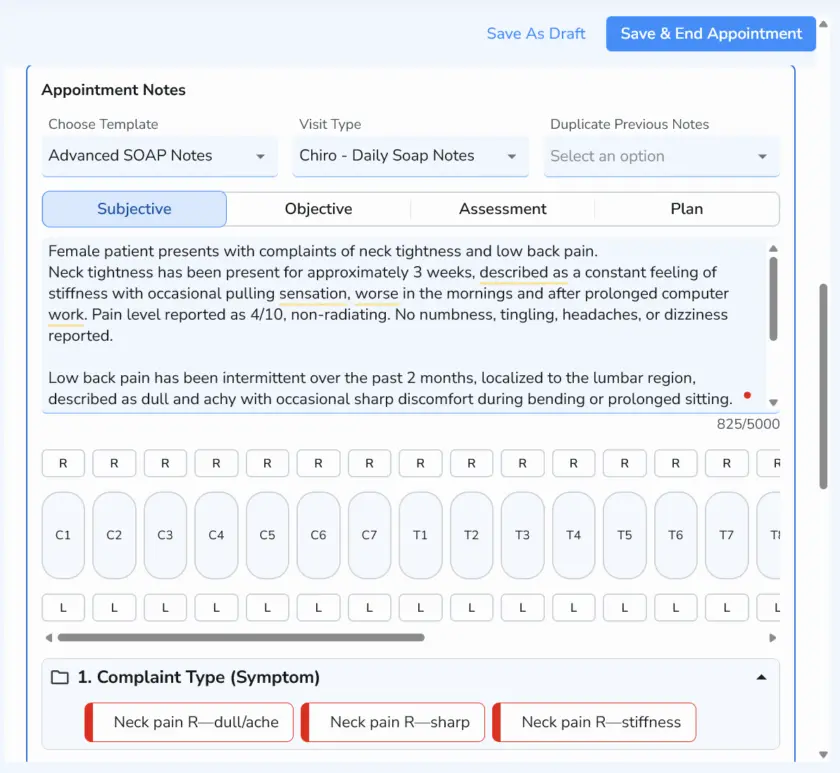
For instance, when using Advanced SOAP notes in Ruana practice management software, you can build and reuse a massage therapy SOAP notes template for common visits like relaxation massage, pain-focused sessions, or recovery work.
As a result, everything remains consistent even when the session details change. You save time on the repetitive parts, but still leave room to document what was specific about that visit.
Security and Compliance
Digital notes for massage therapists allow keeping client records in an encrypted environment and are compliant with standards like HIPAA in the US and GDPR in Europe.
You can document sessions, review history, and manage SOAP notes for massage therapy without worrying about data loss, unauthorized access, or scattered records across devices.
A More Practical Way to Manage SOAP Notes
SOAP notes are not just paperwork. They are the record that helps you remember what happened in the session, protects your practice when questions come up later, and tracks how the client is progressing over time.
That is also why the format matters less than the workflow behind it. When your notes are easy to complete, easy to review, and connected to the rest of the client record, they become far more useful from one session to the next.
Ready to see how Ruana can streamline your entire practice? Explore our massage therapy features and discover why hundreds of massage therapists are joining Ruana for a better way to manage their practice.
About the Authors
★★★★★4.9 · 329 Reviews
Rouzbeh NoroozyChiropractor & Co-Founder · Palmer West · UC Berkeley · 14 Years of ExperienceRouzbeh Noroozy is a chiropractor with 14 years of clinical experience and co-founder of Ruana practice management software. He completed his undergraduate studies at the University of California, Berkeley and graduated from the renowned Palmer College of Chiropractic West in California. As a practicing clinician and clinic owner, he understands firsthand the administrative challenges practices face — and which digital tools genuinely help streamline day-to-day operations.
Anastasiia NoroozyMedical Graduate & Co-Founder · 8 Years of ExperienceAnastasiia Noroozy is a medical graduate and co-founder of Ruana with 8 years of experience working directly with patients at the clinic in Cologne. She manages the day-to-day flow of the practice and knows every patient-facing process from the inside out — from intake and scheduling to follow-up care. Her hands-on clinical and operational experience directly shapes how Ruana is built to work in the real world.
Our team will review your inquiry and get back to you as soon as possible.
Privacy Settings
To provide the best experiences, we use technologies like cookies to store and/or access device information. Consenting to these technologies will allow us to process data such as browsing behavior or unique IDs on this site. Not consenting or withdrawing consent, may adversely affect certain features and functions.
Functional
Always active
The technical storage or access is strictly necessary for the legitimate purpose of enabling the use of a specific service explicitly requested by the subscriber or user, or for the sole purpose of carrying out the transmission of a communication over an electronic communications network.
Preferences
The technical storage or access is necessary for the legitimate purpose of storing preferences that are not requested by the subscriber or user.
Analytics
The technical storage or access that is used exclusively for statistical purposes.The technical storage or access that is used exclusively for anonymous statistical purposes. Without a subpoena, voluntary compliance on the part of your Internet Service Provider, or additional records from a third party, information stored or retrieved for this purpose alone cannot usually be used to identify you.
Marketing
The technical storage or access is required to create user profiles to send advertising, or to track the user on a website or across several websites for similar marketing purposes.
To provide the best experience for our practitioners, we use cookies to personalize content, analyze our traffic, and support our marketing efforts. By clicking 'Accept', you consent to our use of these technologies. You can manage your preferences at any time.
Functional
Always active
The technical storage or access is strictly necessary for the legitimate purpose of enabling the use of a specific service explicitly requested by the subscriber or user, or for the sole purpose of carrying out the transmission of a communication over an electronic communications network.
Preferences
The technical storage or access is necessary for the legitimate purpose of storing preferences that are not requested by the subscriber or user.
Analytics
The technical storage or access that is used exclusively for statistical purposes.The technical storage or access that is used exclusively for anonymous statistical purposes. Without a subpoena, voluntary compliance on the part of your Internet Service Provider, or additional records from a third party, information stored or retrieved for this purpose alone cannot usually be used to identify you.
Marketing
The technical storage or access is required to create user profiles to send advertising, or to track the user on a website or across several websites for similar marketing purposes.